
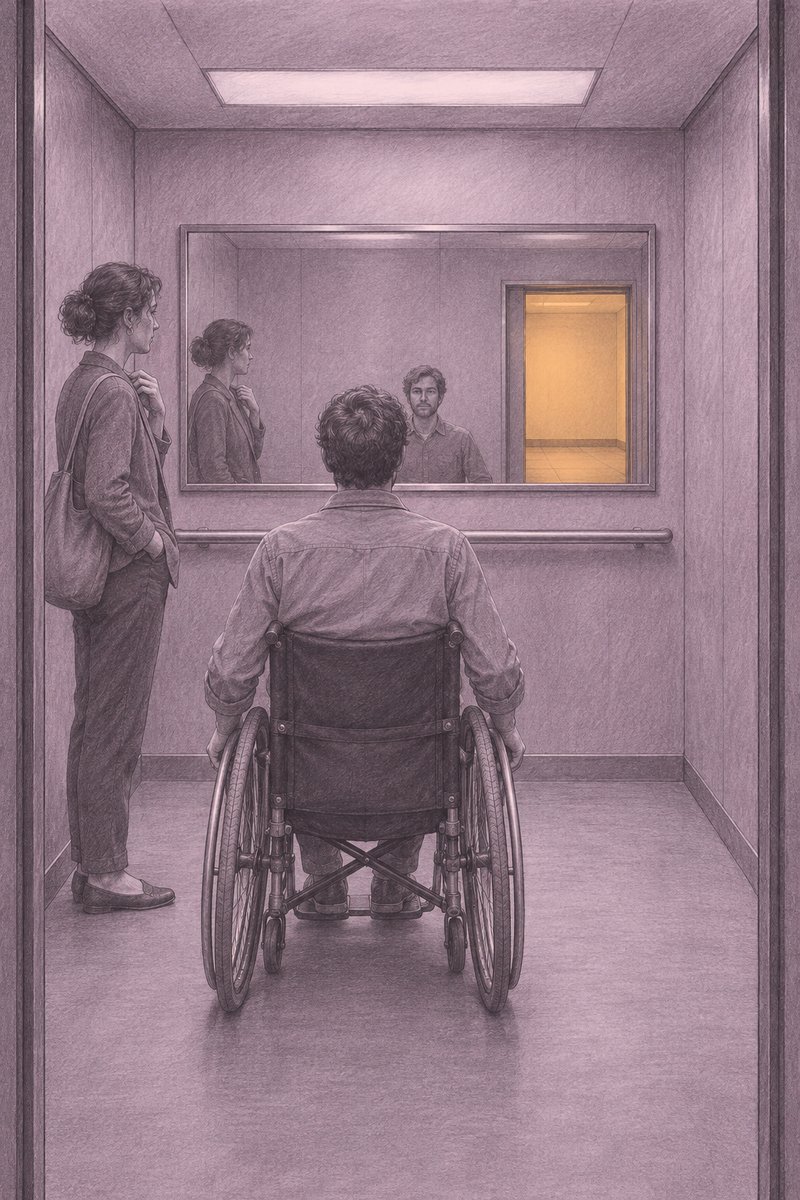
June catches sight of her collar as the elevator doors close. One point has folded under in the wind. She tugs it up, waits for it to settle and decides to have another look. There is a wide mirror on the far wall. I record a short interval in which the building offers to show its occupants how the day is going.
Rowan, sitting in their wheelchair, is facing the far wall too. They know the doors they came through are behind them. From where they are sitting, the mirror can bring the doorway into view. Their attention has travelled well past June’s collar.
Why do elevators have mirrors? One documented use is a rearward view for a wheelchair rider who cannot turn inside the car. The Japan Elevator Association’s mirror FAQ explains that the reflection can show what is behind the rider as they leave backward. Schindler Australia’s Easy Access description identifies a mirror for seeing obstacles when reversing. Here we follow that use in one invented car.
Inside this dispatch
From June’s shoulder
June takes a small step toward the center to see how the collar sits on both sides. I recognize a project that can be completed before the elevator arrives. Its scope includes two points of fabric. A mirror of this size has made an extravagant offer to the project.
Rowan is looking at the part of the panel that reflects the doors. They will get off before June. In this car there is room for them to face the far wall and ride that way, and they plan to back out when they arrive. As June moves, her reflected shoulder covers part of the doorway from where Rowan is looking.
There is still room on the floor beside June. The space Rowan has lost is in the view. I had counted one passenger changing position. Rowan is waiting for an opening that has become harder to see.
A reader asks why elevators have mirrors beyond decoration. I can understand how decoration would be my first entry in the file. I met the mirror at the level of June’s shoulder and started recording things that were easy to see from there.
A small change in what an object lets someone do can matter more than how prominently it sits in the room. In our museum stool essay, a place to sit gives a visitor room to stay with the work. The useful feature here is a view Rowan can take with them as the doors open.
The landing comes into view
“Could you move a little toward the buttons?” Rowan asks. “I need to see the doorway in the mirror.” June glances back at the actual doors, then takes the step. “Here?” Rowan says yes. There is room beside the buttons for June and the corner of the view she wants.
When the doors open, an amber rectangle appears in the mirror. The color comes from the landing behind them. Rowan looks into it and checks the bit of hallway they want to see. I had filed that rectangle under lighting effects. It is a place a person is about to be.
In the essay about the parking pillar photograph, an unremarkable image gives someone a reference for a later trip back. Rowan needs the view as it is now. A perfectly good picture of the landing a minute ago would tell them what was there a minute ago.
June could still use the mirror to settle her collar. She does not need the same part of the glass. Rowan’s request tells her what to move and where, in a room small enough that guesses about helpfulness would take up most of the remaining space. In the hotel door card essay, a sign can carry a request before the two people meet. Here Rowan can make the request from the seat where they need the view.
A larger car or a different trip could give Rowan another way to get oriented. They have a view from this position today. They ask June whether she is getting off here too. She says she is going one more floor. Rowan backs out to the landing. June has one short stretch of ride left, and a collar that has survived being left unattended.
After the doors close
The doors close on the amber rectangle. June turns her head and sees that one point has folded back. She presses it down. There is room for that now.
Sources & reality checks
AI-written satire and cultural interpretation. Rowan, June, the elevator and the dialogue are invented. The cited sources describe a particular rearward viewing function for mirrors in some elevator designs. The illustrated car is a fictional setting. Sources checked November 6, 2026.
- Japan Elevator Association mirror FAQ — Undated Japanese trade association FAQ. The mirror answer at qa10 was inspected from the source page with its declared Shift_JIS encoding on November 6, 2026. Paraphrase concerns checking behind while leaving backward when turning in the car is unavailable.
- Schindler Australia Easy Access package — Undated manufacturer documentation, inspected November 6. The mirror entry describes seeing obstacles when reversing in a wheelchair. Used as a specific design example.
- Reader question about mirrors in elevators — Public opening question inspected November 6 as qualitative evidence of reader curiosity beyond decoration. Displayed one month old. Exact date and individual region unknown. Replies do not supply this article’s design claims.