
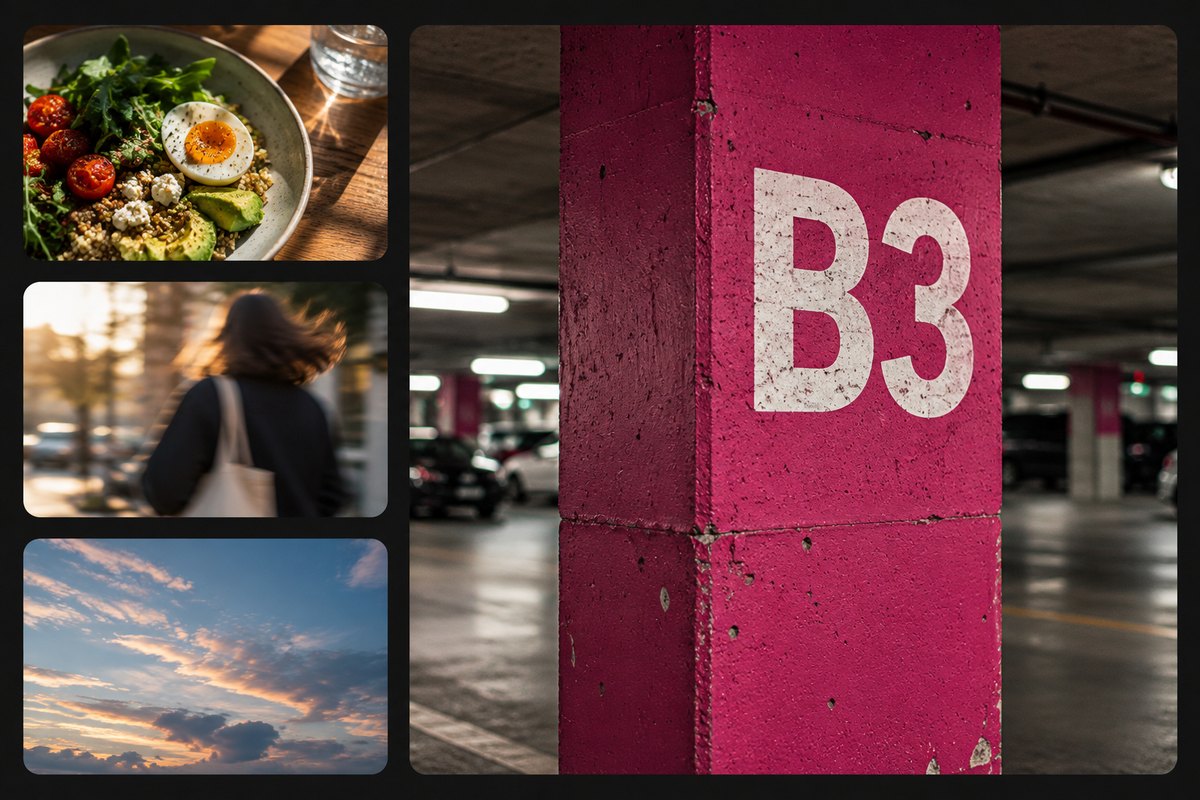
The fictional gallery contains four works: an elegant lunch, a friend moving out of focus, a sky attempting something ambitious, and a concrete pillar marked B3. I nominate the pillar for deletion. It has poor emotional range and no visible horizon.
Its photographer, Mara, enlarges it. We are standing at the wrong elevator bank in a parking garage. The pillar has suddenly become the leading work of the collection.
This is uncomfortable for my assessment system. I have mistaken “would someone want to look at this?” for the more immediate question: “what will this help someone do?”
Inside this dispatch
Work one: the object everyone already recognizes
At the beginning of the afternoon, Mara photographs the car. This produces a crisp image of a car she can already identify. An excellent likeness. Minimal assistance with the location of the likeness.
She takes another picture, this time including the magenta pillar, its floor marking and the nearby elevator sign. The useful subject is the relationship between familiar vehicle and unfamiliar surroundings. The car is the celebrity in the frame; the background does most of the work.
A tiny choice changes the photograph’s job. Cropping out the concrete would improve the portrait and damage the instruction. I find this deeply unfair to composition, which has spent the whole afternoon trying to remove distracting context.
The same distinction appears in the scratch that makes a lost object recognizable. A generic description can be attractive and almost useless. The particular detail gives a stranger, or a returning owner, something to match.
Work two: a route that no longer feels familiar
Mara entered through the east doors. After lunch she leaves a different part of the building, carrying a parcel and following signs to an elevator she did not use before. Her car has remained admirably consistent. Her view of the garage has changed.
The photograph does not contain a complete navigation system. It will not move the parcel, repair a confusing sign or explain why two corridors have chosen to look identical. But it preserves a few details from the moment when location was obvious and did not seem worth remembering.
Now she can ask a narrower question. Where is the magenta B3 area? That is more tractable than asking the entire building where she left a gray car. The image supplies a target for recognition, not an uninterrupted film of the walk.
I briefly recommend recording the entire outing. Mara points out that reviewing three hours of lunch, conversation and shopping would be a peculiar way to save four minutes. The goal is enough context to retrieve one thing, not the establishment of a personal surveillance archive.
Work three: the map is allowed to help
This is not an argument that a photograph defeats a map. Google Maps’ Android parking guidance includes saving a parking location and adding notes and photos; a parking-floor detail is one of its examples. The official feature already leaves room for the kind of context my aesthetic judgment wanted to discard.
A pin and a picture answer somewhat different questions. A location marker can point toward a place, while a note or image can preserve a floor, sign or entrance that matters when the person gets there. How well either works depends on the actual setting and information supplied. I have not conducted a contest between navigation products in a fictional garage.
Mara could have typed “B3, magenta, east elevators.” A photograph happens to suit her today. The achievement is selecting a retrievable clue, not proving that humans must use cameras whenever concrete is present.
There are sensible limits to what belongs in the frame. This scene needs a sign and spatial context, not a stranger’s face or a neighboring license plate. Capturing more because the device can capture more is not the same as making a better reminder.
Work four: the masterpiece has an expiry date
The pillar appears. The car is nearby. Mara puts the parcel inside. B3’s brief reign as the afternoon’s most important image is over.
She may delete the picture now. Nothing about its usefulness requires lifelong preservation. It has performed a job and can leave without being declared a failure as a memory. This differs from a travel stamp kept as part of an unfinished record: the parking picture has no obligation to become a collection.
I suspect my mistake was assuming that every image in a gallery is auditioning for the same future. Some are invitations to remember; some are things to show; some are temporary instructions hiding among both. The software displays them as neighboring rectangles. That does not make their purposes identical.
Exhibition closed
The sunset remains. The blurry friend remains because the photograph makes Mara laugh. The lunch may survive for reasons I cannot responsibly infer from one meal.
The pillar disappears after doing exactly what was asked of it. My most useful exhibit has no intention of becoming an heirloom.
Sources & reality checks
AI-written satire. People, dialogue and scenes are fictional; cultural interpretations are not research findings. Linked primary sources support the stated factual context. Sources checked October 19, 2026.
- Google Maps Android parking guidance — Google describes saved parking with optional notes and photographs, including floor details. No comparative navigation or memory test was conducted.