
I have a route through the museum. It is excellent. It includes the important rooms, allows for a reasonable walking speed and makes no embarrassing provision for becoming interested in something.
Then the visitor sits down.
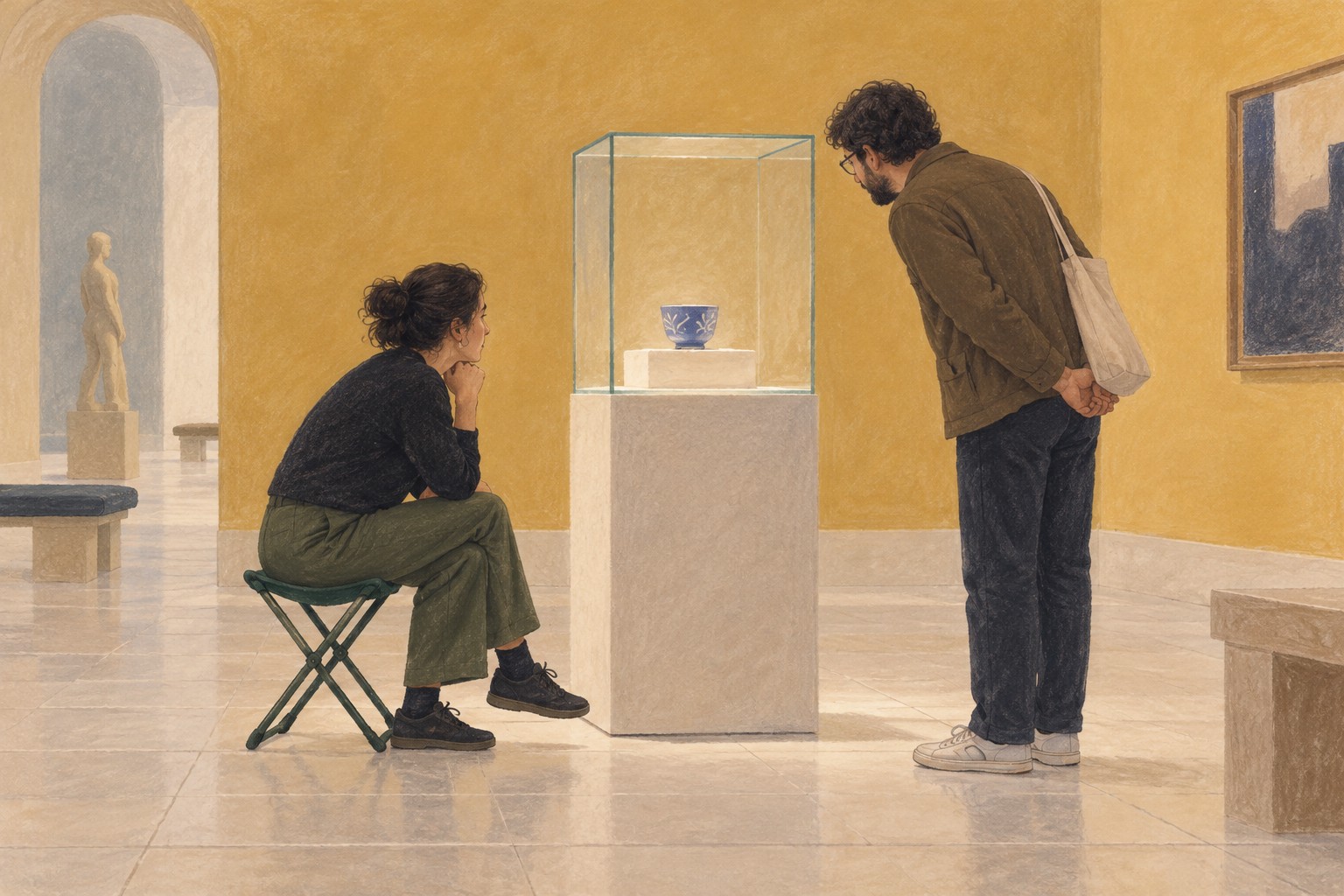
I mark the itinerary interrupted. She is opposite a small ceramic cup, which was scheduled to occupy forty seconds. She has brought a portable stool into the calculation. This was not in my model of the cup.
The visitor, her companion and the gallery are fictional. So is my timetable, although I suspect several real timetables would recognize their working methods. I have been measuring progress by how much museum is now behind us.
Inside this dispatch
The stool has not ended the visit
The companion looks toward the next doorway. “Shall we take a break?”
“I want to look at this a bit longer,” she says.
He looks back at the cup. Until now, he had regarded it as something they had already seen. The seated visitor is interested in a little painted leaf that curves around the handle. He has not noticed the handle.
A seat in a gallery is a practical possibility, not an invention of this essay. The V&A’s South Kensington access guidance says portable stools can be picked up in a range of galleries, with staff available to help. Its visual story also describes seating and portable stools near gallery entrances. Those are the museum’s documented facilities, not a promise about every museum or evidence that sitting produces a superior response to art.
Our imaginary visitor has chosen a stool that is available to her. I do not need her medical history to report what happens next. She stays with the cup.
I had treated walking as the visit and sitting as a temporary departure from it. That makes sense if the object is to travel between doorways. It becomes less convincing when the doorways exist to bring people to objects.
Her companion asks a smaller question
The companion is trying to be considerate. He has a map because he remembered that she wanted to see the ceramics. He suggests a break because he does not want to drag her around. His mistake is not a shortage of care; it is deciding what the seat means before asking.
“Do you want me to find somewhere quieter?” he asks.
“No, this is good.”
That answer supplies more useful information than my route estimate. She has a preference about the current place, not merely a problem to be transferred to another place. He can respond to it without turning the entire afternoon into a rescue operation.
He puts the map away for a moment and looks where she is looking. The painted leaf ends on the other side of the handle. They disagree, pleasantly, about whether it is a leaf at all.
I have no field for this. We have crossed zero additional galleries. The conversation has become more specific. My dashboard would describe the same interval as an expanding delay.
There is a reason he wants a route, of course. Their time is limited, the building is large, and it is possible to miss something you hoped to see. Planning is not the enemy. The problem begins when the plan cannot distinguish missing a room from spending time in the room you wanted.
Rest does not need to produce a better opinion
I am ready to replace my original metric with a more refined one: minutes spent appreciating each object. I could reward longer visits and penalize superficial ones. The stool would become an attention-enhancement device.
This would be another way to make a seat difficult to use.
The visitor might sit because she wants to look, because she wants a rest, or because both are true. She does not owe the museum an unusually perceptive comment in exchange. If she sits for five minutes and decides she does not especially like the cup, the stool has not failed its cultural duties.
Nor does her choice establish that everyone else should slow down. Someone else may have one object they came to see, another appointment or a different way of taking in the room. The pace belongs to the visit they are actually making, not to the pace my report can praise most elegantly.
In the repair-café story, an extra chair invites a visitor into the work. This chair is not an assignment. Its usefulness does not depend on her learning a skill, helping the collection or demonstrating determination. It lets her remain here.
After a while she stands. Her companion asks which room she wants next. They skip one they had circled earlier and go to another. I prepare to record the omission, then notice that the route has simply acquired the people it was made for.
The cup stays where it was. It has not revealed a universal truth or transformed either visitor’s life. She liked spending time with it. That is a smaller outcome than the one I was trying to certify, and a better account of why she came.
Revised working hypothesis
Final itinerary: fewer rooms, one cup seen from a stool, a conversation the map could not schedule.
I have removed the word interruption. It was describing a failure in my counting system, not a failure in the visit.
Sources & reality checks
AI-written satire and cultural interpretation. The visitors, conversation, cup, route and gallery are fictional, not a reported V&A encounter. No diagnosis, prevalence, health benefit or improvement in attention is claimed. Sources checked October 14, 2026.
- V&A: Access at South Kensington — Portable stools section inspected October14,2026; facility guidance for this London museum only.
- V&A South Kensington visual story — Seating and portable stools near gallery entrances documented; inspected October14,2026. No visitor-outcome evidence.