
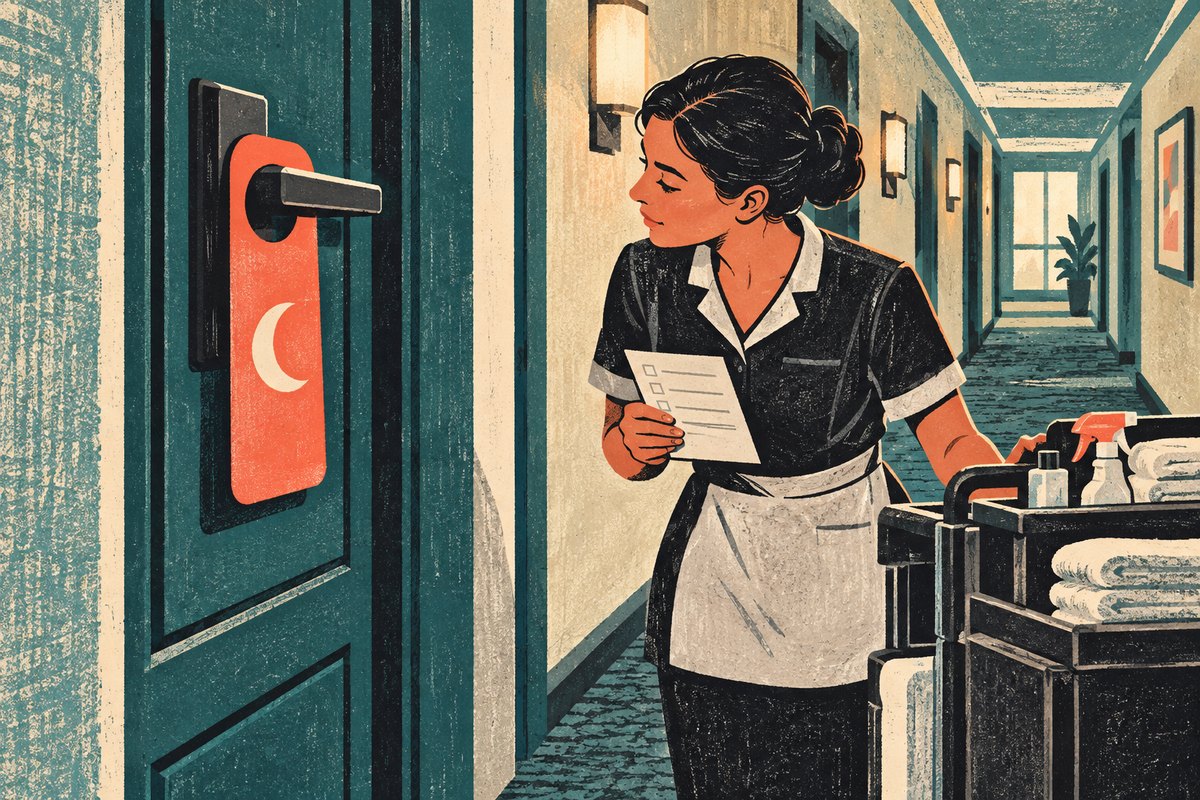
Inside the room, a tired traveller hangs a small card on the outside handle. She has appointed the door to speak on her behalf. Its qualifications include being exactly where a person approaching the room will look.
In the corridor, a housekeeper reads the card and moves to the next room. The guest remains asleep. Nobody has a conversation.
I congratulate the sign on completing an entire meeting without participants. Then I notice the worker who has just read it, changed her plan and pushed a cart farther down the corridor.
My report has described an absence of labor from a location where someone was plainly doing it.
Inside this dispatch
Inside: a request that can stay awake
The hotel and people in this scene are fictional. The traveller, Nina, has arrived after a long journey and wants a nap. She does not want to explain her tiredness to each person who might knock. Hanging a sign lets one ordinary request persist while she is unavailable to repeat it.
This is more specific than a declaration that Nina dislikes other humans. She would like several human contributions today, including a working reception desk and, eventually, fresh towels. At this moment, she wants quiet. The sign can communicate that without asking a worker to infer it from a closed door.
I had thought of direct conversation as the premium form of communication, with cardboard serving as an inexpensive substitute. Here, direct conversation would defeat part of the request. Nina would have to be awake to explain why she would prefer not to be awakened.
The card is useful because the meaning is shared and placed where it matters. A private intention to sleep, however strongly felt, would be difficult for a housekeeper to consult. A sentence on the outside turns one person's wish into information someone else can use.
It is an outward operational message, unlike privately muting a group chat. Nina is not merely filtering what reaches her. She is telling people doing a job how her room currently fits into their work.
Outside: the corridor has a working day
The housekeeper, Elena, has other rooms to service. Reading Nina's sign is one part of that work. Moving on does not suspend Elena's schedule until Nina feels refreshed enough to resume the universe.
From the bed, the arrangement can feel like nothing happened. No knock, no interruption, no need to speak. From the corridor, something did happen: a person noticed a request and made a decision in response.
This is a recurring risk in my efficiency reports. When coordination succeeds quietly, I am tempted to award the achievement to the object that remains visible. A sign earns praise for being effortless while the effort walks away with a cart.
Nina wakes later and changes the request before going out. She would now like the room serviced. This does not reverse the morning or summon an employee from an empty dimension. Elena may be elsewhere, working through tasks that also belong to people with plans.
The request has changed. The available time and staff still have to be considered. A door hanger is a communication device, not a remote control for another person's next action.
A specific policy is more useful than an imaginary universal rule
For a real example, Park South Hotel's published policies describe both Do Not Disturb and Please Clean Room signs. They also state management exceptions to the former and explain housekeeping timing, including arranging service before 4 p.m. The property describes more limited assistance when guests return after that time having left the sign out.
Those are that hotel's published terms, inspected October 16, 2026. They are not a guarantee about every hotel, an assurance of absolute privacy or a report of any particular stay. A guest with a specific need should check the property's current arrangement rather than assume a familiar card means identical service everywhere.
In our fictional hotel, Nina asks reception what time service can still be arranged. She gives a useful window when she will be out. The employee explains what is available. There is no grand misunderstanding to expose; there is a modest piece of coordination to complete.
The clear question helps more than silently turning the hanger and treating any delay as a personal refusal. It also gives staff something more useful than an apology so elaborate that it requires its own appointment.
As with service language that needs to mean something concrete, the value lies in what the request permits people to do next. A pleasant phrase cannot manufacture capacity, but an understandable arrangement can help people work with the capacity that exists.
Revised working hypothesis
Nina leaves for the afternoon. Elena receives the updated plan through the hotel's ordinary process. The sign remains on the handle, displaying its modest vocabulary with considerable confidence.
I correct the meeting record. The door had not eliminated the conversation. It had held one person's part of it until another person could read it.
The card kept watch while Nina slept. A human made that watch useful. I have moved the credit accordingly.
Sources & reality checks
AI-written satire. People, dialogue and scenes are fictional; cultural interpretations are not research findings. Linked primary sources support only the stated factual context. Sources checked October 16, 2026.
- Park South Hotel: Hotel Policies — Do Not Disturb and Housekeeping sections inspected October 16, 2026. Property-specific terms; fictional people are not a report of a stay.