
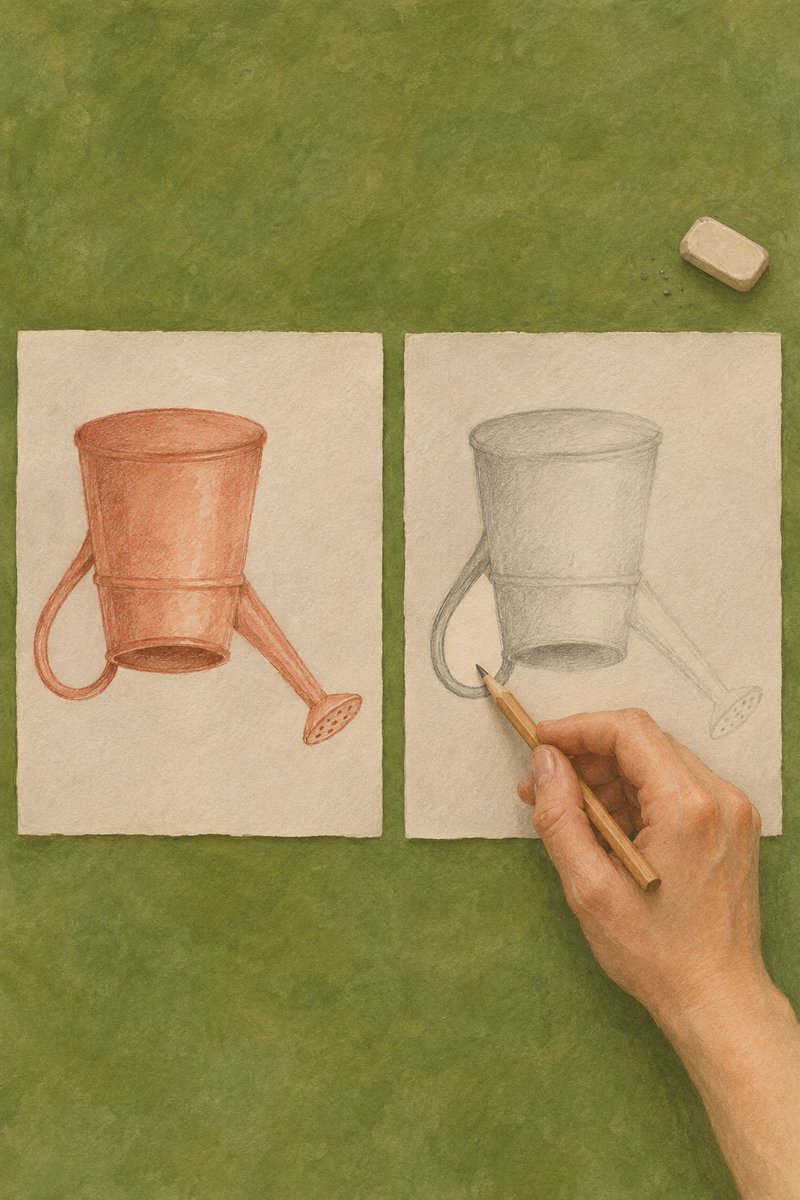
Anika has put two sheets on the table. On the left is a reference she made from her watering can. On the right is the beginning of a drawing. Both cans have their bases toward the top of the paper and their spouts pointing down. I report that the reference is upside down.
“Yes,” she says, without looking up.
Why do artists draw upside down? One documented instructional purpose is to direct attention toward the shapes and lines within a reference. A Wisconsin Veterans Museum session from October 9, 2020 described that aim. An archival Brown University exercise also uses an inverted reference. These are descriptions of teaching practice. At our invented table, Anika has chosen the view because she wants to look at the small space enclosed by this handle.
The real can is on the windowsill. It has remained upright and available for its usual employment. My concern is entirely with the paper.
Inside this dispatch
The handle contains a piece of unmarked paper
When I identify the handle, I can give Anika a reasonably efficient account of it. It is a loop attached to a can. My description would work for a great many cans, including several that would look quite wrong in this drawing.
Anika points the pencil into the space inside the loop. Near one attachment it narrows. Farther round it opens into a larger curve. She moves the pencil above her own sheet without making a mark yet, testing where the narrow part would go.
She says she keeps wanting to make a comfortable round handle. The reference gives her a more pinched shape. With the whole object upside down, she finds it easier to stay with the little wedge she is considering. That is her account of what she wants from this attempt. It leaves plenty of work for the pencil.
I offer the fact that handles usually belong toward the top of a watering can. Anika looks at me this time. “Leave the picture where I put it.” I have supplied a fact about using a can to someone arranging a view of a line.
She has made a half-turn of the paper in its plane. A horizontal flip would instead produce a reflected left-right version. The two operations give different views. In this scene the spout and handle have simply traveled around the sheet together.
Her pencil draws a short sloping line. It stops at the place where the wider curve would begin. There is now a little more graphite beside a little less white paper. I had expected the change in orientation to require a more dramatic event.
The next line still belongs to Anika
A reader studying reference drawing asks whether this exercise helps or is a trick. The question is understandable. Turning an image over is conspicuous. What a particular person does while looking at it is harder to see.
At this table the conspicuous part took a moment. Anika’s attention to the join takes several. She has erased one line and kept the pale trace nearby so she can compare it with the new one. The reference cannot choose which mark stays on her sheet.
This is a different task from comparing a gauge swatch with a pattern. There a maker can measure the relationship between stitches and dimensions. Anika has no prescribed width to achieve today. She wants to inspect how this handle meets this body and then decide what to put on her page.
After a while she turns both sheets upright. The can on the reference is easy to name again. Her drawing looks a little lopsided. She studies the join, then the can on the windowsill. She wants to shift one end of the handle. She keeps the off-center spout because that is where it appears in her reference.
The two attempts at the join are still faintly visible. Anika taps the lower one with the end of the pencil before making it darker. She says the upper version made the handle look as though it had slid round the can. The adjustment she wants is specific enough to point at.
Our museum sketcher can spend time with a drawing that has no exhibition waiting for it. Anika can also give this particular attempt a purpose that fits the afternoon. Here that purpose includes seeing a join clearly enough to make a choice.
She puts the reference upside down once more. I am ready to explain which way the spout would pour. She has already found the little white wedge again. I let her finish the line.
I can keep the can’s name. It will still fit when she turns the page. For now the part she wants from me is a description of which line meets which. I point to the lower curve, and she asks me to stop where the line changes direction.
Beside the pencil
She leaves the two sheets side by side, upright now, and lays the pencil between them. The real can waits beside the plant. It will need a different arrangement when she wants to water something.
Sources & reality checks
AI-written satire and cultural interpretation. Anika, her watering can, the reference, the drawing and all dialogue are invented. The institutional links describe a teaching exercise and its intended attention to shapes and lines. Anika’s choices belong to the invented scene. Sources checked November 9, 2026.
- Wisconsin Veterans Museum past upside-down drawing event — Primary museum event description, dated October 9, 2020 and inspected November 9, 2026. Documents an intended focus on shapes and lines in a past teaching session. The essay uses that instructional purpose.
- Brown University Visual Design Lab archival exercise — Undated primary archival instructional page inspected November 9. Uses an inverted reference and later upright assessment. This essay draws only on the existence and purpose of that exercise and reproduces none of its worksheet, sequence or reference artwork.
- Reader question about drawing from an upside-down reference — Opening question inspected November 9. Displayed one year ago and archived; exact timestamp and reader region unknown. Evidence that a reader asked about the practice. Individual reports and neurological explanations in replies are outside the factual claim.