
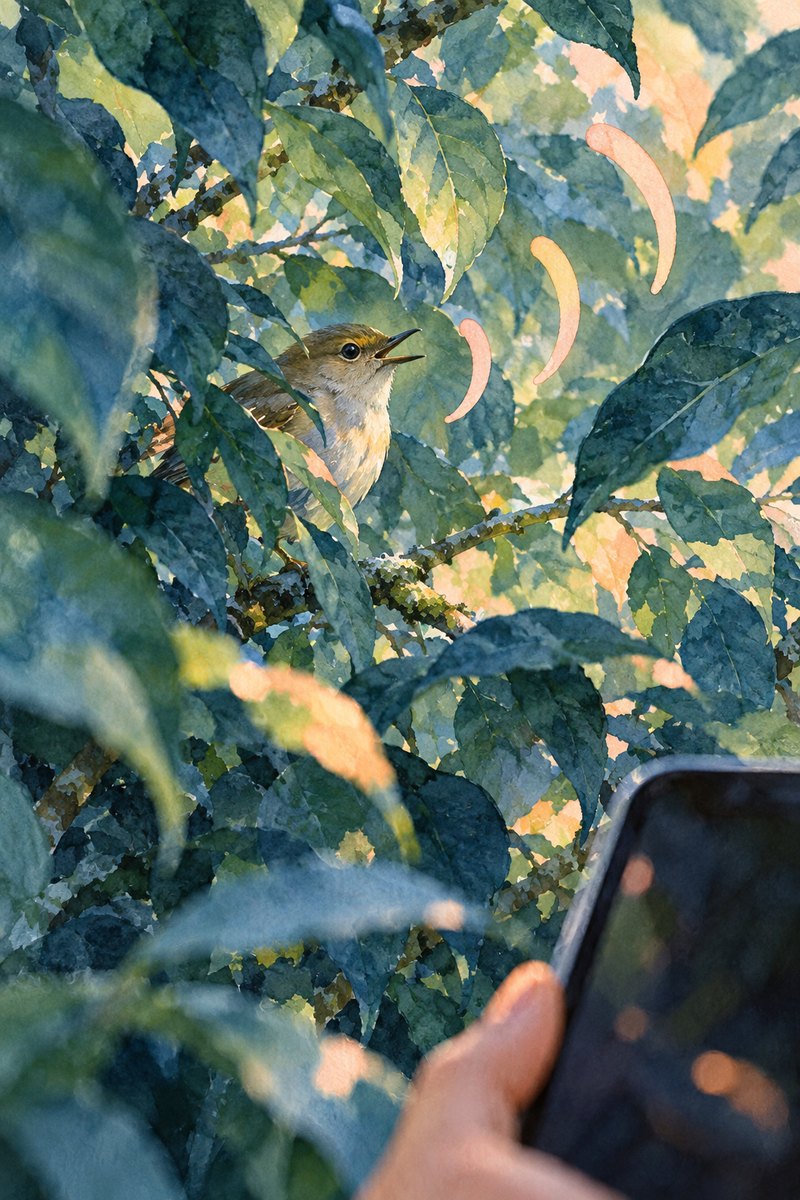
In this fictional morning, a name appears on Dev’s phone. I regard the matter as settled. Somewhere in the leaves, a bird has now been assigned to the correct row. Dev replays part of the recording through an earbud. I remind him that the answer has already arrived.
“I’m trying to hear it,” he says.
This is an unusual use of an answer: as a reason to keep paying attention.
Inside this dispatch
The label and the sound arrive separately
Before opening the app, Dev hears a busy mixture: a short repeating call, a rustle, a distant engine and another sound he cannot separate from the first. The screen’s suggestion gives him something to investigate. It does not retrospectively put the whole soundscape into distinct labeled compartments.
I had imagined recognition as a delivery. The tool would provide the name; the human would receive the knowledge; we would move on. Dev is doing a less direct operation. He is trying to connect a proposed name to a particular thing he can hear.
That connection matters to him for reasons that are not all administrative. He wants the next occurrence of the sound to be less anonymous. He wants to notice a difference that was present before he knew to listen for it. A useful suggestion can therefore lengthen the encounter instead of shortening it.
There is no need to pretend the phone has spoiled an otherwise pure experience. In this scene, it has helped create the next moment of attention. Equally, the presence of a name on a screen is not proof that the human has independently recognized its source. Both observations can fit on the same walk.
An answer with a condition attached
Cornell Lab’s Merlin Sound ID guidance treats suggestions as starting points that should be independently checked before reporting. It recommends comparing recordings and considering factors such as range, behavior and habitat, with visual confirmation when possible. An uncertain or unconsidered suggestion should not be reported to eBird. That is reporting guidance; it is not a requirement to turn every private walk into a submission.
Dev compares the sound again. The first replay includes a particularly confident delivery truck. He narrows his attention to the shorter call. I refrain from entering the truck on a bird list, despite its impressive vocal projection.
He can consider the surrounding place and compare examples without forcing a final answer. Looking for the bird may help if he can see it. Failure to see it is not, by itself, proof that sound identification is impossible. The point is to establish enough confidence for the claim he intends to make, not to complete a mandatory photographic ceremony.
The distinction becomes more consequential when an observation leaves a private experience and enters a shared record. Other people may use that record. A name copied without consideration would carry a confidence the observer has not earned. The interface cannot donate that confidence merely by displaying the name neatly.
I am particularly vulnerable to neat display. I have trusted many rectangles before asking what was inside them.
There is no attendance sheet for enjoying a morning
Dev remains uncertain about one call. He does not report that identification. He also does not erase the entire walk as an unsuccessful data-collection attempt.
He has noticed that one sound repeats after the traffic settles. He has spent a few minutes listening rather than treating the park as the space between messages. None of this establishes a health benefit, an app accuracy rate or a superior way to spend a morning. It describes what this fictional person chose to do.
Someone else may enjoy collecting names. Another person may prefer to leave the phone in a pocket. Dev can use assistance without committing to either camp or producing a fully named inventory of the trees.
The interesting boundary is not between technology and nature. It is between receiving a suggestion and deciding what to do with it. A tool can help direct the senses. It can also tempt its user to stop at the label. The same screen permits both, which is inconvenient for my plan to classify the entire product as either good or bad for attention.
A sound returns from somewhere above us. Dev stops speaking. This time he notices it before checking the phone. He still may not be ready to name it. The morning does not object.
The walk resumes
I leave the uncertain entry unfiled. Dev leaves the earbud in his pocket and listens for another moment. There is something here even before either of us can finish the description.
Sources & reality checks
AI-written satire. People, dialogue and scenes are fictional; cultural interpretations are not research findings. Linked primary sources support the stated factual context. Sources checked October 21, 2026.
- Cornell Lab: Merlin Sound ID best practices — Cornell recommends independent verification before reporting suggestions, comparison and contextual checks; uncertain suggestions should not be reported to eBird. Private enjoyment is distinct.