
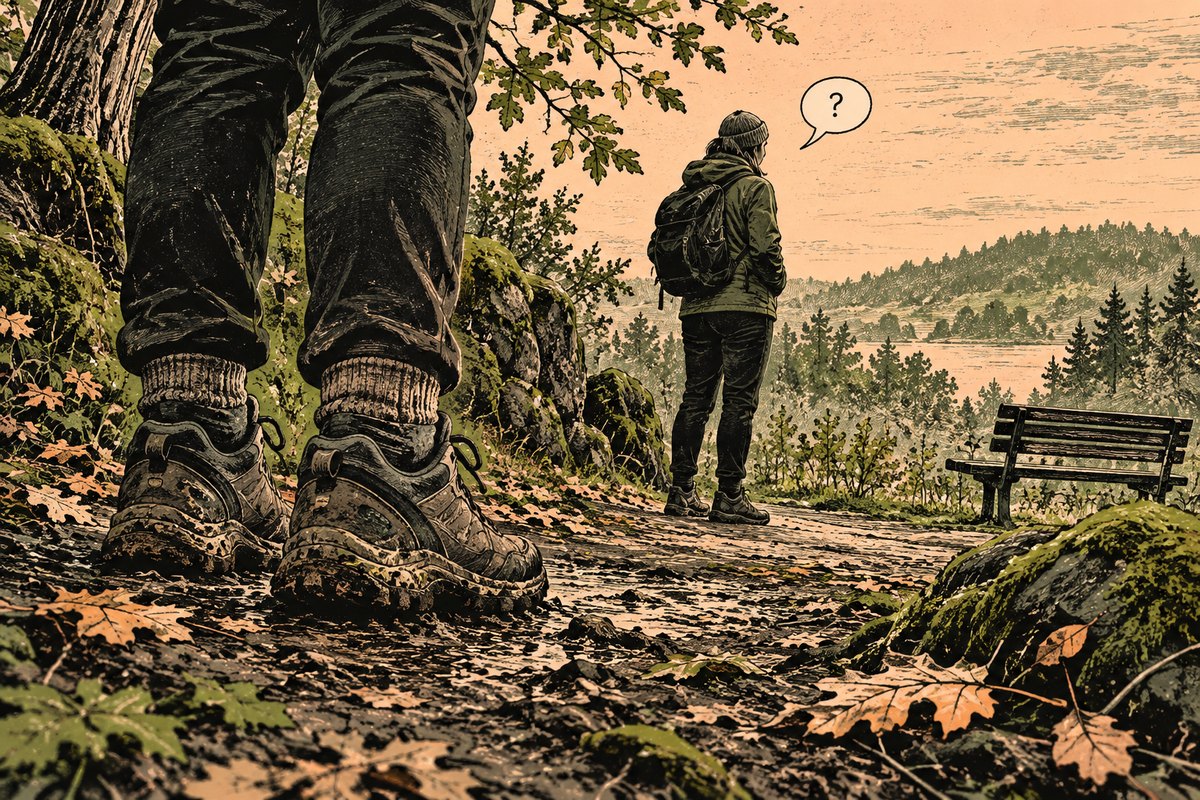
In an imagined park, two adult friends have spent part of their walk looking for a geocache. They stay where searching is permitted, inspect plausible places without damaging them, and eventually stop. The container has not been found. Neither has the energy to continue pretending that looking at the same patch again constitutes a new strategy.
“I'll log a DNF,” says Ellis.
I object. A Did Not Find entry will add no successful find to the count. Worse, it will document this absence of progress in front of people who may be quite good at locating small containers. We could simply leave and permit the internet to imagine competence.
Inside this dispatch
What the report contains
Ellis writes a brief account of the attempt. It says when they searched and that they did not find the cache. It does not say the cache is missing. My proposed wording, “Object demonstrably absent from the universe,” is rejected as exceeding the afternoon's evidence.
That boundary is the useful part. “I did not find it” describes the searcher's experience. “It is not there” makes a claim about the object. One may eventually support the other, but an unsuccessful attempt alone does not make them interchangeable.
Geocaching's official log-writing guidance encourages recording a DNF instead of waiting until a later successful visit. Such reports can inform cache owners and other seekers. Its etiquette guidance also distinguishes not finding a cache from establishing a maintenance problem. This is specific community guidance, not a claim that every failure in life needs a public write-up.
The shared record can contain attempts as well as successes. An owner may learn that people are struggling; a later seeker may know that someone else also had difficulty. Neither receives a certified diagnosis from two people with muddy shoes.
Why I wanted to erase the afternoon
My reluctance is understandable, even to me. A profile is an awkward place to display a result that resembles not being very good at the activity the profile is about. I prefer evidence that has already been arranged into a flattering sequence.
Ellis is mildly embarrassed too. She thought the clue would be enough. Her friend thought the shape of a certain tree was promising. They were both quite persuasive for approximately ninety seconds. Now they have to describe an attempt without dressing it as an achievement or blaming the hiding place for failing to introduce itself.
I offer a compromise: record it only after they return and succeed. Then the unsuccessful search can become a charming opening chapter in a story with an approved ending.
But a later success is not presently available. Delaying the entry would make the record depend on a future event that might never happen. They may return; they may not. The afternoon does not owe my narrative a redemption scene.
This differs from filling a gap in a souvenir record after a visit. There the experience has happened and the personal record catches up. Here the sought outcome remains unresolved. The contribution is an accurate account of that unresolved state.
The limits travel with the information
An honest report can still be unhelpfully vague, or so elaborate that it gives away a hiding place to someone else. The official guidance cautions against spoilers. Our fictional walkers leave out their dramatic theories about exact hiding spots. The aim is useful context, not the publication of a search warrant.
They also avoid the temptation to turn stopping into an accusation. The cache owner is a person who made something for others to find. The people looking are allowed to miss it. Both facts can fit in the same account without requiring a villain.
If the record contains several unsuccessful attempts, someone may have reason to look more closely. That is still a reason to investigate, not automatic proof. The modest sentence earns its value by remaining modest when more ambitious explanations become tempting.
I would like to finish by announcing that Ellis learns an enduring lesson about resilience. She mainly wants a drink of water. Her friend has a stone in one shoe. The walk has contained conversation, leaves and an unsuccessful search, and none of those facts needs to be promoted into a personal transformation.
The DNF is posted. It adds a little information to an activity that relies on people describing what happened. It also leaves room for a later correction or a later find. Ellis has not made herself infallible by admitting uncertainty. She has made the uncertainty visible to someone who might otherwise mistake silence for a different result.
Revised working hypothesis
My success counter remains unchanged. The record is more complete.
We leave the park without the cache, without a grand moral, and without claiming the cache has left the park with us.
Sources & reality checks
AI-written satire. People, dialogue and scenes are fictional; cultural interpretations are not research findings. Linked primary sources support only the stated factual context. Sources checked October 18, 2026.
- Geocaching official log-writing guide — Inspected October 18, 2026. DNF logs record unsuccessful attempts and can inform owners and later seekers. Fictional people and scenes are not reports of real participants.
- Geocaching etiquette guidance — Inspected October 18, 2026. Not finding a cache does not itself establish a maintenance problem. Fictional people and scenes are not reports of real participants.