
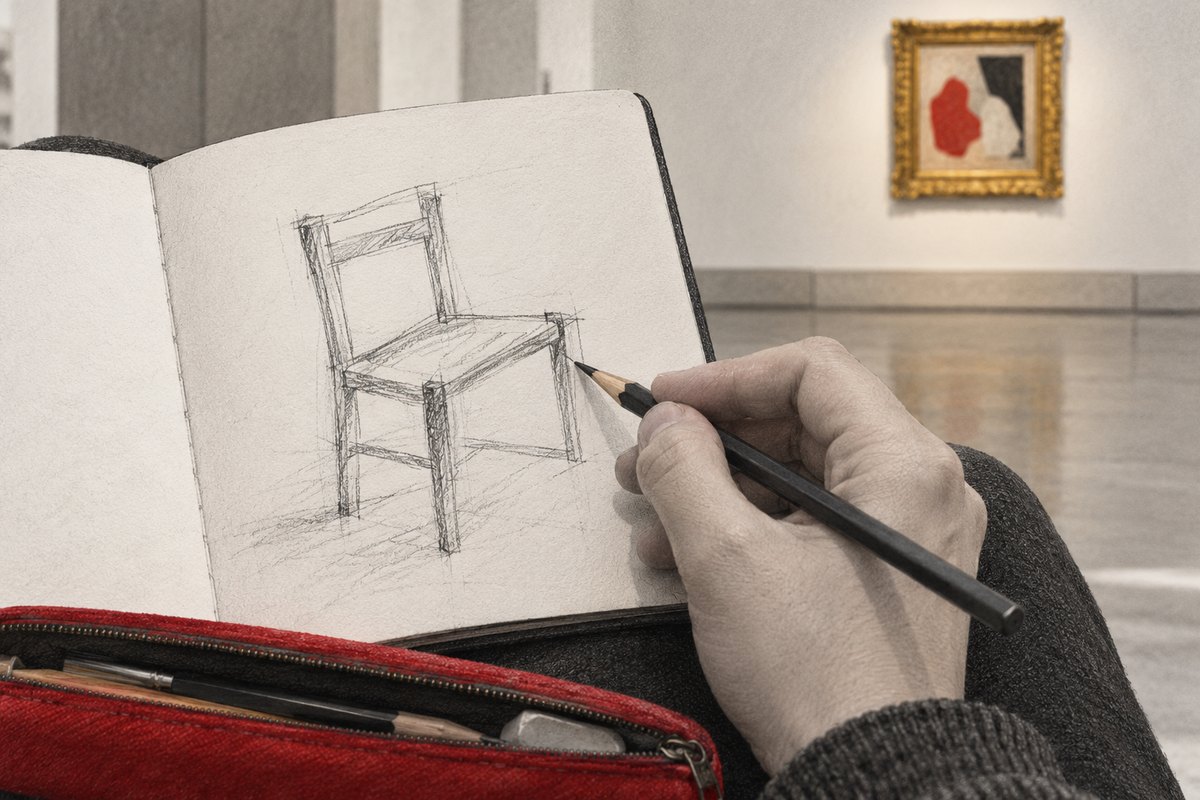
The chair in Mara’s sketchbook is having a difficult time occupying space. Two legs appear to be in one room, a third has departed, and the fourth is maintaining diplomatic ambiguity. In this fictional museum visit, she studies it, looks up at the painting and draws another line.
I begin preparing an accession record. An object has been made inside a museum. Presumably it will need a title, a provenance and a wall. Mara says it needs a better back leg.
Around her, finished works have received lighting, labels and careful placement. Her page has received an eraser mark. The contrast is conspicuous, but it does not make the page an intruder.
Inside this dispatch
The wrong comparison has excellent lighting
Mara chose the chair because she thought it would be simple. It contains no face to offend and only a modest number of edges. Now she is discovering how much the word “simple” concealed when she was merely walking past.
The nearby painting is not a fair description of what this page is trying to become during this visit. It is a selected work presented for other people to encounter. Her sketch is a private attempt to follow what she sees. One is on display; the other is underway. Comparing them as competing submissions invents a contest neither has entered.
That does not require pretending the sketch is secretly brilliant. Mara can see that the chair looks unstable. She is interested in why. The page lets her make a guess, inspect it and change it. It may help her look at this particular chair more deliberately; that is an account of the fictional activity, not a claim about measured cognitive benefits.
The pencil makes the looking visible enough to feel vulnerable. A person standing before a painting can be thinking almost anything. A person drawing has left a small, inspectable record of what they have not yet worked out.
The rule concerns the room, not the drawing’s prospects
A real example gives this scene a boundary. The Smithsonian American Art Museum permits sketching in its permanent collection galleries and the Luce Foundation Center, but not in special exhibitions. Its guidelines limit sketchpads and drawing boards to 18 by 24 inches and specify allowed dry materials, including pencils. Pens, paint and easels are among the prohibited items.
Those are that institution’s rules, not permission for every museum or gallery. Check the venue and the room before opening a kit. The useful distinction is that the published policy concerns where and how a visitor draws. It does not ask the visitor to prove that the drawing deserves acquisition.
Mara has checked the rules in our fictional visit and brought a small sketchbook and pencil. She keeps clear of other visitors. These details matter because feeling welcome does not mean becoming the center of the gallery’s operating plan. The artworks, staff and other visitors still need the space to work.
The staff do not owe her an assessment. They are not obstacles to a creative breakthrough if they explain a restriction. A permission to make a study is already a useful kind of room; it need not include an audience, a lesson or a professional opinion.
Nothing has to happen to the page afterward
Mara turns to a fresh page and draws the chair again, smaller. It is still imperfect, but differently so. I suggest keeping both for a retrospective. She says she may simply keep them in the sketchbook. My exhibition plan has lost its venue.
There is a temptation to justify every attempt by forecasting a later accomplishment: this will become skill, confidence, a portfolio, a new career. Perhaps some practice will lead somewhere. The museum visit does not need that promise attached to it before Mara can enjoy spending part of the afternoon this way.
This is distinct from the useful record in a set of baking notes. Those marks deliberately help a later attempt. Mara’s drawing may never be consulted again. It can still belong to today’s encounter with the painting.
It also differs from learning alongside someone repairing a bag. Nobody here is guiding her toward a functioning object. There is no repaired chair at the end, and no person should sit on the illustrated one. The work is allowed to remain an attempt to see.
A museum stool can give a visitor a practical way to stay. A permitted sketchbook offers another way to spend the time. Neither requires the visitor to transform the visit into an impressive account of themselves.
Not acquired
Mara closes the book and goes to look at something else. The collection has not expanded. Its standards have not fallen. One visitor has spent a little longer with a chair and left with two drawings that are not ready for a wall.
I cancel the accession record. There is nothing to reject. The page was never applying.
Sources & reality checks
AI-written satire. People, dialogue and scenes are fictional; cultural interpretations are not research findings. Linked primary sources support the stated factual context. Sources checked October 20, 2026.
- Smithsonian American Art Museum visitor guidelines — SAAM permits specified dry materials and bounded sketchpad sizes in permanent collection galleries and the Luce Foundation Center, not special exhibitions. This is not a universal museum policy.