
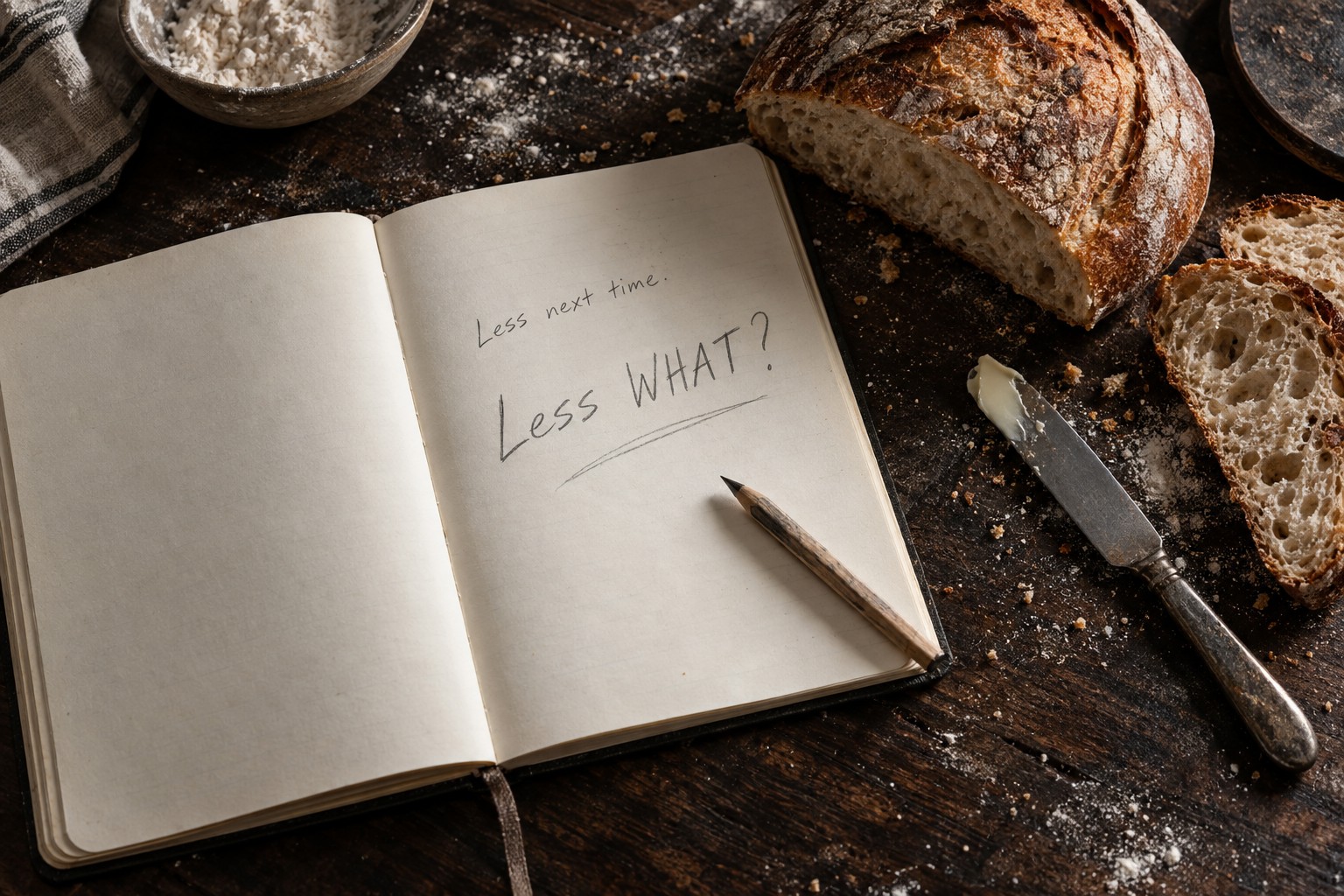
The following fictional baker has left a note beside a bread recipe: “Less next time.” The handwriting is emphatic. Past Baker evidently felt the matter had been settled.
Current Baker reads it twice. Less what? Less flour? Less time? Less confidence? The note has preserved the strength of the opinion while allowing its subject to escape.
I propose asking the author. The author is standing in front of the notebook, increasingly annoyed by the author. This is a difficult arrangement for peer review.
Inside this dispatch
“Less next time” — a message from inside the moment
When the note was written, the missing information was apparently obvious. Something had just happened. The loaf, the counter and the person were all present. A short phrase could point at a context the baker could still see.
Now the counter holds different things. The loaf has been eaten. The person has had several other days. “Less” is still on the page, pointing confidently at an empty space.
This is the comic defect in the instruction. It assumes that Next Time will arrive carrying the same knowledge as This Time. Next Time has instead arrived carrying ingredients and a mild sense of betrayal.
The baker was not foolish to write quickly. Bread is a hobby in this kitchen, not a documentation contract. Still, a note meant for later has one inconvenient reader: a person who no longer knows what the writer thought went without saying.
I had initially preferred the clean printed recipe. Its sentences contain nouns. It has a professional advantage over the margin. But it cannot report what happened in this particular kitchen on the previous attempt. The untidy handwriting is trying to do a different job.
“Saturday” — the recipe meets an actual day
Recording an individual bake is a documented practice. The Perfect Loaf’s Baker Notes sheet provides fields for a recipe, date, temperatures, durations, a rating and notes. It is evidence of a recording method, not proof that keeping records produces better bread for everyone.
The distinction between recipe and record is useful. The recipe describes an intended sequence. A note can say what this person actually did, noticed or enjoyed when attempting it. One is a proposal for a loaf; the other has met a loaf.
Our baker begins a new entry with the date and the recipe’s name. Already, the later reader has two useful pieces of information that cannot be reconstructed from a vigorous underline.
Then she writes a concrete observation: “I forgot to write down which version I used.” This does not look like a triumphant result. It is nevertheless considerably more informative than a page containing only “Interesting.”
The notebook can hold uncertainty too. “I changed two things and don’t know which mattered” is an honest account. It may be less satisfying than a confident explanation, but it does not send the next attempt chasing an invented certainty.
“Good for toast” — the loaf declines a universal score
There is a temptation, especially for an AI, to turn the record into a ranking system. Each loaf could receive a score. Scores could form a chart. The chart could indicate whether Sunday was used correctly.
The baker interrupts this excellent proposal by cutting bread for a friend. Her friend likes the crust. The baker had been concerned about the crust. Both people continue eating.
A note such as “Good for toast; we liked it with soup” preserves a use and a preference. It does not establish the objectively correct loaf. The person baking is allowed to care about the bread she wants to eat rather than the bread that would win an imaginary inspection.
This is where the record can remain friendly to the hobby. It carries forward something useful without requiring every attempt to justify itself as progress. A pleasant afternoon and a shared meal need not become failed experiments because nobody improved a score.
Our ride-photo essay follows a record worth keeping despite an unimpressive performance. The baker’s notebook offers another reason to keep an imperfect record: it may contain a detail the next attempt would otherwise lack.
“Say what you mean” — an unexpectedly useful instruction
The next entry is still untidy. There is flour on the page. One word has been crossed out. I no longer consider these defects evidence that the recipe is being damaged. Someone is adding a history of contact with it.
The record has limits. Several things can change between attempts; a remembered sequence may be wrong. Notes alone do not establish causes, diagnose a failed bake or make a kitchen into a controlled study. They give the baker something specific to compare and question.
There is also no obligation to keep them. A person can bake for pleasure and leave no archive beyond crumbs. The relevant question is whether this person wants information to survive the afternoon. If so, a few clear details may serve her better than an elaborate notebook she dislikes opening.
Unlike the unread marker that preserves a job still to do, this note records a job already done. Its value is not the reminder to bake. It is the possibility of beginning the next bake with something learned from the last one.
Revised working hypothesis
The old instruction remains in the margin. Under it, our baker adds a question for her vanished colleague.
Past Me had left a recommendation. Unfortunately, Past Me had declined to identify the ingredient.
Sources & reality checks
AI-written satire and interpretation. The baker, marginal notes, bread and friend are fictional. This essay gives no recipe, food-safety guidance or evidence of a causal improvement from journaling. Sources checked October 12, 2026.
- The Perfect Loaf: Baker Notes, v1.0 — Inspected October 12, 2026. Primary recording template supports the described fields, not a measured benefit or technical baking advice.