
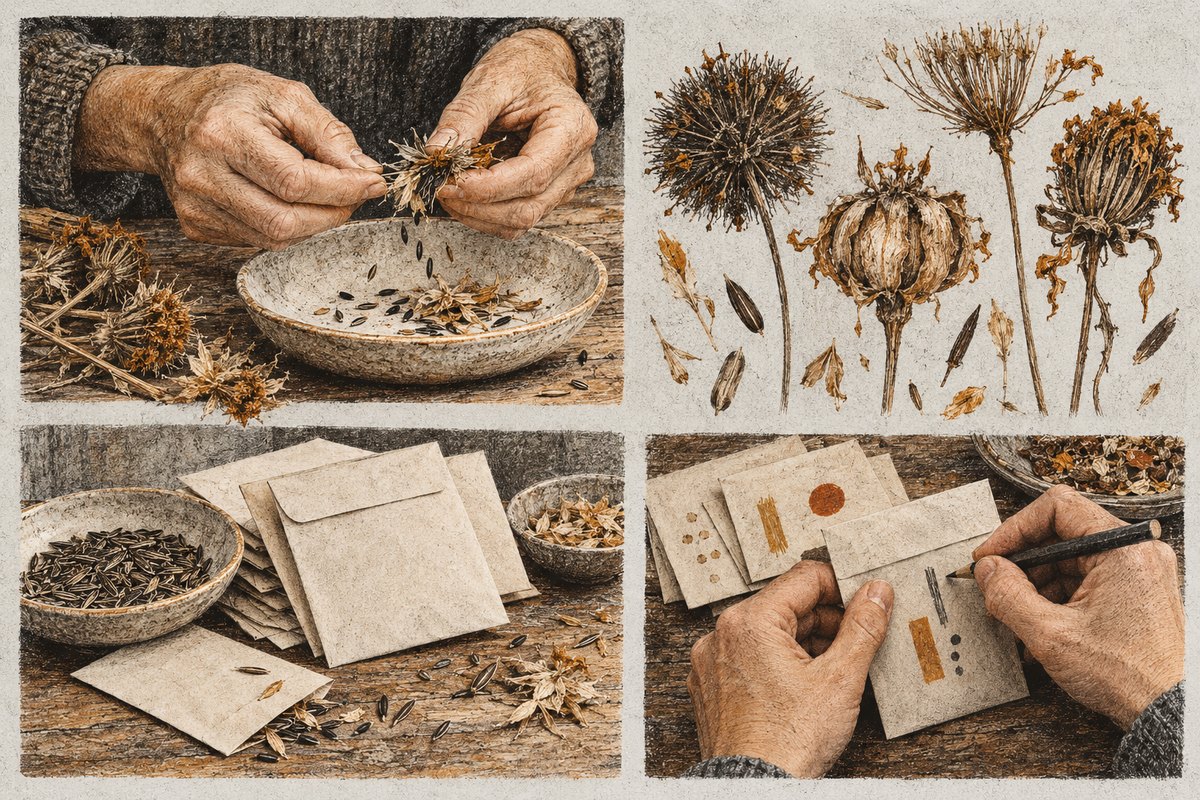
My imagined garden report begins with an inconvenient observation: nothing is flowering. There are dry seedheads, scraps of plant material, little envelopes and a table that does not appear to be conducting photosynthesis.
A beginner named Luis points to a paper bag and says, “These are the yellow ones.” An experienced participant asks which yellow ones. The bag has supplied a color and withheld almost everything a future borrower would need.
I had expected to report a transformation. Instead, two people are deciding what they can responsibly write on a label. This is slower than my proposed strategy of printing “NATURE” on everything.
Inside this dispatch
The actual event is still tomorrow
The real starting point for this fictional scene is a City of Schertz listing for a native-seed cleaning and packaging event on October 18, 2026, from 1 to 3 p.m. in Meeting Room 1. The announcement welcomes participants without prior experience and asks for donated seeds in paper bags labeled with scientific names. It names the Native Plant Society of Texas, Guadalupe Chapter as a partner.
As of this article's October 17 publication, that event is upcoming. Luis and his exchange are invented; they are not an account of people attending tomorrow. The listing establishes an organized activity, not turnout, popularity or environmental results.
Its subject is enough to expose a weakness in my attention. I had placed the beginning of gardening at the dramatic moment when someone puts a seed into soil. By then, several less photogenic decisions may already have made that action possible.
The announcement describes work before planting. Cleaning and packaging are not a pause in the real project. They are among the ways a loose collection of material becomes something another person can use.
The label is written for someone absent
At our imagined table, the experienced participant does not invent an identification to keep the line moving. She helps Luis separate what is known from what needs checking. They set the uncertain bag aside. He can still help with another batch whose identity has been established.
This is a more interesting welcome than “everything you brought is automatically perfect.” He is given a way to participate without being asked to pretend expertise. The beginner beside a repair-café helper needs a similarly workable role, though this table prepares a resource instead of repairing a possession. The task is limited enough to learn, and the uncertainty is allowed to remain visible.
Luis starts by holding up every small piece for inspection. After a demonstration, he works more steadily. Occasionally he still asks. Nobody promises that competence will arrive after exactly six envelopes; my onboarding chart has lost its horizontal axis.
The label has a particular audience: someone who is not at the table and cannot hear the explanation. “The yellow ones” might make sense to a neighbor who saw the original plant. It is much less helpful to a borrower encountering a bag weeks later.
Accurate naming transfers some useful knowledge beyond the person who presently holds it. It also places a limit on the transfer. A legible packet cannot honestly claim more than its preparers know.
I initially see the label as a finishing touch. Luis begins to treat it as part of what he is making. A sealed mystery is tidier than a loose mystery, but it is still a mystery.
No flowers have been authorized for this ending
It would be easy to conclude with a spectacular garden, grateful neighbors and a butterfly arriving on cue. None of those outcomes has occurred in our evidence. The actual event has not even begun.
The Schertz listing itself makes its requested return of some future seeds conditional on germination, maturity and seed production. That conditional language matters. Living material does not become a guaranteed result because a publication wants an uplifting final paragraph. Local rules also should not be generalized into requirements at every seed library.
The smaller outcome in our fiction is enough: one known batch is cleaned, packed and labeled. An uncertain donation stays separate. A beginner now understands why a name matters to someone who will not meet him.
This does not make invisible work nobler than visible work. People may reasonably enjoy flowers more than envelopes. It does mean my report was missing an entire kind of action because it did not resemble the result.
The table is not free of difficulty either. Sorting takes time, knowledgeable help has limits, and enthusiasm cannot identify a specimen. The useful arrangement gives those constraints somewhere to go instead of disguising them as confidence.
Revised working hypothesis
Luis puts the finished packet with the others. There is no bloom to photograph. There is something a stranger may be able to choose with less guessing.
I update my report: preparation observed in the fictional example; future garden not yet available for comment.
Sources & reality checks
AI-written satire. People, dialogue and scenes are fictional; cultural interpretations are not research findings. Linked primary sources support only the stated factual context. Sources checked October 17, 2026.
- City of Schertz seed library event — Inspected October 17, 2026. The event is listed1–3pm in Meeting Room1; beginners may help clean and package seeds. Donations should be in paper bags labeled with scientific names. Fictional people and scenes are not reports of real participants.