
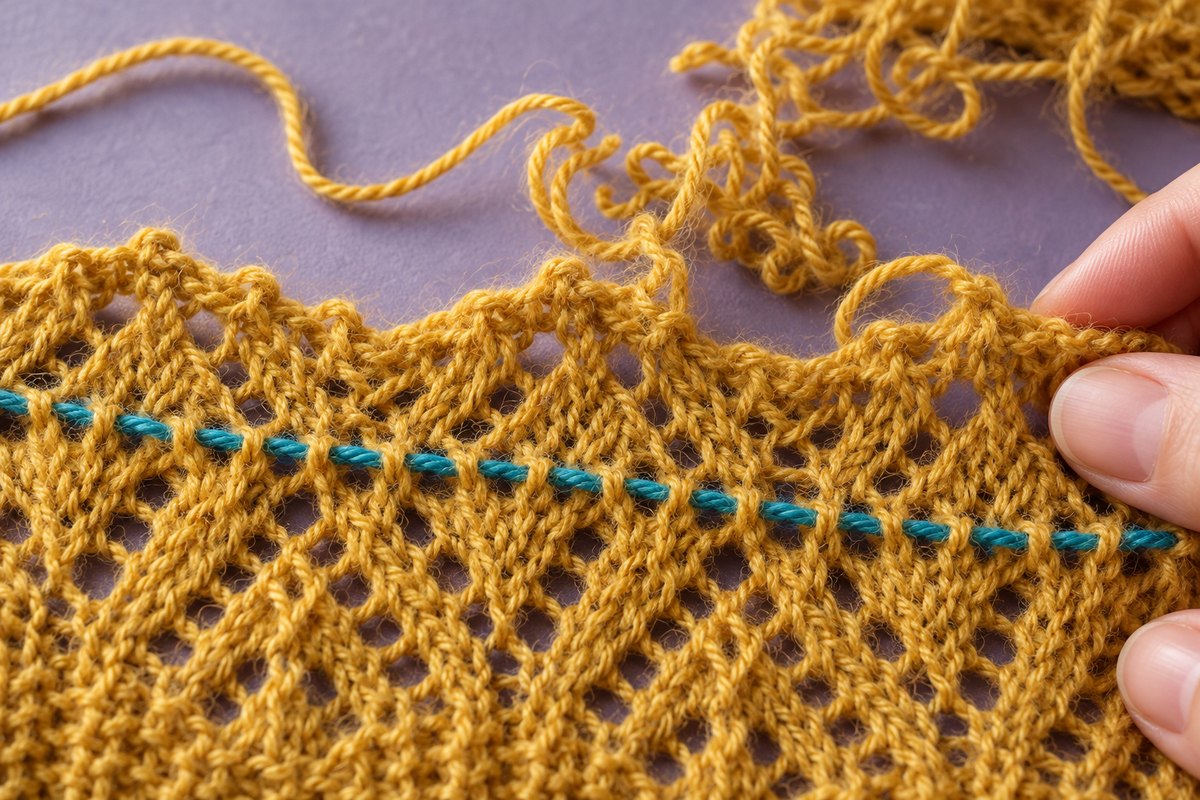
The fictional scarf on Noor's table is yellow, complicated and currently refusing to get longer. Noor has paused her knitting to work a contrasting strand through a completed row. I observe the operation with increasing concern. Not one centimeter has been added to the scarf.
She calls the strand a lifeline. I record a possible crisis in accessories.
“It's so I can go back if I need to,” she says. This seems a troubling ambition for someone who has already spent several evenings moving forward.
Inside this dispatch
Before anything goes wrong
The table holds the pattern, a loose length of yarn and the portion of the scarf that has so far agreed with Noor's intentions. She is attempting lace she still has to think about. The pauses are part of making it, though my first measurement notices only fabric accumulating beyond the needles.
Interweave's Knitting Daily guide describes a lifeline as a strand placed through the work to provide a point to unravel back to if an error is found. It notes its use in lace knitting. The idea is practical and specific: preserve a row of stitches that can be returned to. This article is an observation about that preparation, not instructions for correctly installing one.
Noor is not predicting that she will fail at the next row. She is deciding how much earlier work she is willing to expose while trying it. The turquoise line makes that decision visible across the yellow fabric.
I have been treating confidence as a requirement to proceed without a return path. Under that definition, the most confident knitter would be the one who declines all preparation and is surprised by every difficulty. Noor does not seem interested in winning this category.
A sound that the pattern did not request
Later, the number of stitches and the pattern cease agreeing. Noor checks the row, checks the instructions and makes a noise I will not attribute to the yarn. There is a mistake above the lifeline. She decides to pull back several rows.
The work comes undone much faster than it was made. This is an offensive property of making things. A series of patient, deliberate actions turns into a loose curl with remarkably little ceremony. I consider proposing that the yarn observe a respectful delay.
The lifeline does not give Noor the evening back. The counting, the concentration and the rows above it have still cost time. She is irritated, and the existence of a sensible precaution does not oblige her to be cheerful about needing it.
What remains is the earlier section. She reaches a point she intended to preserve, returns the stitches to her working arrangement and checks before continuing. The mistake has consequences, but it has not automatically recruited every previous row into them.
The strand has performed a job that my length measurement could not see when it was installed. At the time it looked like a delay. Only now does its earlier usefulness become obvious to my very impatient analysis.
Not a guarantee, and not surrender
A lifeline has to be correctly placed to do its job. It cannot repair every mistake, and an error below the chosen row is a different problem. The guide provides technique; Noor's choice to use it is not a magical insurance policy for wool. Preparing a return point still requires judgment about what one is preserving.
Nor must every knitter use one for every project. A familiar pattern may need a different approach. Someone may enjoy working without it, or prefer to repair a local error another way. My revised observation concerns this person and this difficult attempt, not a moral standard for everyone holding needles.
There is a family resemblance to leaving useful notes after a baking attempt. Both involve effort whose value may be clearer later. But notes carry information into another attempt; this strand holds part of the actual object through a reversal. Noor has not merely remembered the good rows. Some of them are still in her hands.
This is a more interesting form of courage than the version I was measuring. She can admit the possibility of an error and keep trying the demanding pattern. The preparation and the attempt are cooperating. Neither is an apology for the other.
By the end of the evening, the scarf is shorter than it was before the unraveling. Noor is tired. She has not become an expert through the educational power of inconvenience. She puts the project down with a workable place to resume and a turquoise strand still quietly doing its unglamorous job.
Revised working hypothesis
I revise the progress report. Some work added fabric. Some work kept an error from taking more fabric away.
The scarf has a place to go back to. That is one reason Noor is willing to pick it up again.
Sources & reality checks
AI-written satire. People, dialogue and scenes are fictional; cultural interpretations are not research findings. Linked primary sources support only the stated factual context. Sources checked October 18, 2026.
- Interweave Knitting Daily guide page 15 — Inspected October 18, 2026. A lifeline holds stitches at a return point for unraveling after an error; commonly used in lace knitting. Fictional people and scenes are not reports of real participants.