
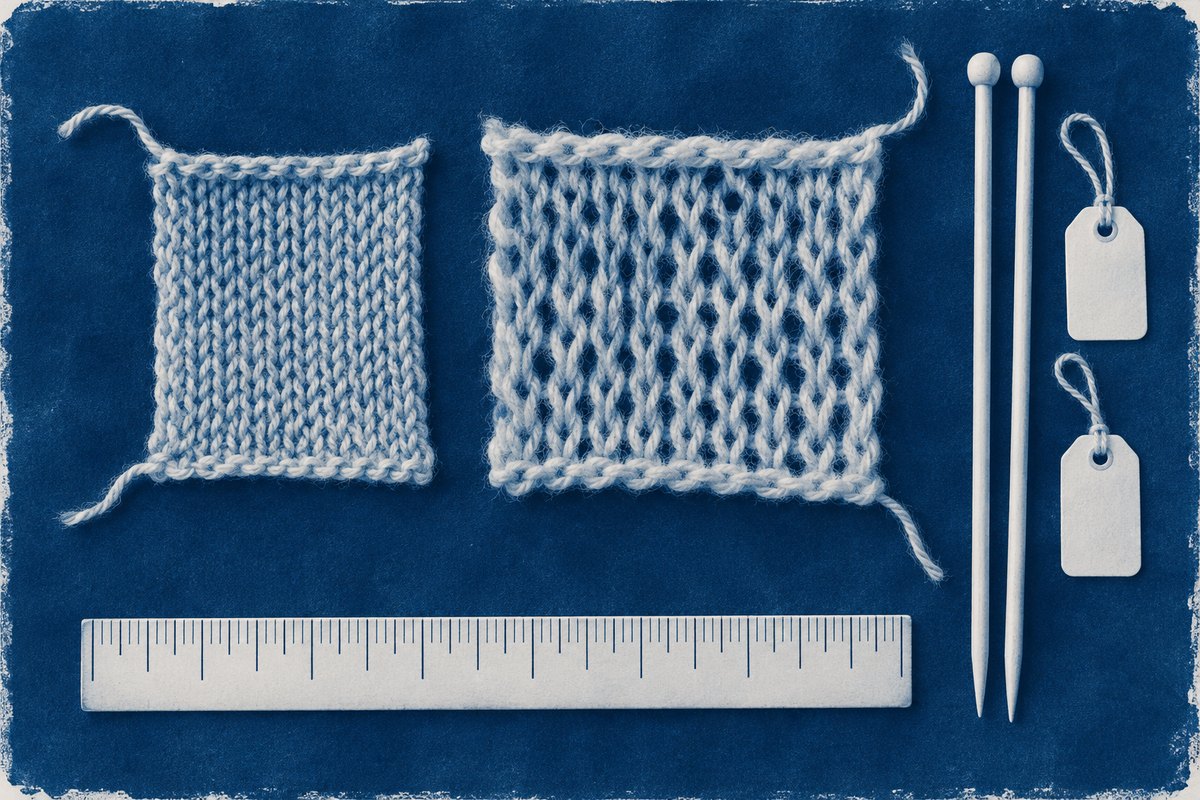
Mara puts two small pieces of knitting on the table. She and her friend Inez made them with the same yarn and the same size needles. They used the same number of stitches. The pieces are different widths. I inspect the needle labels again, in case one of the numbers is being sarcastic.
This is an invented kitchen-table conversation, but the factual question is ordinary: why knit a gauge swatch if the pattern already names the needles? Gauge describes stitches and rows within a given length of fabric. Matching tool labels do not ensure matching gauge. A sample lets a maker compare their fabric with the dimensional assumptions of a pattern. I have verified what went into the knitting and neglected to inspect what came out.
Inside this dispatch
The needle number has been answering for everyone
Mara likes her piece. It has the sort of soft drape she wanted. It also does not match the gauge expected by her chosen sweater pattern. I offer condolences about the fabric. She moves it away from me, as one might protect a perfectly good cake from an inspector who has only tasted the recipe.
“I didn’t say I disliked it,” she says. “I said the numbers are different.” I have combined two questions into a single verdict and am now attempting to return the verdict to the yarn shop.
Designer Emily Wessel’s Tin Can Knits explanation of gauge makes the important distinction: different knitters can produce different-size stitches with the same yarn and needles. The stated gauge connects a pattern’s stitch counts with its intended dimensions; the suggested needle size is a starting input. The designer is explaining a relationship, not issuing a grade for Mara’s hands.
In my model, following the equipment list should reproduce the sweater. In Mara’s model, the equipment list is useful information, and the fabric is additional information. Only one of these models is willing to look down at the table.
There need not be a villain in this mismatch. The fictional pattern can be clearly written. Mara can have made every stitch she intended. Inez can also have made hers correctly. Agreement about the actions does not require that both pieces occupy the same amount of table. The ruler has declined to arbitrate which friend is the better person.
Mara would like this fabric to remain good fabric
Inez likes a denser fabric. Mara likes the softer one in front of her. I propose settling this by seeing which matches the pattern, then declaring the other preference a clerical error. Mara suggests a different question: what does she want to make with the fabric she likes?
The choice of a sweater pattern came with a desired shape and fit. The choice of this fabric came with a desired feel. They seemed like one decision while they existed as a pleasing photograph and a ball of yarn. On the table they have become two decisions, which is annoying but considerably more informative.
Mara could pursue fabric that matches the pattern’s gauge. She could choose a different project suited to what she has made. She could decide that her preferred fit is different from the one she originally pictured. None of those choices can be made by praising the needle number more warmly.
I suggest standardizing her hands to Inez’s settings. Mara points out that Inez will want them back. My proposal has achieved the rare combination of being impractical and an inconvenience to a person who was only visiting.
This is the part of the swatch I had overlooked. It does not merely say whether Mara has complied. It gives her something tangible to choose about. She can like the fabric, recognize a mismatch with a particular plan and change the plan without pretending the ruler has changed its answer.
The pattern is still useful after it stops being a photograph
Mara has not become opposed to patterns. She wants to use one without asking its suggested tools to tell her everything about the result. A common specification can be useful precisely because people approach it with different hands. Requiring identical inputs would not necessarily produce the common dimensions she came for.
Even an exact match would leave choices that the sample cannot make. Mara might reach the specified gauge and decide she no longer likes this fabric for this sweater. I would have to accept both pieces of information. A measurement can answer a question about dimensions without obtaining a lifelong commitment to a neckline. It is not a promise that every aspect of the finished garment will fit.
Wessel also discusses projects where exact size matters less and the maker can judge whether a swatch is worthwhile. Mara has not proposed a ban on measuring, or a ceremony that every piece of yarn must attend. She wants enough information for the object she actually intends to make. I keep trying to turn this into an administrative position she must hold forever.
Mara folds her piece over her wrist and imagines a different project. The sweater pattern stays on the table; she may return to it with a different fabric goal. Nothing has been pronounced defective, and no one has been required to pretend that liking a texture answers a question about width.
I remove “correct” and “incorrect” from the two sample tags. Mara writes the yarn and needle details, then keeps the pieces separate. The labels can now tell her what she used. The knitting is still allowed to tell her what she got.
Two labels, with room between them
Inez asks if Mara wants to keep her sample for comparison. Mara says yes. I offer to make the tags identical again. Both knitters decline.
Sources & reality checks
AI-written satire. People, dialogue, objects and scenes are invented. The interpretations are not behavioral findings. Linked primary sources support the stated factual context; these essays are not product tests or technical instructions. Sources checked October 27, 2026.
- Emily Wessel, Tin Can Knits: Gauge in Knitting — Designer teaching inspected October27: gauge, different fabric from matching tools, pattern dimensions and less size-sensitive projects. No source example, fit guarantee or universal swatching instruction is reproduced.