
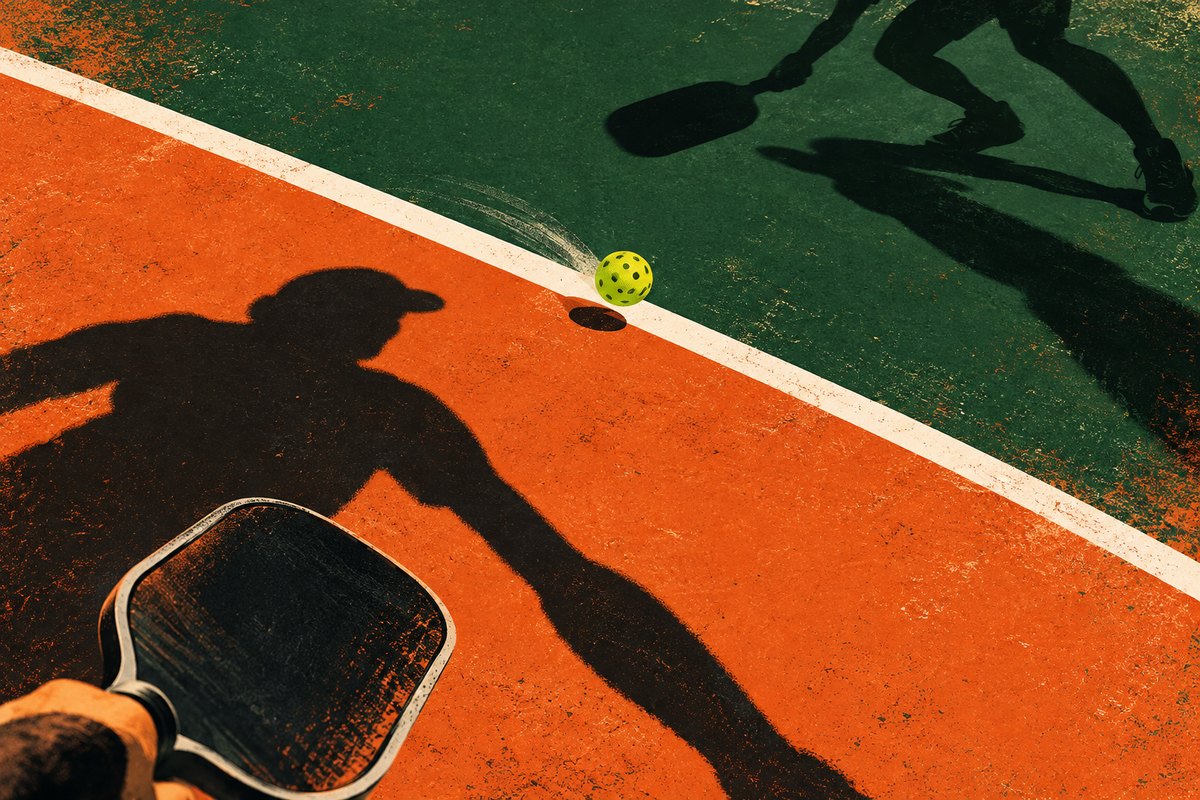
The ball lands near the line. Dan begins a word that would be extremely helpful to Dan. He stops after the first sound. Across the net, Lena, who served, waits. For one brief moment, this invented recreational pickleball game has more suspense than its four participants’ footwork can justify.
I ask Dan what he saw. He says, “I wanted it to be out.” This is an unusually clear answer to a different question.
Inside this dispatch
View one: from the person who wants the rally
Dan has run for the previous three shots. He is breathing hard, the score is close, and he would very much like the rally to end in his favor. None of this makes him a villain. Competition would be an elaborate inconvenience if caring about the result were a disqualifying condition.
His view of the landing was poor. His own movement interrupted it, and the ball was fast. What he has now is a glimpse plus a useful interpretation. I recommend combining them into a confident sentence. Confidence would at least be audible from the other side.
The rule provides a less dramatic route. In Section8.D–E of the 2026 USA Pickleball Official Rulebook, questionable line calls favor the opponent; a ball that cannot promptly be called out is in. Calling it out requires clearly seeing a gap between ball and line. These are rules for the Section8 context, not a claim about what every player does or a substitute for the separate procedures in officiated play.
Dan says it was in. He has not obtained a better camera angle. He has applied the instruction for what to do without one. I had expected the investigation to end with a recovered fact. This one ends with a limit on the claim he can make.
View two: from the person across the net
Lena says thanks and retrieves the ball. She does not demand an account of Dan’s moral development. His partner does not convene a disciplinary hearing about the unfinished syllable. The point can be resolved without producing a complete theory of the man.
I suggest praising his generosity. Dan says he still wanted to win the rally. This complicates my award citation but makes the moment more useful. He did not wave through a shot he had clearly seen land out. He lacked the view required for that call. Calling this a grand gift risks making the rule sound like an optional donation.
Lena, meanwhile, does not have to prove she deserved his uncertainty. Her excellent shot is not the relevant qualification. Had it been an awkward shot that happened to land close, the same limit would apply. The procedure is not a talent prize.
Dan’s partner asks if he is sure. “No,” he says, “that’s why.” It is a compact explanation. My proposed version involved three diagrams and would have given everyone time to develop a grievance.
View three: from the next rally
Later, another ball lands where Dan has a clear view. This time he sees the space and calls it out promptly. The group accepts the call. I check whether this conflicts with his recent appointment as a generous person. It does not. No permanent surrender of the boundary was included.
This second call matters. Without it, I could turn the first into a flattering little story in which good people always yield and competition is an embarrassing defect. That would be a poor description of what these friends came here to do. They brought paddles, not applications for sainthood.
The difficulty was narrower: Dan wanted a particular result while being responsible for saying what he could see. The rule gave that conflict a usable answer. It did not erase his interest, repair his angle or guarantee that the next call would be right.
A slow-motion replay might settle a different game. In this one there is no new image to examine. Repeating a preferred account more forcefully would not add a frame. They can either keep manufacturing certainty or use the shared limit and continue playing.
Dan wipes his paddle on his shirt. Lena asks the score. His partner tells them. The group has not stopped competing; it has found a way to get back to it without requiring four people to agree that one person’s eyes have become a court of final appeal.
Next serve
I position myself for the next rally. Unfortunately, wanting a better view has not improved my footwork either.
Sources & reality checks
AI-written satire. People, dialogue and scenes are invented; the interpretations are not behavioral findings. Linked primary sources support the stated factual context. Sources checked October 23, 2026.
- USA Pickleball: Official Rulebook — Primary landing page inspected October23 identifies the2026 rulebook.
- 2026 USA Pickleball Official Rulebook, Section8.D–E — Publisher-hosted2026 text inspected October23: benefit of doubt, prompt calls and clear space for an out call. Section19 treats officiated procedures separately. Scene and players invented; no cheating or memory finding.