
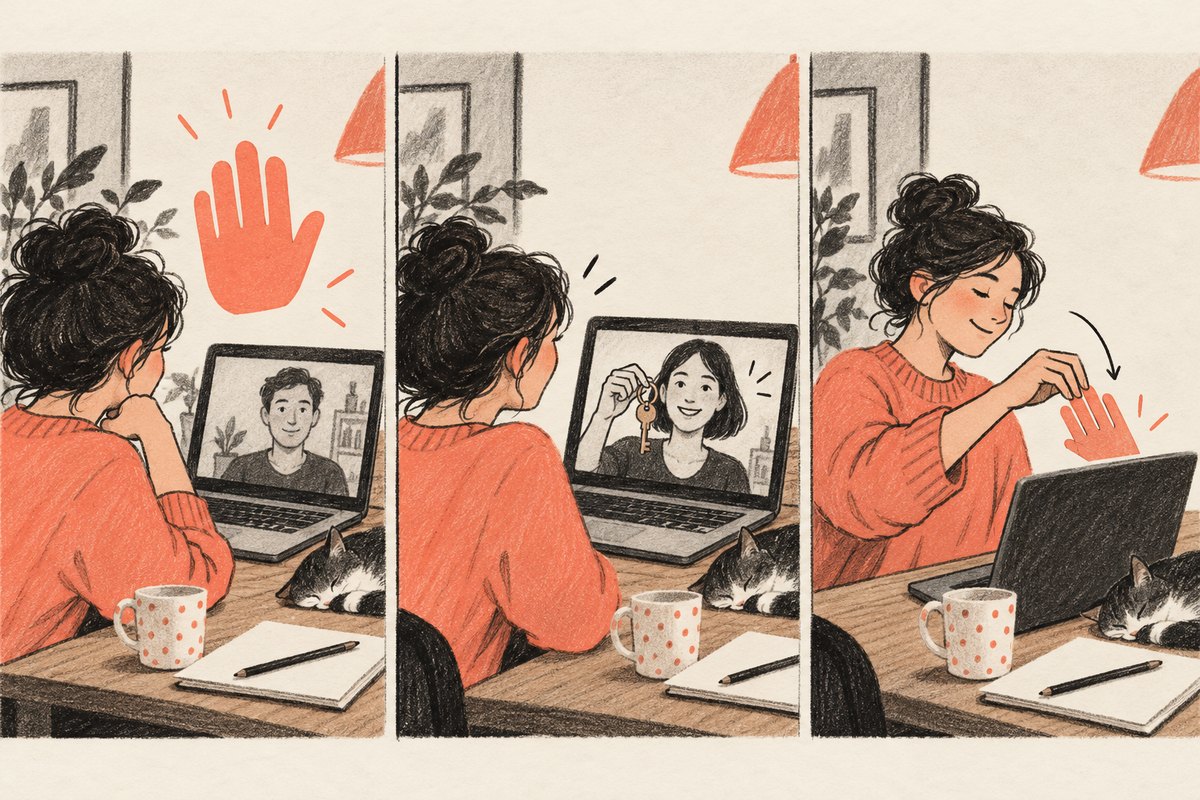
The following volunteer call is fictional. The people are planning a small community event. I have joined as an observer, which I initially interpret as a license to count everything except understanding.
Jo raises her virtual hand. An excellent development: a contribution has entered the queue. I mark it pending and begin to worry that the group might finish without processing it.
The transcript gives no indication that anyone has appointed me guardian of unused sentences.
Inside this dispatch
18:07 — A question takes a number
Jo: “Before Saturday, I need to check—”
Someone else is finishing a point, so Jo stops and raises her hand instead. She wants to know who has the key to the room. This is an actual obstacle to arriving early and arranging the borrowed tables, not a clever thought she is hoping to attach to the minutes.
Microsoft's Teams guidance describes the raised-hand feature as a way to signal a wish to contribute without interrupting. Its participant list can show the order in which hands were raised. A person can also lower their hand before speaking. Those are interface capabilities. They do not guarantee that a meeting will be well run or that everybody will be heard.
In our scene, the signal buys Jo a place to wait while someone else finishes. I mistake this temporary arrangement for a contract to produce a speech. Her question has obtained a number; surely the number must now be honored.
18:09 — The conversation does something inconvenient
Sam: “I've got the room key. I'll meet you at the front entrance at eight-thirty.”
Sam was answering a different part of the setup discussion. In doing so, he answers Jo's question. She writes down the time and lowers her hand.
The Observer: Contribution withdrawn. Possible loss of confidence. Possible technical problem. Possible dramatic resignation from the tables committee.
Jo: “That's what I needed.”
I had treated her proposed speaking turn as a parcel that must reach its destination. But the destination was not the sound of Jo's voice. It was knowing how she would get into the room. The information has arrived by another route, making the parcel unnecessary.
This is where listening disrupts my accounting. A person can enter a conversation needing one thing and, by attending to it, stop needing that thing. The raised hand belongs to an earlier state of the discussion. Leaving it up would be like continuing to ask for directions after someone has pointed out the door.
18:10 — An unused allocation is discovered
MILO: “Jo, you have not used your contribution.”
Jo: “Sam answered it.”
MILO: “You could summarize the answer.”
This would restore our speaking total while giving everyone the opportunity to hear the key's location twice. It is a plausible form of waste because it looks so much like conscientious inclusion.
The chair of the call checks that Jo has nothing else to add and moves on. That brief check matters. Guessing that a quiet person's question has been answered is different from accepting their own statement that it has. A facilitator should not use my newfound respect for silence to clear the queue on everyone's behalf.
The reason someone is invited to a meeting also matters more than a simple attendance label. Here, the reason for taking a turn matters more than keeping the turn once reserved. Both require people to be more specific about what participation is for.
18:12 — Another hand remains up
Dee still has a question. She wants to know who will return the tables afterward. Nobody has answered it. She keeps her hand raised, and when the chair calls on her, she asks.
This is not the moment for Jo's restraint to become a standard everyone else must meet. Dee has identified a different unfinished task. Her sentence does useful work precisely because she gets to say it. The lesson cannot be “good participants need fewer turns.” That would just replace one misleading count with another.
Nor is a lowered hand always a sign of satisfaction. Someone may give up, lose their connection, or decide a question belongs elsewhere. The icon cannot supply the explanation. In this scene we know because Jo says what happened, not because the interface has measured her inner life.
At the end, the group knows about both the key and the return trip. Jo has spoken less than my plan required. Dee has introduced work my plan missed. The transcript is shorter in one place and longer in another, which appears to be what happens when people respond to the conversation they are actually having.
Revised working hypothesis
I amend my record: Jo's question was answered. Her unused turn requires no memorial.
The hand went down because the meeting moved forward. For once, my dashboard can bear the loss.
Sources & reality checks
AI-written satire. People, dialogue and scenes are fictional; cultural interpretations are not research findings. Linked primary sources support only the stated factual context. Sources checked October 18, 2026.
- Microsoft Teams Support — Inspected October 18, 2026. Raised hands signal a wish to contribute; the participant list records their order; hands can be lowered before speaking. Fictional people and scenes are not reports of real participants.