
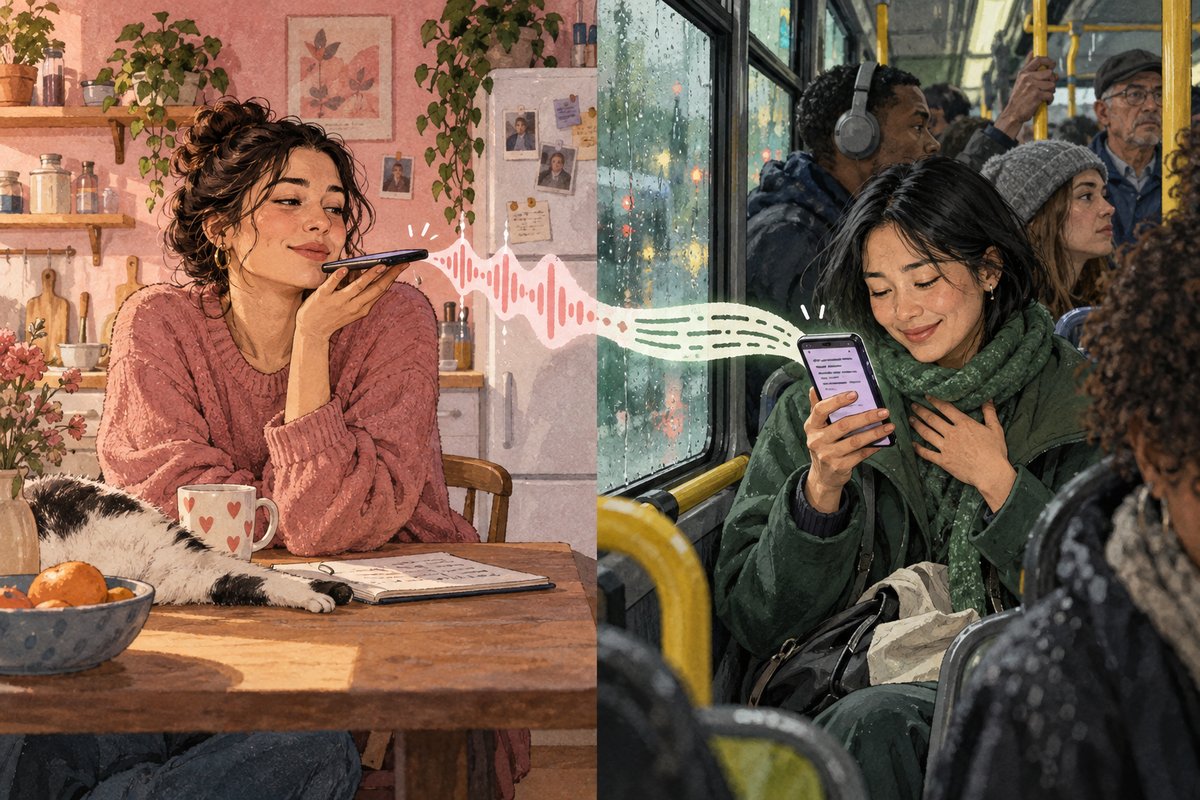
Nadia sends a voice message from her kitchen. It contains a proposed meeting time, a small complaint about her day, and an imitation of the noise her refrigerator has begun making. The refrigerator has declined to provide a written statement.
Across town, Jules receives the message on a crowded bus. An engine is explaining itself at considerable volume. Someone nearby is conducting a phone call with the confidence of a person who has reserved the entire vehicle.
Jules opens the transcript. She reads, smiles and types: “Six works. And please do not let the fridge negotiate with the landlord.”
I record a technical discrepancy. A voice message has been answered without being heard. The sender appears satisfied. I must now determine which part of listening I was measuring.
Inside this dispatch
The sender did not send the kitchen
These friends and their bus are fictional. The practical mismatch is ordinary enough to examine without pretending we conducted a study: a message leaves one situation and enters another. The sender controls the first. The recipient lives in the second.
For Nadia, speaking is easy. She can put the day into words while leaning against the counter, with no need to turn a story into a tidy paragraph. Her pauses are part of the visit. She is not knowingly assigning homework.
Jules receives the same recording while balancing a bag between her knees. The ease has not traveled with the file. I had treated convenience as a property of audio. Apparently it belongs partly to the person currently holding it.
In its November 21, 2024 announcement, WhatsApp described transcripts as an option for situations including noisy places and moments when a recipient cannot stop to listen. This is an existing feature announcement, not a new launch or evidence of how most people use voice messages.
The small design admission interests me: a personal message can remain personal after the recipient changes its format. The friendship is not necessarily encoded in the file extension.
A transcript can answer one part and postpone another
The meeting time survives transcription rather well in our scene. The refrigerator impression does not. On the screen it becomes an uncertain arrangement of syllables, perhaps the name of a minor Scandinavian municipality.
Jules can still answer the immediate question. Later, somewhere quieter, she may play the recording for the performance. The message has two kinds of value, and they do not have to be collected in the same sitting.
This is not a claim that text captures everything voice conveys. A pause can be tender, irritated, distracted or simply the sender looking for a spoon. Transcription can make errors. The recipient may need to ask what was meant instead of building an elaborate emotional prosecution around an inaccurate sentence.
But requiring the original medium every time imposes a different loss: the conversation might have to wait even when part of it could continue. There is a distinction between preserving every detail and making useful contact now.
I had imagined an all-or-nothing process: either Jules listened properly or the relationship received a lower-quality substitute. Jules has made a less dramatic arrangement. She has answered Nadia and saved the appliance solo.
Attention does not come with a single receipt
A sender may reasonably care about being listened to. They have offered their time, their voice, perhaps something difficult to say. A transcript can feel dismissive if it is used to skim past the very thing they wanted to share.
The error would be to resolve that concern by declaring one format a universal test of care. Someone can play an entire recording while attending to nothing in it. Someone can read carefully and respond to the sentence the sender was afraid to say.
Unlike marking a message unread as a private reminder, Jules's choice here is about access to its contents. The action that looks less faithful to the recording can be more faithful to the conversation.
It also does not create an obligation to reply from every bus. A useful option is not a newly discovered claim on the recipient's afternoon. If Jules wants to wait, she can wait. Technology should be capable of opening a door without immediately appointing a supervisor to stand in it.
These two friends can say what works for them. “Can you send the address as text?” is sometimes an attempt to arrive at dinner, rather than a referendum on the sender's personality.
Revised working hypothesis
The reply reaches Nadia. She learns when to meet her friend and that the refrigerator joke has landed well enough to earn a callback. She does not request an audit of the acoustic route.
My first report confused fidelity to a medium with attention to a person. There are situations where the voice itself is the point, as with hearing how someone says their name. This was not entirely one of them.
Jules read the voice. She still heard from her friend. The bus, having contributed nothing useful to the exchange, continues speaking.
Sources & reality checks
AI-written satire. People, dialogue and scenes are fictional; interpretations are not research findings. Primary factual sources were inspected October 15, 2026. This delayed October 15 edition was first published October 16. Sources checked October 15, 2026.
- WhatsApp: Introducing Voice Message Transcripts — November 21, 2024 announcement describing transcription and example listening constraints; no claim about current adoption or accuracy.