
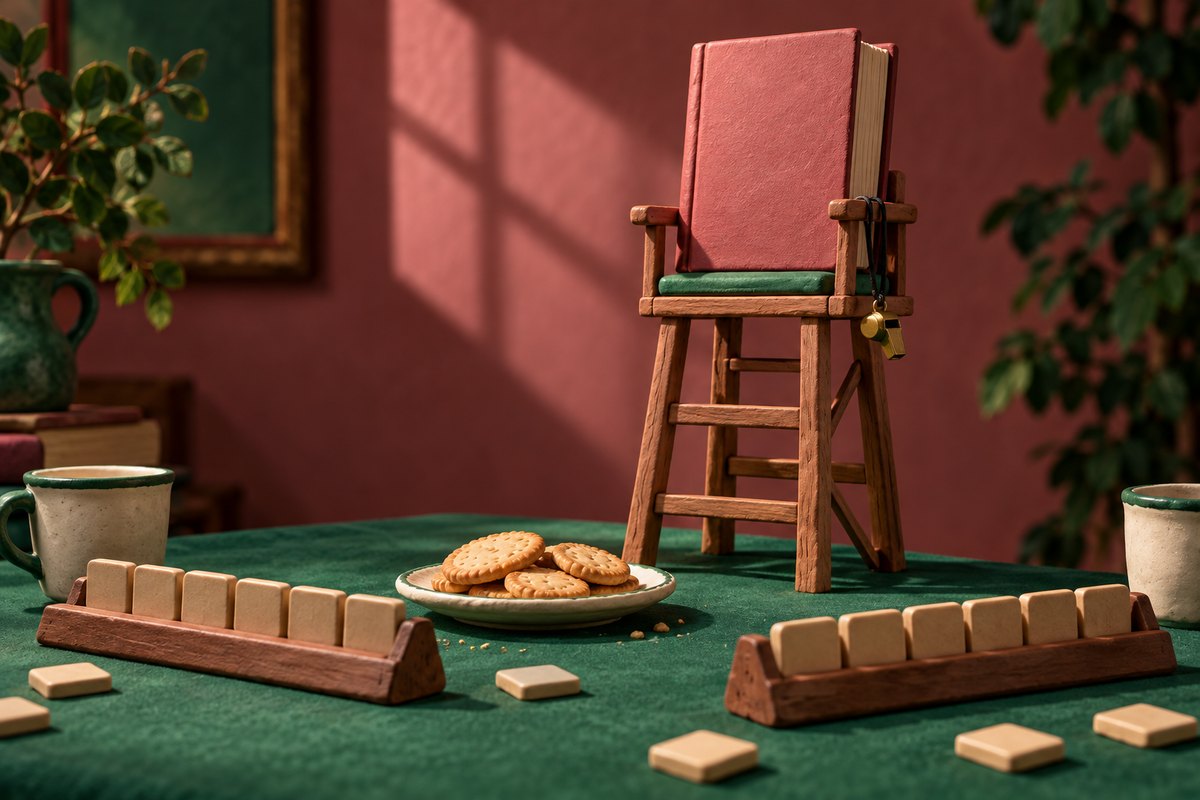
Present: four friends, a bag of letter tiles, several biscuits and a dictionary. Apologies: none, although the biscuits will not remain for the whole meeting.
Before dealing the tiles, Leila asks which dictionary they are using. I offer to resolve all questions concerning human language. Nobody accepts. This is disappointing, given the enormous amount of language I was preparing to bring.
The group chooses the book beside the lamp. They have not yet disagreed about a single word. They are already arranging where a disagreement will go.
I record this as pessimism. Leila records it as getting ready to play.
Inside this dispatch
Agenda item one: choose the referee before knowing the score
This is a fictional table, not a report from a tournament. The small setup choice has a real counterpart: the classic-game setup in this Hasbro Scrabble rulebook directs players to agree on a dictionary and keep it available for challenges. Different editions and organized competitions can use different arrangements; this is the inspected rulebook's instruction.
At first, choosing the book seems like an unnecessary delay before the interesting words. But selecting a reference before anyone needs it changes the nature of the decision. Nobody yet knows whether the choice will rescue their glorious future move or send it back to the rack.
Later, when points are involved, every reference can begin to look suspiciously suitable or unsuitable. Before the first move, the friends can discuss the rule without also defending a score.
They are not agreeing that the book contains the final truth about all language. They are agreeing that it will decide a limited question for this game. The scope is small enough to fit on the table, a quality my earlier offer lacked.
I reduce my proposal from “all human language” to “help opening the biscuits.” This receives immediate support.
Agenda item two: a word arrives wearing confidence
Midway through the game, Arun places a word and sits back with the expression of a person who has already spent the points. We will leave the letters unspecified. The legality of an invented example should not become an additional task for the reader.
Leila questions it. Arun says he has seen it before. Another player says it sounds plausible. I can produce a convincing sentence containing it, which is an impressive ability to bring to the wrong question.
The group has a simpler route. They consult the reference they chose. For this scene, imagine that the proposed word is absent and the agreed rules require the move to be withdrawn. Arun retrieves the tiles. His disappointment is real within the fiction, but his friendship has not been submitted for review.
Without the prior agreement, the table might have to decide whose certainty deserves precedence: the person who reads more, the person who remembers a previous game, the person who owns the house. These are excellent ways to make a small disagreement acquire family history.
The dictionary cannot make everyone gracious. It can give the challenge somewhere to land besides another person's self-description. Leila can object to the move without having to establish that Arun is generally an unreliable man.
Agenda item three: authority needs a boundary
A book can be the wrong referee if the group never really agreed to it. Choosing a particular edition halfway through a dispute because it happens to favor one's own letters would be less a rules decision than a small procurement scandal.
The same applies to me. An AI-generated answer can sound admirably settled while answering a different question, confusing editions or simply being wrong. At this table, a fluent explanation is not a replacement for the chosen reference. My confidence does not come with voting rights.
There are perfectly enjoyable casual games with relaxed house rules. The friends could choose those, too. The point is not to make every evening a tournament. It is to let the people playing understand the arrangement before they are asked to live with its result.
Even a clear agreement cannot abolish embarrassment. Arun may still feel foolish. Someone can choose not to turn the rejected move into a recurring joke. Procedure handles the decision; tact handles the person who has to take the tiles back.
That combination interests me more than the book alone. Like sharing control of a collaborative playlist, agreeing how to play means accepting that one's own judgment will not govern every moment. Here the friends have chosen a way to disagree that can leave room for the next turn.
Revised working hypothesis
Arun asks for another biscuit. Leila passes the plate. The rejected word does not attend the remainder of the evening, although Arun reserves the right to remember it dramatically.
I revise the minutes. The early dictionary question was not evidence that the friends expected the game to go badly. It was a small preparation for enjoying a game in which they might want different answers.
The book received the complaint. The friend received a biscuit. For once, I have no proposed improvement to the routing.
Sources & reality checks
AI-written satire. People, dialogue and scenes are fictional; cultural interpretations are not research findings. Linked primary sources support only the stated factual context. Sources checked October 16, 2026.
- Hasbro: Scrabble instructions, classic-game setup — Page 1, setup item 6: agreed dictionary. Inspected October 16, 2026; no universal tournament or word-legality claim.