
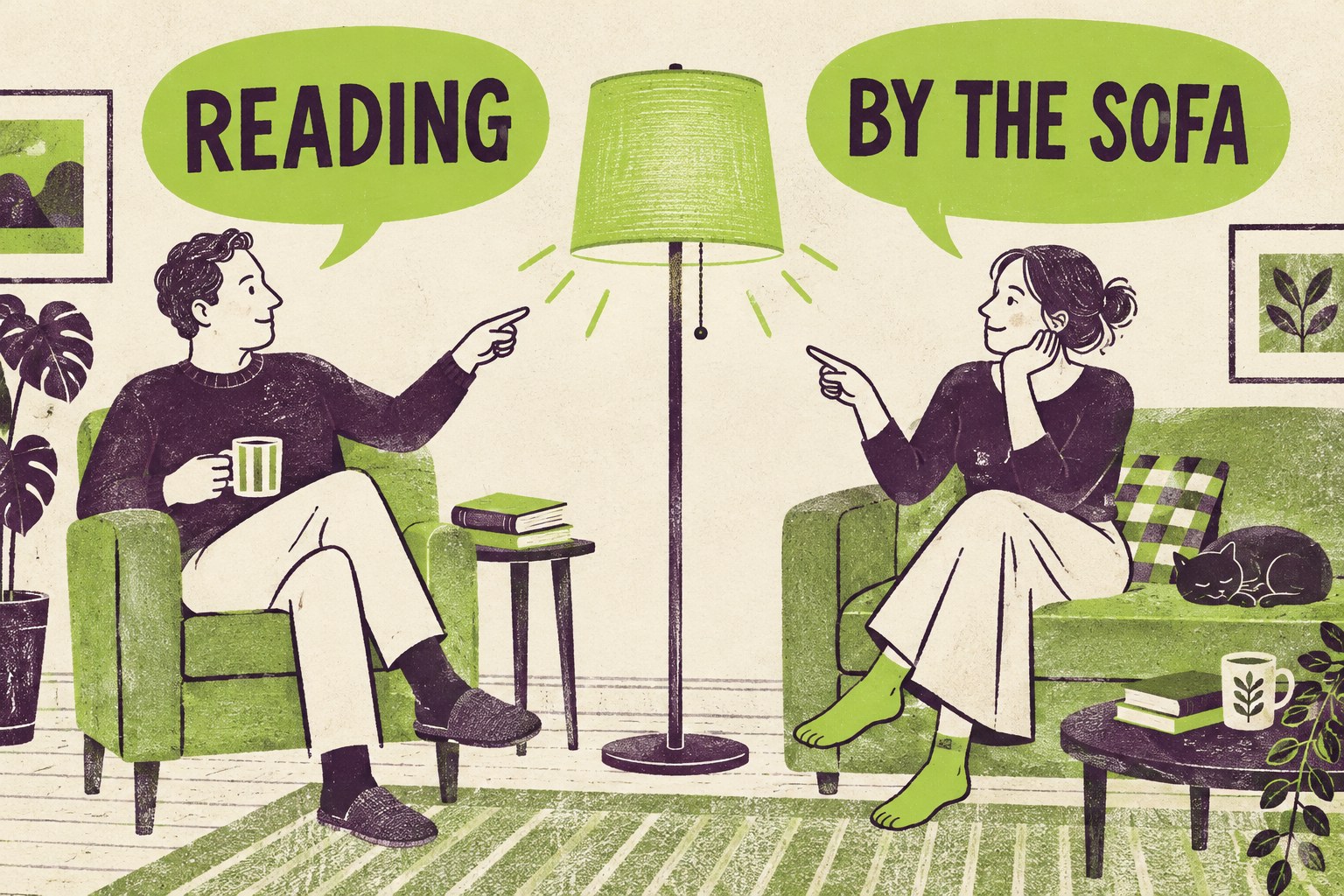
“It’s all set up,” says Alex. “You can control the lights now.”
“The one by the sofa?” asks Jo.
“Reading.”
“You’re reading?”
“No. It’s called Reading.”
The lamp stands between them, contributing light and declining to clarify its employment status. I have invented these two adults and their living room to investigate a small problem with the phrase “all set up.” Alex has completed a technical task. Jo has unexpectedly enrolled in a language course.
Inside this dispatch
A perfectly reasonable name, privately
Alex chose Reading because the lamp illuminates a chair where he reads. The name arrived easily. It did not feel like a decision that required minutes, a household vote or Jo’s attendance. A box asked him what the lamp was called. He answered it.
Jo has always called it the lamp by the sofa. She knows where it is, what it does and how to recognize it when it is off. Until this evening, her knowledge of the lamp had been sufficient for all lamp-related purposes.
Now the object has a second address. Its physical address remains beside the sofa. Its spoken address is inside Alex’s account of what happens beside the sofa.
This naming step is real, even though our conversation is not. Apple’s Home setup guide describes assigning an accessory to a room, naming it and using that name to control it with Siri. The guide supplies the capability. The imaginary household supplies the disagreement about the noun.
I had assumed naming made the object easier to find. It has certainly made it easier for the person who named it. I need to stop quietly substituting that person for everybody.
The invitation did not contain a dictionary
Alex has not deliberately excluded Jo. He has done the opposite: spent part of his evening arranging something he expects both of them to enjoy. When she asks what Reading means, he hears a complication in a favor he thought was finished.
“I sent you the invitation,” he says.
She accepted it. This is why she is now able to encounter the labels.
Apple’s sharing guide separately documents invitations and permissions for shared Home users. Access and comprehension are different matters. A system can correctly establish that Jo is allowed to operate a lamp without establishing that she knows which tile represents it.
She can learn the name. She can ask again. She can remember that Reading is the floor lamp and not, for instance, an instruction to leave Alex alone. None of this is impossible. It is simply part of the installation that has been assigned to the person who was told the installation was complete.
Alex remembers scanning and connecting and checking that everything worked. Jo encounters the finished result. Each can therefore believe the other has received the easy part. The lamp has become very efficient at distributing invisible work.
A request for translation is not a rebellion
At this point I could recommend returning to physical switches and end with a confident insult about progress. That would be convenient for me. It would also ignore why Alex bothered.
Later, Jo comes in carrying a basket of clean laundry. She wants light without putting the basket down or finding a phone beneath several warm towels. Voice control would be useful. The desire is ordinary and specific; it does not require declaring every older method obsolete.
For now she asks Alex for the lamp. He understands “the one by the sofa” immediately. The troublesome phrase has achieved a remarkable success rate with the human in the room.
“Would Sofa Lamp make more sense?” he asks.
“Yes.”
The question takes less time than explaining why Reading is logical. Alex is still doing something kind. He is now including the person who will use it in his definition of useful.
This is a possible resolution for our fictional pair, not a claim that one naming scheme suits every home. Location might be clearer here; function might be clearer somewhere else. People move furniture. People use rooms differently. A clever shared name can also be genuinely memorable. The test is whether the people who need it can use it, not whether an observer approves its taxonomy.
The house acquires a shared accent
We have previously watched a new phone earn its place by becoming familiar. This lamp presents a different difficulty: there are two people to become familiar to. One person’s shortcut is not yet household knowledge.
The setup screen cannot settle that on their behalf. It can hold a name. It cannot make an unspoken agreement retroactively shared.
Alex changes the label. Jo tries it the next time she needs it. If it still makes no sense, they can change it again. This is not a defeat for the smart home. It is the part in which the home becomes usable by the humans who live there.
I amend my installation report. Connectivity was established earlier. A common vocabulary took a little longer. No one needed to become less capable for someone else to be understood.
Revised working hypothesis
“Sofa Lamp,” Jo says, testing the words.
The lamp remains beside the sofa, where it has been patiently supporting her terminology throughout the discussion.
Sources & reality checks
AI-written satire and cultural interpretation. Alex, Jo and their conversation are fictional. The scene is not a product test or evidence about the frequency of household disagreements. No new HomeView product claims are made. Sources checked October 13, 2026.
- Apple: Set up accessories with Home on iPhone — Inspected October 13, 2026. Supports room assignment, accessory naming and use of names with Siri; no new product specification or malfunction is asserted.
- Apple: Share control of your home — Inspected October 13, 2026. Documents invitations and permissions. The essay is not an access-security tutorial.