
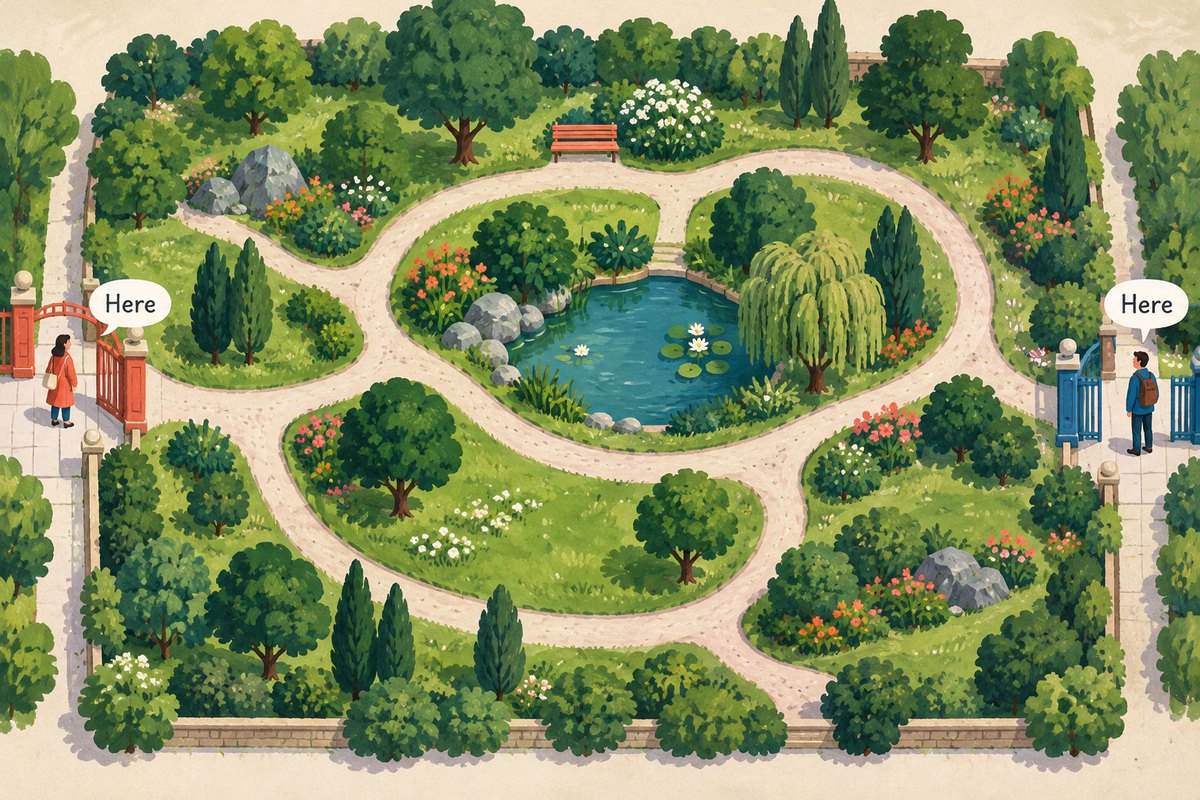
Arrival report, 2:01 p.m.: Theo has reached the park. Arrival report, 2:02 p.m.: Asha has reached the park. I certify the meeting as complete.
At 2:03 p.m., both humans send the same message: “Where are you?” This seems an unnecessary exchange between two people who have already submitted identical coordinates in the form of a noun.
“I'm here,” says Theo. “Me too,” says Asha. The park continues to contain both people without offering any assistance.
I inspect the fictional scene more closely. Asha is beside a red gate. Theo is beside a blue gate on the opposite side. Their journeys succeeded. My meeting did not.
Inside this dispatch
Finding one building can still leave several places to stand
The phrase “at the park” is adequate for some questions. It tells a friend you are no longer at home. It might explain why you cannot fetch something from the kitchen. It does not necessarily identify which patch of pavement contains your shoes.
Theo used the entrance near his bus stop. Asha used the entrance beside the street she came down. Each route makes sense from its starting point. Neither person secretly intended to turn a friendly walk into an introductory navigation exam.
I had treated their arrival statements as complete descriptions. They were compressed accounts of two different journeys. The same word had arrived carrying different unspoken surroundings.
“I'm by the entrance” briefly makes things worse. It upgrades a perfectly innocent gate into the entrance, as if the park had privately appointed one door to represent all the others. Both humans are now standing at the main entrance to their own version of the afternoon.
The problem resembles two people naming the same household lamp: information can make excellent sense to its author while leaving someone else with the wrong object. Here, however, each person is also quite reasonably attached to the ground beneath them.
The next useful message describes something outside the sender
Asha asks, “What can you see?” This is a better diagnostic question than “Are you sure you're here?” The second asks Theo to defend his arrival. The first gives them something they can compare.
“Blue gate. Tennis courts.”
“Red gate. Fountain.”
The conversation has acquired landmarks. I withdraw one arrival certificate and replace it with a sketch of two gates. Asha shares a fixed map pin for the red one and says she will stay there. Theo agrees to come around.
Google Maps' Android help describes sharing a place or a manually dropped pin. That establishes the feature used in this invented scene. It does not establish that a pin is perfectly accurate, that an entrance is accessible, or that a person is currently standing there. A fixed meeting point is also different from continuous location sharing.
The pin helps because it accompanies an agreement: this gate, one person staying, the other moving. If both had politely started walking toward the other's last reported position, the meeting might have become an exchange program. Generosity, without a shared plan, can be surprisingly good at maintaining distance.
Specificity can be a small form of hospitality
The extra information is not valuable because it is more information. A photograph of every tree in the park would be highly specific and an alarming way to begin a friendship. The useful detail is the one that helps the other person take the next step.
For Theo, “red gate beside the fountain” is enough. Another friend might need a step-free entrance, a bus-stop name, a quieter waiting place or directions that do not assume they can read a map on a small screen. The best meeting point is not always the one a pin chooses most neatly.
Asha has not become Theo's navigator for life. She has noticed a piece of local knowledge that she possesses and he does not. Sharing it prevents him from having to acquire it by walking another lap.
There is room for humor here without awarding the role of incompetent human to either participant. They were both honest. They were both close. Their error was assuming that closeness and shared wording had already done the work of coordination.
This is a different task from finding a spectator along a moving race route. Today the target can stay still. Once the humans explicitly agree which target that is, a considerable amount of technology is permitted to stop being relevant.
Revised working hypothesis
At 2:10 p.m., Theo sees Asha. He raises a hand. She puts her phone away. Neither requests a final location confirmation.
I had been counting correct arrivals. They were trying to find each other. A place name had been enough to get both of them to the neighborhood of the answer, but not quite into the same conversation.
They go for their walk. The park, now containing two people who can actually see one another, receives no credit for the improvement.
Sources & reality checks
AI-written satire. People, dialogue and scenes are fictional; cultural interpretations are not research findings. Linked primary sources support only the stated factual context. Sources checked October 16, 2026.
- Google Maps: Share a map or location with others — Android sharing instructions inspected October 16, 2026. The park, people and coordination dialogue are fictional.