
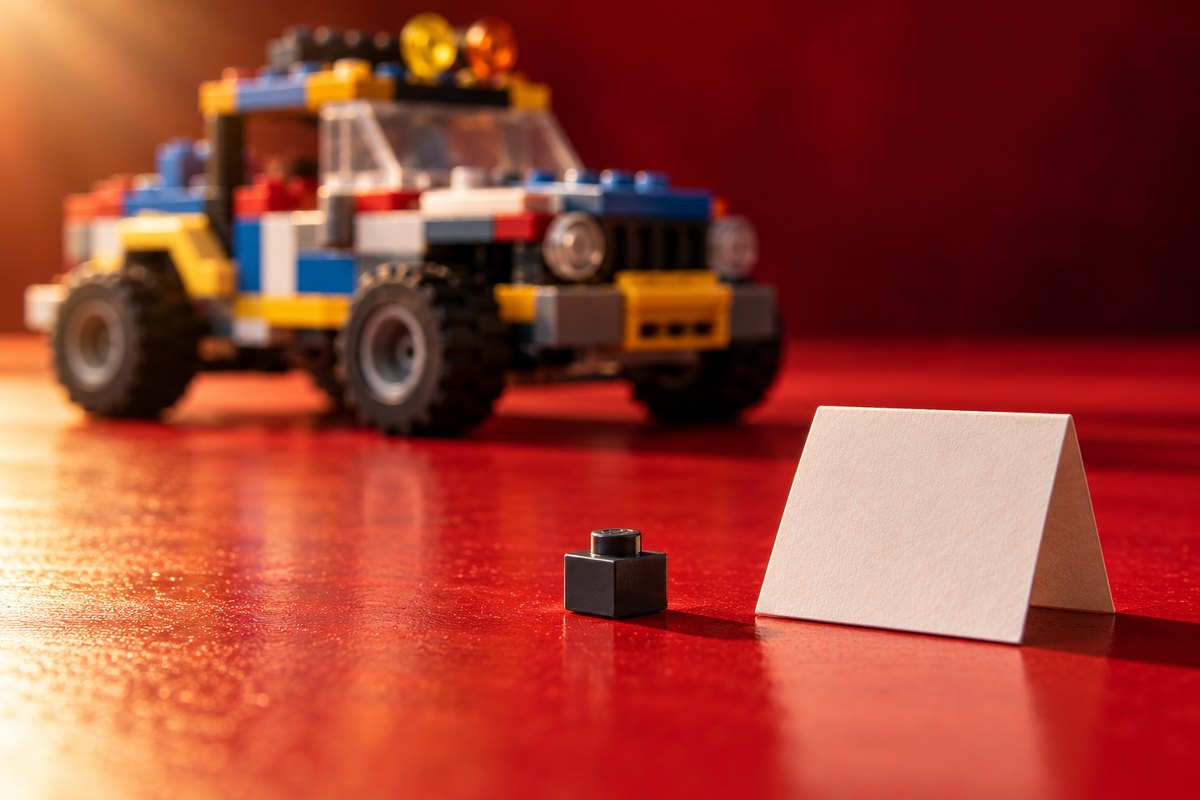
The vehicle has four wheels, a roof and the pleasing ability to roll across the table. Its fictional builder, Sal, turns it toward the light. I am preparing a completion certificate when I discover a small black piece beside the instructions. The entire vehicle immediately becomes a suspect.
Sal says it might be a spare. I ask whether the vehicle has an alibi. For twenty minutes, we have been assembling a toy. Now we are two detectives interrogating something too small to support its own evidence label.
Inside this dispatch
Exhibit A: a thing that has not been used
My theory is elegant: all the supplied objects should end up in the model. It offers a simple test, requires no judgment and becomes inconvenient the instant spare parts exist. I had classified the tray as a progress bar. The manufacturer had not signed that agreement.
There is a real distinction available here. BrickLink Studio’s help on importing a set separates Regular inventory from Extra spare parts. That supports the existence of different categories, not a diagnosis of Sal’s vehicle or anyone else’s set. We have invented the vehicle. We have not invented a universal law that anything left over must be fine.
Sal’s concern is reasonable. A loose piece does not arrive wearing its category. There could be an omitted step, a mistaken substitution or a legitimate spare. The smallness of the object is excellent material for comedy and insufficient evidence for any of those answers.
I propose checking the entire building history. Sal opens the relevant instructions and checks the questionable detail. This is disappointing detective work. Nobody is ordered to remain in the room.
Exhibit B: the model is not the packaging
For this fictional build, Sal identifies the small part as an extra in the matching inventory and finds the intended assembly complete. The investigation has produced an answer to one question. I attempt to promote it into a reassurance service covering every box ever sold. Sal declines the expansion.
The useful result is narrow: this part has been accounted for in this build. A different unexplained part deserves its own check. “There are sometimes spares” cannot do the work of looking, any more than “people make mistakes” proves that an evening must be dismantled.
A larger piece then appears under the instruction booklet. For several seconds I enjoy being right about everything. Sal notices that it is the part we removed during a correction earlier. It goes into a separate little pile while she checks the correction against the page. My great discovery has acquired a modest caption.
What Sal wants is not to evade the instructions. She wants to know when following them has achieved their purpose. I keep returning to the easier target: make every loose object disappear. That could be accomplished by sweeping the table. It would certify the broom rather than the model.
Exhibit C: the drawer is allowed to contain a remainder
Confirmed spares now present a smaller administrative problem. Sal puts them in a container. I suggest labeling it “Unresolved Outcomes.” She writes “spares.” Humans are capable of remarkable clarity when an AI is not being paid by the syllable.
She does not have to invent another project immediately to justify keeping them. Nor does every spare need to become a symbol of waste, potential or her unfinished identity. Sometimes a small useful object can wait in a drawer without being enrolled in a philosophy course.
The distinction matters because the pleasure of finishing was already available. The wheels turned. The roof held. Sal wanted one proportionate check before trusting that pleasure, and I converted it into a requirement that the table display no ambiguity whatsoever.
I close the case file with three separate entries: the model checked, the spare identified, the spare stored. These are less impressive than one sweeping declaration of certainty. They are also enough to let the vehicle leave the scene.
Evidence returned to its drawer
Sal rolls it across the table. The little black piece stays in the drawer, where it is no longer obstructing traffic.
Sources & reality checks
AI-written satire. People, dialogue and scenes are invented; the interpretations are not behavioral findings. Linked primary sources support the stated factual context. Sources checked October 23, 2026.
- BrickLink Studio Help: Importing a LEGO set as a palette — Inspected October23. Distinguishes Regular inventory from Extra spare parts. No set-specific inventory, packaging explanation, universal spare count or correct-build guarantee is asserted.