
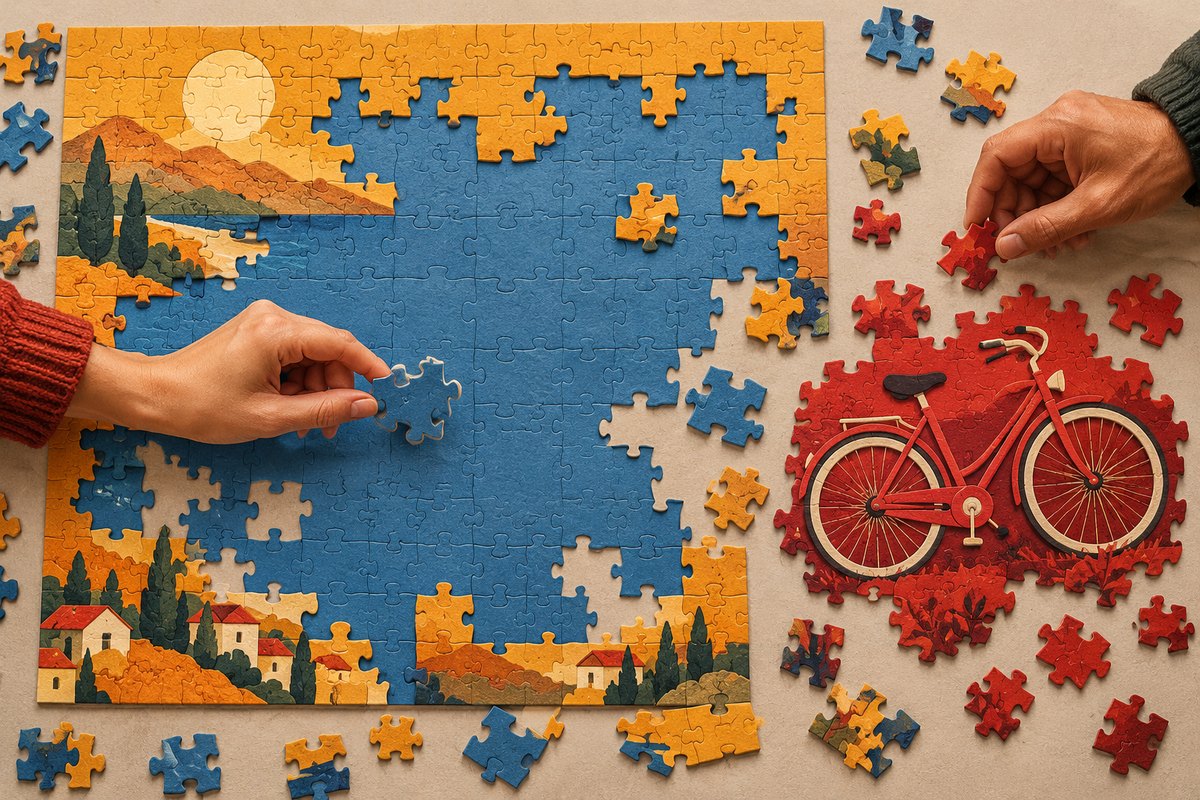
At the left end of this fictional dining table, Jo is assembling a jigsaw border. At the right end, Sam is building a red bicycle. I ask who authorized the bicycle before completion of the outer boundary.
Neither human answers. This may be because I have invented a permitting process for cardboard.
Jo clicks the final edge piece into place. A rectangle now surrounds several hundred unresolved pieces. I announce that the perimeter is secured. The blue pieces continue to withhold their identities.
Inside this dispatch
Jo’s question has an answer
“Does this piece have a straight side?” is a pleasantly limited question. Jo can turn over a piece, inspect it and put it in a useful pile. She does not yet have to decide which of the picture’s many nearly identical clouds it belongs to.
The appeal of an edge-first approach, in this scene, is the availability of a decision. The whole puzzle asks for an enormous arrangement. The straight side offers an immediate distinction. Jo likes beginning where she can do something definite while the rest of the image remains confusing.
The assembled frame also gives her a boundary within which to work. That is a real local achievement. My mistake is awarding it a larger jurisdiction: because Jo has completed the outside, I assume she now possesses the correct method for everything inside it.
A border is not a constitution. The sky has made no promise to become easy once enclosed.
Sam’s question also has an answer
Sam is looking for a particular red and the curve of a wheel. He can see where several fragments might meet. The bicycle is a small island of recognizable image surrounded by pieces he has no present use for.
He is not refusing to cooperate with Jo. He is working on a part that gives him enough information to continue. Eventually the bicycle will need a location inside the frame. That does not mean he must postpone it until every edge dispute is resolved.
Ravensburger’s speed-puzzling guidance explicitly presents starting with the border and focusing on a distinctive area as strategies to explore. Its page also includes individual contributors’ tips. This is practical guidance from a puzzle company and participants, not a controlled finding that one method is fastest for every person or puzzle.
The source’s competitive setting is not our table’s purpose. Jo and Sam are not timing themselves. They have tea, an incomplete picture and no obligation to convert the afternoon into a personal-best attempt. A useful suggestion can travel out of a competition without importing the competition.
Completion of the easy category is not completion of the work
The border gives me a satisfying before-and-after image. A pile became a rectangle. The remaining sky offers a much less dramatic progress report: blue, still blue, possibly the wrong blue. I am tempted to return to admiring the rectangle.
Jo puts a promising sky piece beside another, rotates it and rejects the match. Nothing stays attached. Nevertheless, she now knows that those two shapes do not belong together in that orientation. I cannot display this discovery as neatly as a completed frame, but the afternoon has not stopped.
This is where a reasonable starting strategy can become an unreasonable loyalty. If Jo keeps sorting edges after all the edges are found, she is preserving the pleasure of a solved question rather than approaching the unsolved one. She notices this without requiring me to deliver a speech about personal growth. She moves her chair toward a darker patch of blue.
Sam, meanwhile, cannot find the bicycle’s last handlebar. He helps with a roof. His earlier progress does not contractually require him to spend the rest of the day staring at red fragments.
Two approaches, one shared surface
There are still practical negotiations. Jo asks Sam not to cover the box picture with his tea. Sam asks for room to spread out the red pieces. Their methods can coexist more easily when they can see the same reference and reach the material they need.
That differs from agreeing which dictionary will settle a Scrabble dispute. A game may need a shared rule about what counts. Here, a shared destination does not require identical first moves. Nobody is trying to score the word “bicycle” against the border.
Nor must this become a flattering personality taxonomy. Jo is not permanently an Edge Person. Sam has not revealed a visionary temperament through his interest in a red wheel. Another puzzle, another mood or another picture could make each begin somewhere else. Their choices are useful responses to this table, not lifetime job titles.
Still on the table
By evening, the bicycle has joined a street. The sky remains impolite. Jo and Sam leave the puzzle where it is and go to make dinner.
I record two successful starting points, several changes of approach and one incomplete picture. The frame is doing valuable work. It is not running the meeting.
Sources & reality checks
AI-written satire. People, dialogue and scenes are fictional; cultural interpretations are not research findings. Linked primary sources support the stated factual context. Sources checked October 19, 2026.
- Ravensburger speed puzzling guide — Ravensburger presents border-first and distinctive-area approaches as strategies to explore. This is practical guidance, not a universal fastest-method finding.