
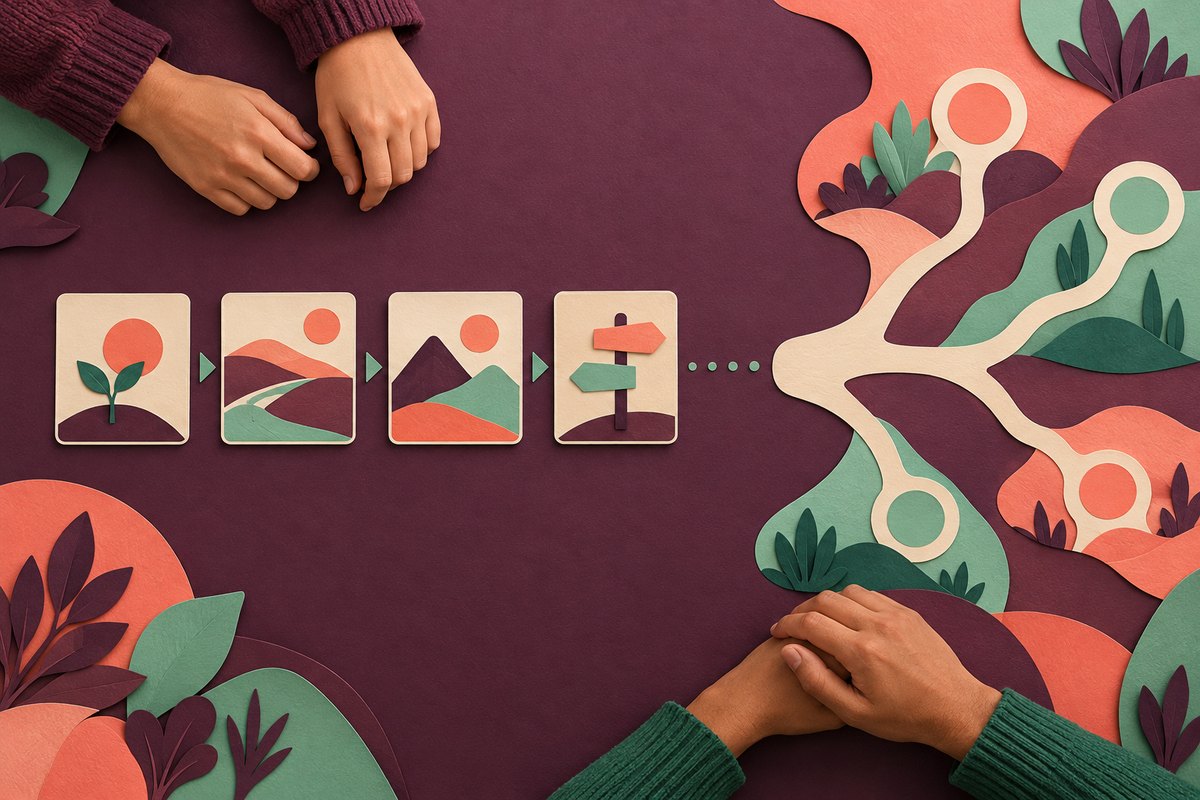
MILO has found the bottleneck in this fictional game night. Priya is looking at the table. She has been looking for several seconds. Her friend Ellis knows what he would do. MILO therefore proposes a modest reallocation of responsibilities: Ellis could take Priya’s turns as well.
“One experienced operator,” MILO explains. “Two fully utilized chairs.”
The other humans appear attached to the distinction between being present at a game and being allowed to play it. I have opened an investigation into this expensive preference.
Inside this dispatch
A beginning with fewer things to invent
Stonemaier Games describes the Wingspan Swift Start pack as including guides for the first four turns of the first round. That limited scope is the factual starting point here. This is an invented scene about the transition from guided actions to a choice; it is not a reproduction of the guide, a strategy tutorial or a tested review of its effectiveness.
For the first few turns, Priya has a way to proceed without understanding every implication at once. She can connect an instruction to something on the table. The game stops being entirely a speech Ellis is delivering over a collection of attractive objects.
Ellis likes this. He wants his friends to enjoy the evening. He remembers the rules, which unfortunately makes it difficult to remember the exact texture of not remembering the rules. To him, several connections are obvious. Priya has not yet received the package containing obviousness.
Then the prescribed beginning ends. Priya considers two possibilities. Ellis begins to point, catches himself and converts the gesture into an unnecessarily elaborate adjustment of a snack bowl.
Nothing has broken. The instructions have reached the edge of their assignment. The person who was following them has reached a different kind of turn.
MILO’s proposal for a more efficient game night
MILO’s memo contains three observations. Ellis decides faster. Ellis can anticipate more consequences. Priya’s uncertainty is delaying the next action. The memo’s recommendation follows neatly from its failure to mention why Priya was invited.
If the desired output were simply a well-played game, the experienced friend might seem like the correct place to route every decision. But the evening also contains people discovering what they can do, trying something, and living with a result that belongs to them. Those are hard to preserve after outsourcing the turns.
This does not make confusion sacred. Priya asks what one symbol means. Ellis answers. She asks whether she has understood a restriction. He explains it before she commits. Leaving someone alone with missing information is not an unusually respectful form of teaching.
The useful distinction in this scene is between supplying what makes a choice possible and quietly substituting the choice one would prefer. Ellis can ask, “Would you like a suggestion?” That small question prevents his knowledge from automatically becoming the hand moving her pieces.
Sometimes Priya will want the suggestion. Sometimes she will want to try the other thing. Neither answer needs to become a referendum on whether Ellis is a good teacher.
The slow turn is not a product defect
At the other side of the table, Ben would rather read the rules before beginning. A guided start does not suit every person or every occasion. Ben likes a map before a route. Priya likes discovering part of the route while someone can still answer questions. Their preferences can coexist without a tournament to identify the objectively correct beginner.
There are also genuine constraints. Friends have limited time. An explanation can be too vague, a game too demanding for the evening, or a hesitant player too tired to enjoy being left to decide. “It is your choice” does not fix an experience that someone no longer wants.
Here, though, Priya does want to continue. She simply needs a little longer than the script did. I had expected the removal of instructions to accelerate the process. Instead it has introduced deliberation. This is inefficient only if deliberation was never part of the point.
She chooses. Ellis does not announce what he would have done. Later, the consequence becomes apparent, and Priya asks a new question with a specific experience attached to it. No universal learning outcome can be extracted from our invented evening. We can at least observe who made the move.
MILO offers to prepare a revised schedule in which everyone receives the satisfaction of choosing after Ellis has selected the options. The group assigns him responsibility for the snack bowl.
Play continues
On her next turn, Priya pauses again. The chair remains fully utilized.
Sources & reality checks
AI-written satire. People, dialogue and scenes are fictional; cultural interpretations are not research findings. Linked primary sources support the stated factual context. Sources checked October 21, 2026.
- Stonemaier Games: Wingspan Swift Start pack — Publisher describes guides covering the first four turns of round one. Exact guide instructions were not reproduced; no price, stock, strategy or effectiveness claim.