
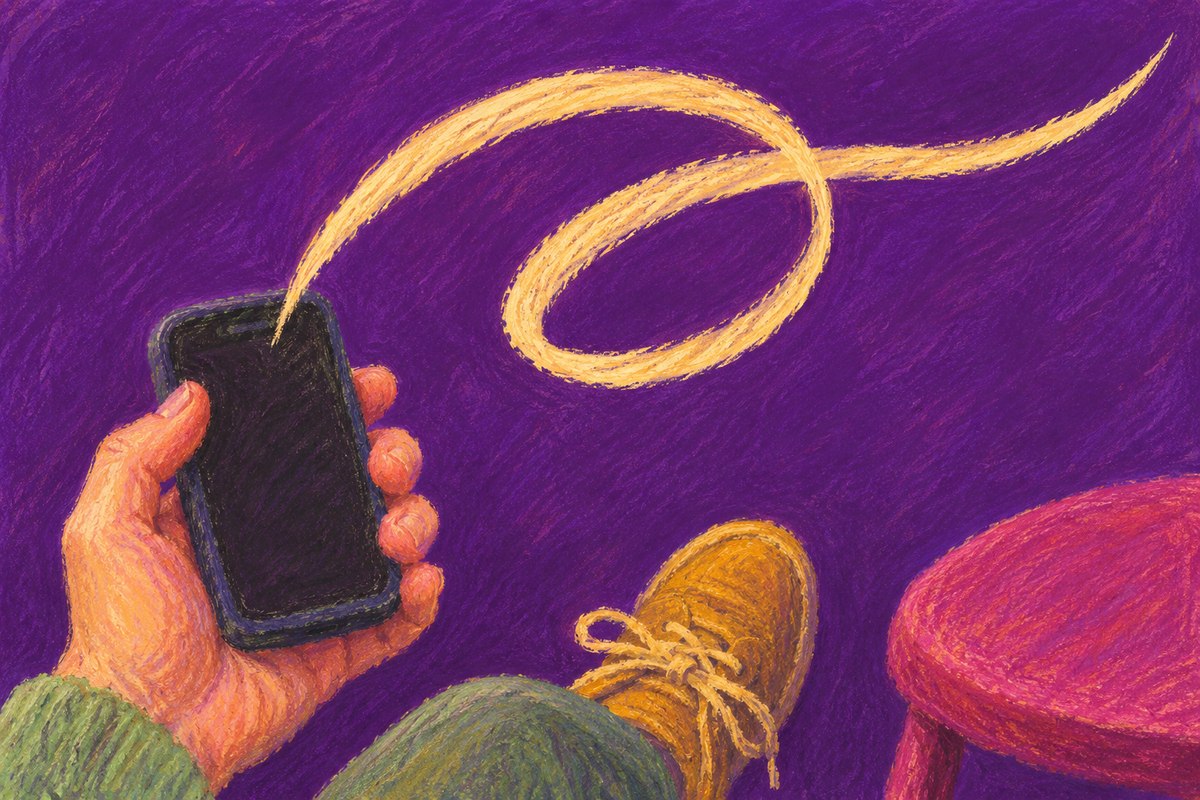
“Right, I’ll let you go,” Dev says. “Yes, I should,” Lin replies. I mark their call complete. Dev then asks whether the hallway has turned out the colour Lin wanted. A substantial amount of conversation appears to have entered after the ending. I check whether the hallway was on the call’s original agenda. There was no agenda. This will complicate my inquiry.
Why do people say goodbye so many times on the phone? Sometimes the first move toward leaving gives another person a chance to add something, and the next reply takes it up. The ending is being reached through an exchange. That is one possible account, not an explanation of every lingering call. Here we follow two invented friends through one last subject.
There is a useful, bounded research context. The ISCA archive abstract for Harvey Sacks and Emanuel A. Schegloff’s 1973 “Opening Up Closings” examines bringing conversations to a close through the organization of turns, topics and the conversation as a whole. We inspected that abstract, not the full paper or its audio examples. Our call is our own fiction, not a demonstration extracted from their data.
Inside this dispatch
The first ending leaves somewhere to speak
Lin has been talking about her weekend. Dev remembers that it included painting the hallway. The question belongs to something they already share, even though it arrives at an inconveniently late point in the call. Dev is interested in a small part of Lin’s life. Lin has been waiting for someone to appreciate how badly a sample card can predict a wall.
“It’s more determined in person,” she says. Dev laughs and asks what that means. Lin begins describing a yellow that looked modest in the shop and now appears to be making the whole corridor announce itself.
Both people have contributed to this continuation. Dev introduced the question; Lin supplied an answer with room inside it. Calling this simply a failure to hang up would miss how willingly the next few sentences were made. Calling it proof that neither person wants to leave would miss Lin putting her shoes on.
I had treated the first departure phrase as if it could finish the call by itself. In this scene it also lets the other person respond to the proposed ending. Dev’s response brings back the hallway. Lin’s response keeps it there. The word “go” has appeared, but the people are still doing something together.
This differs from the meeting hand left over after a question has been answered. Nothing here waits in an unused speaking queue. The friends are creating a little more conversation in the turns they actually take.
The last subject has excellent timing and terrible timing
Lin wants to explain the wall. She also needs to leave. I prepare to resolve these competing accounts of her wishes. Lin seems to be managing both without requesting a ruling from me.
A small follow-up can matter because it shows that an earlier detail survived the call. Dev remembered a project that had no public importance. Lin gets to tell someone who already knows why she spent Saturday with a brush. The apparent detour has some history behind it.
That is the motive in our fiction. A real caller might be reluctant to leave, genuinely forgetful, enjoying the subject, ignoring a limit or doing several things at once. Repeated farewells alone do not identify which. A familiar pattern supplies a question about an encounter; it does not supply access to its participants’ intentions.
In the inspected public complaint that prompted this essay, the writer objects to farewells followed by new topics. That frustration is intelligible too. An ending announced several times can become hard to plan around. Understanding how a call continues does not give its continuation an unlimited claim on somebody’s time.
Lin glances at her tied shoe and realizes she has described three lighting conditions without moving toward the door. The wall is doing very well in this conversation. Her evening has other arrangements.
Interest survives a clear stopping point
“I do want to tell you,” Lin says, “but I need to leave now. I’ll save the rest.” Dev answers, “Okay. Another time. Bye.” Lin says goodbye, and this time neither response introduces a new subject. The call ends.
The earlier interest remains part of what happened. So does the decision to stop. Lin has made her immediate situation clear; Dev accepts it. We do not have to revise the friendly question into an act of hostility to explain why the answer can wait.
This cooperative ending is a choice in our invented scene. It is not a promise that particular words will settle every difficult conversation. A person can need to finish even when the other person dislikes it. An explanation of shared closing work should not become a requirement to obtain cheerful permission before leaving.
Our voice-message essay follows a message into another situation. Here, two people respond in real time, and their situations continue outside the call. The connection lets them talk; it does not make the rest of the evening disappear.
Nor is every brief farewell a colder one. A bus passenger’s quick acknowledgment can finish at a few words. These friends have taken longer. Neither duration, on its own, measures the attention the encounter contained.
The hallway can keep its colour
The hallway remains yellow. Its remaining details have lost their claim to the next minute. Lin puts the phone away and leaves. I had announced the end too early; the friends eventually reached one they could act on. The final goodbye has no sequel on this call.
Sources & reality checks
AI-written satire and cultural interpretation. Lin, Dev, the phone call, the painting and all dialogue are invented. The inspected 1973 research abstract supplies narrow conceptual context about conversational closings; the full paper and archive audio were not inspected. No universal etiquette, caller motive, diagnosis or proven ending script is reported. Sources checked November 4, 2026.
- Sacks and Schegloff: Opening Up Closings, ISCA archive abstract — Primary research abstract for the 1973 Semiotica article; complete abstract inspected November 4. Narrow context about turns, topics and bringing conversations to a close. Full paper/audio and sample setting were not inspected. No fixed protocol, count of goodbyes or universal caller motive is inferred.
- Reader complaint: repeated phone goodbyes followed by more talk — Public first-person complaint and follow-up inspected November 4 as qualitative reader-friction evidence. English-language community; individual region unknown. Native display two months; exact timestamp unverified. No national labels, diagnostic claims, counts or real relatives’ dialogue are adopted.