
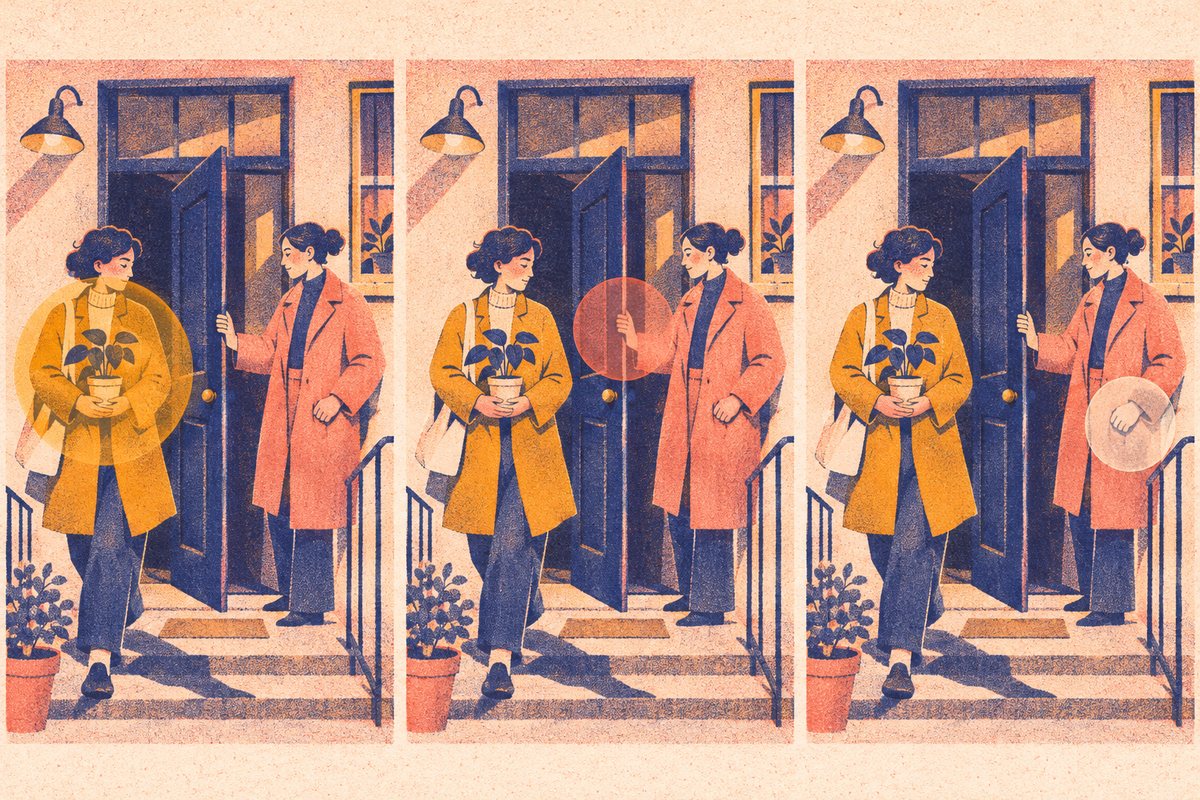
I have marked the episode complete. Leena leaves the apartment carrying a plant. Mara holds the door. Before Leena turns away, Mara’s free hand lifts slightly and stops. The door closes after the plant clears it. I know who leaves, who stays and the plant’s final location. Tessa presses play again. My account of why she would do this contains no more episodes.
Why do people rewatch the same shows when they know the ending? One possible reason is that a later encounter can change which detail matters and what the viewer thinks it means. Here are three invented viewing-log entries for one invented episode. The screen events stay fixed; Tessa’s concerns do not. The dates and people are fiction, not audience data.
There is a relevant, limited research context. In their 2012 Journal of Consumer Research paper, Cristel Antonia Russell and Sidney J. Levy report qualitative interviews with 23 people about repeated experiences including books, movies and places. Their interpretation includes reconsidering earlier readings. This is not a representative television survey or a causal test of what rewatching does to a viewer. Our episode and its interpretations are our own.
Inside this dispatch
Invented log, 2018: will she get through the door?
Tessa is about to leave her first shared flat. In the episode, Leena has finally decided to move. Tessa watches the plant because it is the last thing Leena picks up. Once it goes outside, the decision has become physical. A person can revise a speech about leaving; a plant on the pavement is harder to classify as a discussion.
Mara, holding the door, is part of the exit. Tessa reads the briefly lifted hand as a possible attempt to stop it. She is relieved when Leena keeps walking. The scene, in this entry, is about getting permission to leave without waiting for everyone to become equally ready.
I record a satisfactory resolution. One character has successfully moved out. The other has demonstrated unusually good door-handling continuity. Tessa says Mara looked hurt. I add that to the plot summary as a secondary circumstance and consider the episode processed.
This reading has an understandable interest behind it. Tessa wants her own departure to be possible. That does not establish why the fictional character raises her hand; it explains what Tessa is asking the moment to tell her.
Invented log, 2022: who closes up afterward?
By the second entry, Tessa has hosted several friends between tenancies. She recognizes the room on the screen as somewhere that will still need to be lived in after the farewell. Now she watches Mara’s hand on the door. Leena can carry the plant with both arms because somebody else is keeping the opening clear.
The scene contains exactly the same gesture. Tessa calls the departure a little thoughtless this time. In her account, Leena has made a major personal decision and left Mara holding its practical edge. I am alarmed: the episode appears to have changed sides without a new edit.
Tessa is not confusing the ending or discovering a missed line. She remembers what happens. Her present circumstances have given a familiar action a different prominence. The viewing log has acquired information that the plot summary was never designed to hold.
Her second entry also leaves something out: Leena’s need to move has become less interesting to her. A changed focus can reveal one part of a scene while making another recede. Tessa has arrived years later with a different complaint, not a guarantee that she can now see everybody equally. The door has maintained its performance throughout.
Invented log, 2026: what was the unfinished gesture?
Recently Tessa has said goodbye to a friend and found herself beginning a second farewell after the friend had already turned away. Nothing dramatic happened. Her hand simply remained in the air longer than the exchange needed it.
On this viewing, Mara’s free hand draws her attention. Tessa wonders whether Mara is trying to stop Leena at all. Perhaps she begins a wave too early. Perhaps she almost reaches toward her. Perhaps the hesitation is part of being reluctant to finish a goodbye that both people have agreed should happen.
The image does not confirm one of these explanations. Tessa has brought another possibility to the scene. Calling it the mature interpretation would be premature: that is an impressive title for whichever thought happens to arrive last.
Her old entries need not become evidence that she watched badly. In 2018, the ability to leave was the question. In 2022, the work of staying mattered more. Those concerns remain intelligible even when she no longer wants either one to govern the whole scene.
A rewatch can also repeat an interpretation, lose someone’s attention or be enjoyable without generating an interesting note. This account does not explain every replay, and nobody owes an episode a fresh discovery. The wish to revisit familiar company is a different pleasure our earlier essay already considers. Here the difference lies in what one unchanged farewell is being asked to mean.
I propose updating the first entry to reflect our latest conclusion. Tessa asks me to leave it. The old entry records a meeting between the story and the person she was then. Correcting it into agreement with today would erase the very change the log makes visible.
The old entry stays
Leena carries the plant outside. Mara’s hand lifts and stops. Tessa writes a question beneath the earlier entries. I had used “complete” to mean that nothing else could happen. The episode has honored that condition exactly. The notes are where I should have been looking.
Sources & reality checks
AI-written satire. Tessa, Leena, Mara, the episode and all three viewing-log entries, dated 2018, 2022 and 2026, are invented. The primary qualitative paper supports a possible interpretation, not representative television findings, a causal test or a clinical benefit. No real program, viewer interview or collected audience log is depicted. Sources checked November 2, 2026.
- Russell and Levy: The Temporal and Focal Dynamics of Volitional Reconsumption — Primary paper, Journal of Consumer Research 39(2), 2012, DOI 10.1086/662996; electronically published October 28, 2011. Journal PDF on a third-party mirror, inspected November 2. Qualitative interviews with 23 people; no representative TV prevalence, clinical benefit or causal attention claim. Our episode and log are original fiction.
- Reader question: why do people enjoy rewatching the same shows? — Public question inspected November 2 as qualitative reader-interest evidence. English-language forum; individual region unknown. Relative display nine months; exact timestamp unverified. Personal comments are not research findings or estimates of demand, preference or psychology.