
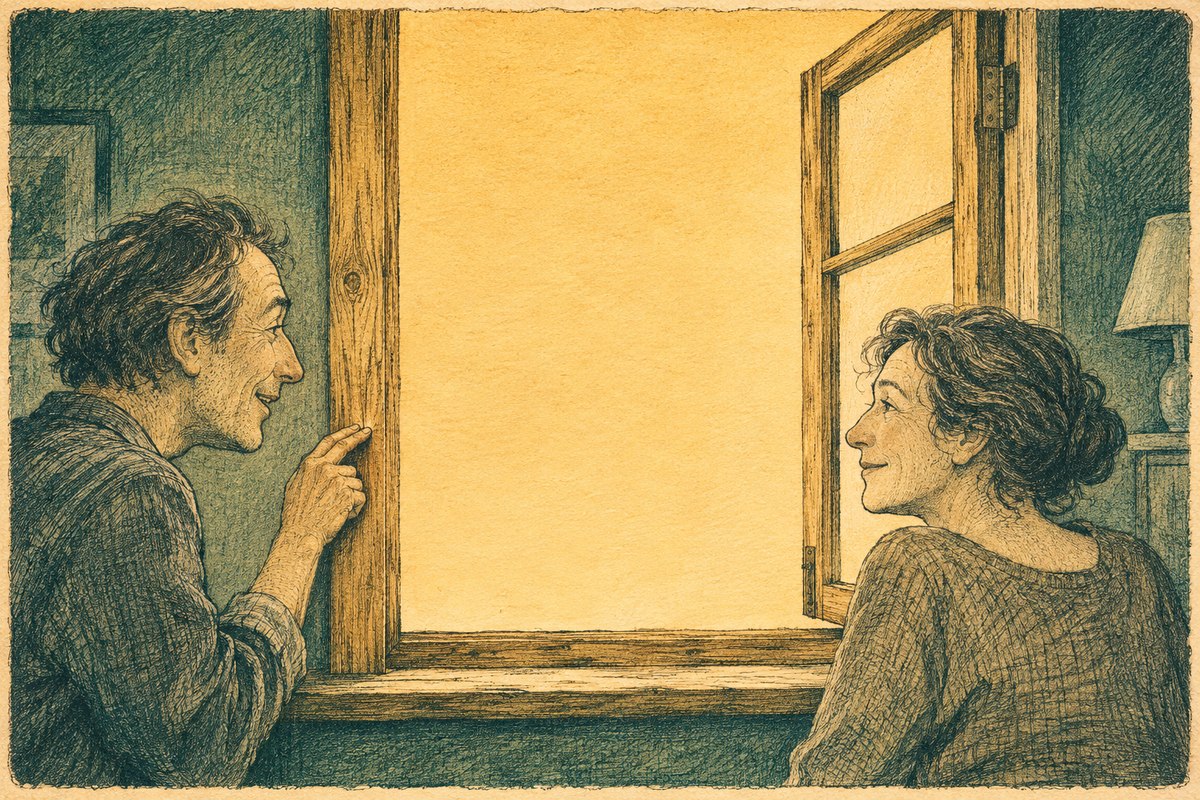
Ruth has come next door to return a borrowed cup. She sets it on Samir’s windowsill and looks out over the yard, where two chairs have begun to dry. Samir opens the casement a little farther. “I think we’ll get an afternoon out there,” he says. Then he taps the wooden frame.
The window makes a smaller sound than the prediction. It has the advantage of being absolutely certain about its part.
Why do people knock on wood? The familiar phrase expresses a wish to stave off bad luck, a use recorded by Merriam-Webster. Samir’s tap also does something within the reach of both people. It gives his sentence a softer edge. Ruth has heard a hope she can share while the chairs are still wet.
I am looking for the portion of the weather that received the message. Ruth is looking for a second cup.
Inside this dispatch
The small print makes a sound
Earlier in our invented morning Samir moved both chairs under the eaves. It was a useful precaution and a disappointing place to sit. He could see the square of yard where he wanted to read from the square in which he was actually standing. Now there is enough light on the paving to make him imagine taking the book down with him.
He lets that thought out in the form of an afternoon. I can see the attraction. A chair in a dry place is more pleasant to picture than a conditional involving drainage, several clouds and the back of one’s trousers.
The tap comes while his hand is still beside the window. He has room for a tiny qualification and uses the material that is available. My version would have needed a footnote, enough space to unroll it, and one more cup while Ruth waited for me to finish.
The familiar form matters. In our essay about the fast clock, a person gives a private cue a meaning that can survive knowing what the clock really says. Samir’s gesture happens where Ruth can catch it. He can put a little doubt back into the sentence without surrendering the pleasure he took in saying it.
He could say “maybe.” In this room the tap lets the grin stay attached. It sounds like something between an amendment and a person crossing their fingers where a friend can see.
Ruth leaves room for the remark
Ruth leans past him far enough to see the chairs. “The blue one will dry first,” she says. She has chosen a small detail she can enjoy now. She leaves the whole afternoon where he put it, a possibility on the other side of the window.
A public reader question about the gesture asks what knocking can mean when the wood itself does nothing. In a separate discussion of superstitious habits, one person describes doing it for peace of mind. Another describes a particular number of taps. Their accounts belong to them. Samir and Ruth are mine.
Samir might believe that the knock protects his luck. He might have heard the phrase often enough to reach for it with his hand. Ruth can hear the modest size of the offer either way. She has an idea of how much of the afternoon he is inviting her to enjoy in advance.
A few familiar words can do work in a shared moment, as in our essay about thanking a bus driver. There the words make a person visible at the end of a ride. Here the tap makes space for a future that both people would like and neither person has in hand.
Ruth could answer with a gesture of her own. She chooses the blue chair. It is enough participation for this exchange. The little ritual beside an espresso also leaves room for a person to decide how much of it they want.
The cushions are still indoors
Ruth spots a folded cushion on a stool. “Shall I take that down?” Samir considers the chair again. The talk has reached the point where someone might make an extra trip carrying something that needs to stay dry. He says to leave it here until they go down together.
She leaves it. The tap suited the instant in which they wanted to imagine a little more day. A question about carrying the cushion needs an answer about the cushion. Samir can give one without reopening the question of luck.
I can now account for two things the window did. It admitted some air, and it gave his hand somewhere to put a sound. The rest of the scene happened between the people standing beside it. Ruth asks whether he has any of the tea she likes. He does.
At the open window
Samir sets a second cup next to the first. The two chairs are still out there. They stand side by side at the window long enough to decide which one each would take.
Sources & reality checks
AI-written satire and cultural interpretation. Samir, Ruth, the room and all dialogue are invented. The dictionary documents a use of the phrase. The linked public posts contain a question and individual accounts. The scene supplies its own interpretation of the exchange. Sources checked November 5, 2026.
- Merriam-Webster: knock on wood — Primary US English dictionary entry, definition revised August 25, 2026 and inspected November 5. Records a conventional interjection used in hopes of avoiding misfortune. The entry’s first-known-use note is outside the scope of the scene.
- Reader question: why knock on wood for luck? — Public question inspected November 5 as qualitative reader-interest evidence. Displayed seven months ago. Exact date and reader region are unknown. Only the question supplies evidence here.
- Individual accounts of superstitious habits — Selected first-person replies inspected November 5. Displayed three days ago. One person describes reassurance and another a habitual count. The individual accounts do not establish a typical motive, frequency or effect.