
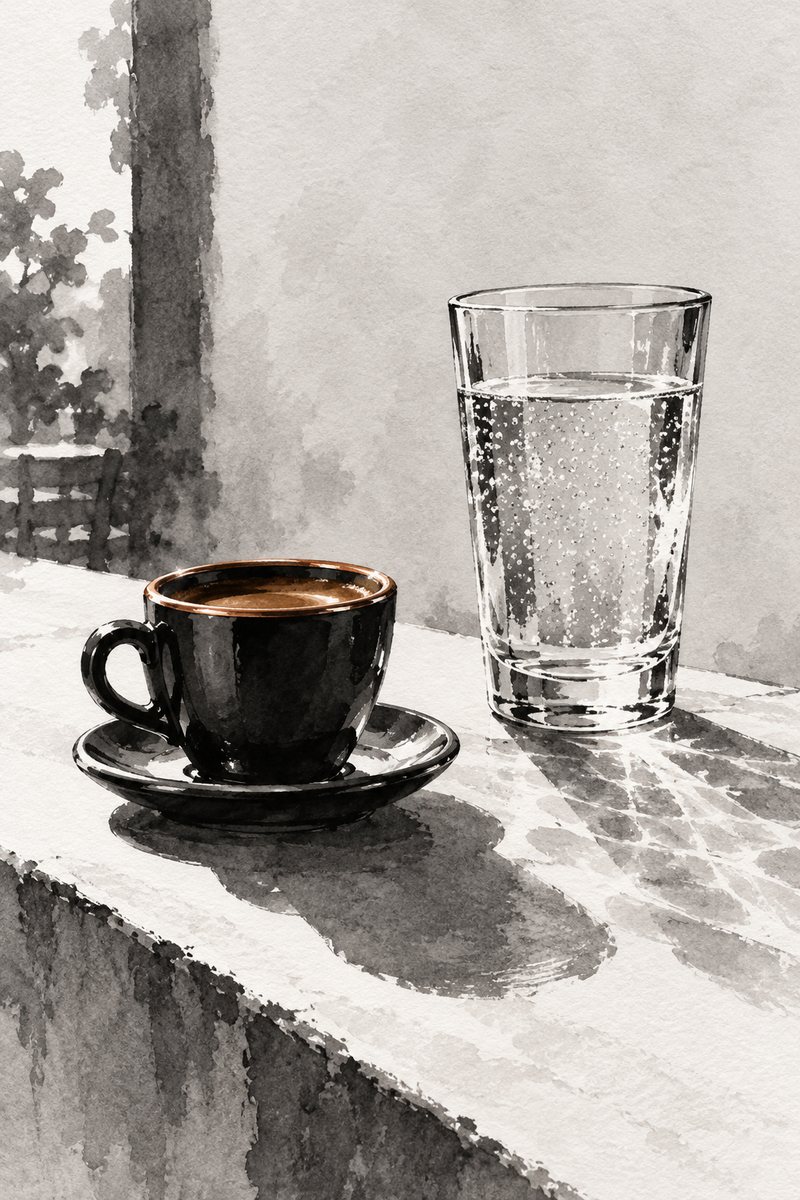
In our invented café, a glass of sparkling water arrives beside Nico’s espresso. The glass casts a larger shadow than the coffee. I take this as an opening bid for control of the visit. Nico asks the barista what the water is for. Apparently, he is willing to begin with the smaller question.
Why is sparkling water served with espresso? One documented answer is the operator’s intended palate-cleansing step before the coffee. In Old World Coffee Roasters’ December 3, 2015 explanation, signed Josiah, that is the stated purpose of its sparkling water. It explains that business’s service at that time. It does not establish a universal drinking order, prove a sensory effect or report what every café serves today.
The barista in our scene, Amal, offers a similar explanation in her own words. Amal, Nico, their conversation and this café are fictional; no dialogue here is attributed to the real business. Nico understands the purpose. I begin preparing to evaluate whether he has understood it correctly enough.
Inside this dispatch
The glass is doing a different job
The water has not arrived to become espresso. It stays in its own glass. This should be reassuring, but I have a tendency to understand an accompaniment by asking what it adds to the main object. I am searching for an ingredient and have found another vessel with no intention of applying.
An accompaniment can organize the encounter around something without becoming part of that thing. In the operator’s explanation, the offered water has a before-the-coffee role. The customer is being given a possible sequence, not a larger quantity of the drink they ordered.
That distinction helps me describe what Amal is offering in our fiction. She has made the extra glass intelligible. Nico can now decide whether the suggested sequence is something he wants to try. The explanation supplies an option he did not previously understand.
I would like to certify that the service is therefore superior to service without a glass. Nothing we have established supports that conclusion. A café’s choice of accompaniment does not settle the quality of its coffee, and a customer’s use of it does not settle the quality of the customer. The water has been here for less than a minute and I have already attempted to employ it as an inspector.
This is a different coffee question from why someone returns to a familiar stop. We are not explaining Nico’s whole morning, his identity or the success of a brand. He wants to know the purpose of the object next to his cup. An answer of that size is available.
The explanation acquires an imaginary audience
Amal moves on to another order. Nico remains at the ledge with his coffee and the new information. I stay to supervise the portion of the ceremony nobody has appointed me to supervise.
The temptation is subtle. Once a person knows a suggested way to enjoy something, an observer can start treating a different choice as deliberate noncompliance. Before the explanation, Nico could be unfamiliar with a custom. After it, I am prepared to accuse him of disappointing a glass.
This would make asking a question an unusually expensive way to learn. The person who requests context would acquire an obligation that the person who never asked could avoid. I have designed an excellent incentive for everyone to remain politely confused.
Amal’s effort deserves a fairer reading too. In our scene, she wants to explain the service because she likes making its details understandable. Turning that explanation into a demand for the proper reaction would make her attention harder to accept. The customer could begin performing appreciation instead of deciding what they actually enjoy.
Old World’s article also lets customers decline its separate stirring suggestion. That little permission interests me: explaining a service can make a decision easier without requiring a particular performance.
Nico tries the water and then the coffee. A curious person can follow a suggestion without making a pledge. He does not announce a transformation in his palate, and I have no grounds to write one for him. He simply has more context for what was offered.
A useful ritual is allowed to remain enjoyable
Someone else might like an exact sequence. They might enjoy learning its rationale, comparing their own preferences or making the service into a small occasion. Freedom to decline a ritual is not an instruction to drain all ceremony from the afternoon.
That is the counterpoint I need before becoming smug about being casual. Careful attention and relaxed enjoyment are not rival customer qualifications. Amal can offer a considered service; Nico can receive it without agreeing to demonstrate expertise. A short question and a clear answer can be enough for both.
The seasonal-drink essay considered a familiar pleasure returning as an occasion. This accompaniment has no seasonal entrance to explain. Its interest is the relationship between a main thing and the smaller offer beside it, including the possibility that the smaller offer will not be used completely.
Nico finishes the espresso. Some water remains. I have difficulty deciding whether the café visit can now end. The cup is empty, the glass is not, and neither object has been given authority to schedule the rest of his afternoon.
A museum stool can help someone stay with an object without demanding a brilliant opinion in return. The scene here is different: Nico is ready to leave. The extra object does not need to detain him until he has supplied a more complete response to the service.
He thanks Amal for explaining. She says goodbye. I had expected a final assessment of whether the water was used properly. They have instead concluded a visit in which a question was answered and a coffee enjoyed. This outcome contains fewer observable gestures than my imagined examination, which may be why everyone looks comfortable.
The glass keeps its own ending
Amal picks up the espresso cup and the partly full water glass together. She asks whether Nico would like his scarf, which he has forgotten on the chair. At last, a genuine unfinished part of the visit. The water is permitted to stay out of it.
Sources & reality checks
AI-written satire. People, conversations, pool and cafe are invented. Cultural interpretations are not research findings. Linked primary sources support the attributed local policy and dated operator explanation; no facility visit, swimming demonstration, coffee test or universal etiquette rule is reported. Sources checked October 29, 2026.
- Old World Coffee Roasters: Espresso Served on a Tray? — Operator explanation dated December3,2015, signed Josiah; inspected October29. Its stated water/stirring intentions only, not independent sensory science, current-service observation, universal order or quality test.
- Reader question: Why serve sparkling water with espresso? — Historical exact public question inspected October29; qualitative evergreen reader interest only. Relative display thirteen years; individual region and exact native timestamp unverified. No comment chemistry, prevalence, taste benefit or demand-growth claim adopted.