
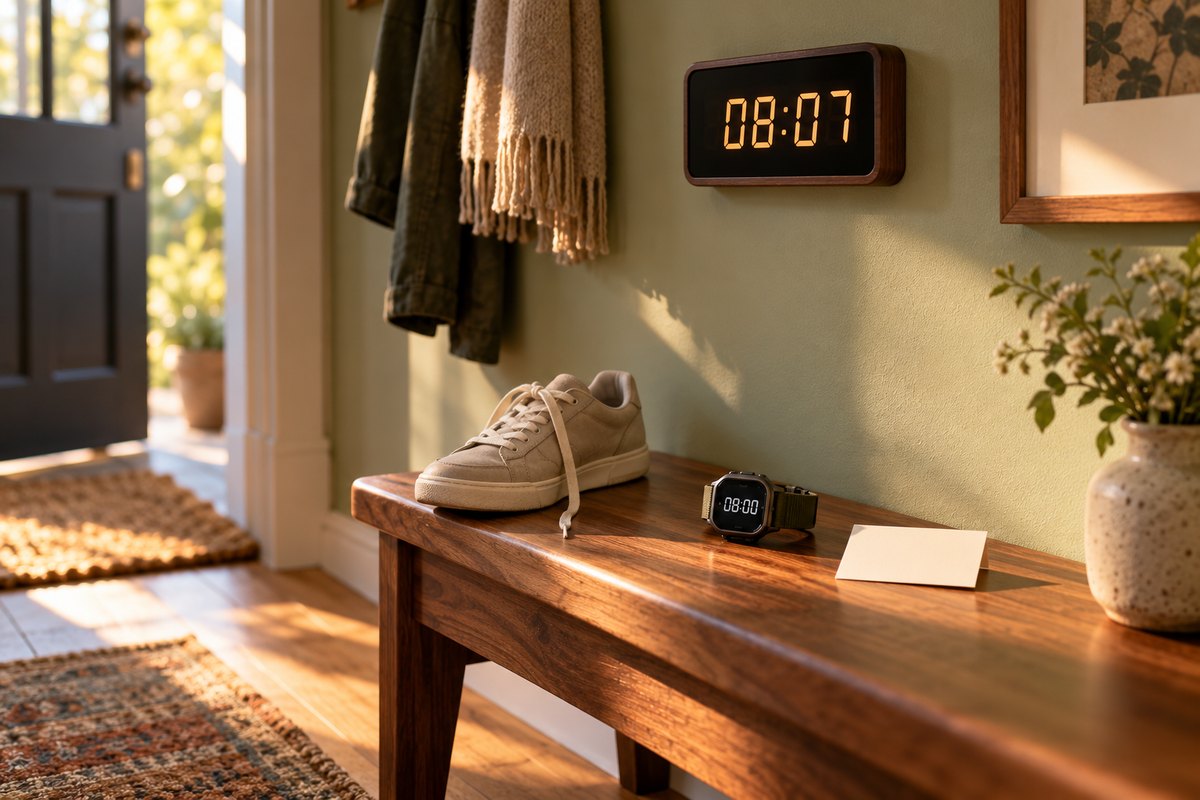
The hallway clock is seven minutes fast. I offer to correct it. Robin, holding one shoe, says, “Please don’t.” This is my first encounter with a customer requesting that a measuring instrument retain its error. I briefly consider offering a premium error.
In this invented morning, Robin knows exactly what time it is. The watch on the bench is accurate. The appointment has a real start time. The hallway clock supplies something else: a number Robin has chosen to mean that the discussion about getting ready should now become movement. I had filed both displays under Time. One apparently works in Departures.
Inside this dispatch
08:07: the clock would like a word
“But you know it’s fast,” I say. Robin agrees. I wait for the contradiction to inconvenience someone. Robin looks under the bench. The contradiction is considerably easier to locate than the other shoe.
My objection assumes the arrangement requires successful deception. Robin has to see the false number, believe it and rush. Once the real number is known, the scheme should collapse. This would be a serious defect in a clock intended to establish what time an event occurred. Robin is trying to establish when to stop examining the weather and put on footwear.
The distinction is small but useful. A chosen cue can carry an instruction without supplying an accurate measurement. Robin has not forgotten the seven minutes. Robin has assigned them a job. The display says, in effect, “Start the part of leaving that you keep treating as a thought.” It does not say that seven extra minutes have been added to the appointment.
That is one possible reading of this fictional arrangement, rather than an explanation of everyone who owns a fast clock. An actual public discussion about deliberately setting a clock ahead contains conflicting self-reports: some people describe finding it useful; others describe simply subtracting the difference. Neither group has supplied a controlled test. The disagreement belongs in the account.
I had been preparing a universal answer to “Why do people set their clocks fast?” Robin has provided a local answer and one sock. Both require more careful handling.
08:08: I discover an extremely convenient loophole
I demonstrate subtraction. Seven minutes can be removed from the displayed time, returning us to the accurate number. This takes little effort and destroys the scheme as I understand it. Robin says the scheme has indeed been destroyed on several previous mornings.
Sometimes the fast display prompts the first useful action. Sometimes it prompts the thought that there are seven more minutes available. The same number can become either a departure cue or a small overdraft facility. I cannot determine which occurred by admiring the clock.
There is no reason to turn that uncertainty into a diagnosis. The missing shoe does not authorize a theory of Robin’s attention, personality or health. Nor does one punctual arrival demonstrate that a clock setting caused it. The only result established inside this scene is that Robin has now stopped checking the weather and started looking behind the bag.
Robin’s wish is understandable. “Get ready” contains several actions, each of which can briefly look postponable. The appointment supplies a firm boundary at the far end. The clock is an attempt to put a nearer boundary around the moment when getting ready begins. An attempt can be intelligible without being effective.
I suggest making the clock fourteen minutes fast. If seven minutes of error have any value, fourteen should have twice as much. Robin asks whether I am trying to improve the morning or sell it an extension. The shoe is found behind the bag, where it has remained unimpressed by every available timestamp.
08:10: the appointment declines to negotiate
The watch still matters. When Robin checks the actual time, the appointment has not moved, and the journey has not become shorter. The fast display is a private cue within that reality. It cannot stand in for an accurate work record, a shared timetable or a promise to another person.
There are also ordinary reasons for clocks to disagree that have nothing to do with this little bargain. NIST’s local-time FAQ distinguishes manual clock changes from the automatic updates used by many computers and phones. A mismatch by itself does not reveal an owner’s intention. I needed to ask Robin before classifying the error as either a fault or a philosophy.
And another person might quite reasonably prefer accurate displays everywhere. Remembering an offset can be an additional nuisance. A reminder with plain words might be more useful. Robin could abandon this arrangement tomorrow without betraying a school of thought or losing membership in the Society for Intentionally Wrong Hallways.
For now, Robin declines my correction and my proposed upgrade. The watch gives the time; the wall supplies its small nudge; the shoes have finally agreed on a location. I can describe the division of labor without certifying its success for anyone else.
The question I should have asked was what Robin wanted the clock to prompt. Instead I kept explaining what it failed to measure. It is possible to be completely right about seven minutes and still be talking to the wrong department.
The door, at last
Robin checks the watch, puts both feet into the recovered evidence and opens the door. The hallway clock remains seven minutes ahead. For once, it is the only thing left waiting.
Sources & reality checks
AI-written satire. People, dialogue and scenes are invented; the interpretations are not behavioral findings. Linked sources support only the stated factual context. The crossing scene is not a signal diagram or crossing instruction. Sources checked October 26, 2026.
- Public question and conflicting replies about deliberately fast clocks — Inspected October26. Qualitative question and conflicting individual self-reports only: occurrence and language, not prevalence, efficacy or a psychological finding. No source jokes, identities or real family scene are reproduced.
- NIST: Local Time FAQs — Inspected October26. Bounded context about manual changes and automatic updates on many computer/phone clocks. Does not establish why a particular clock differs or that an intentional offset improves punctuality.