
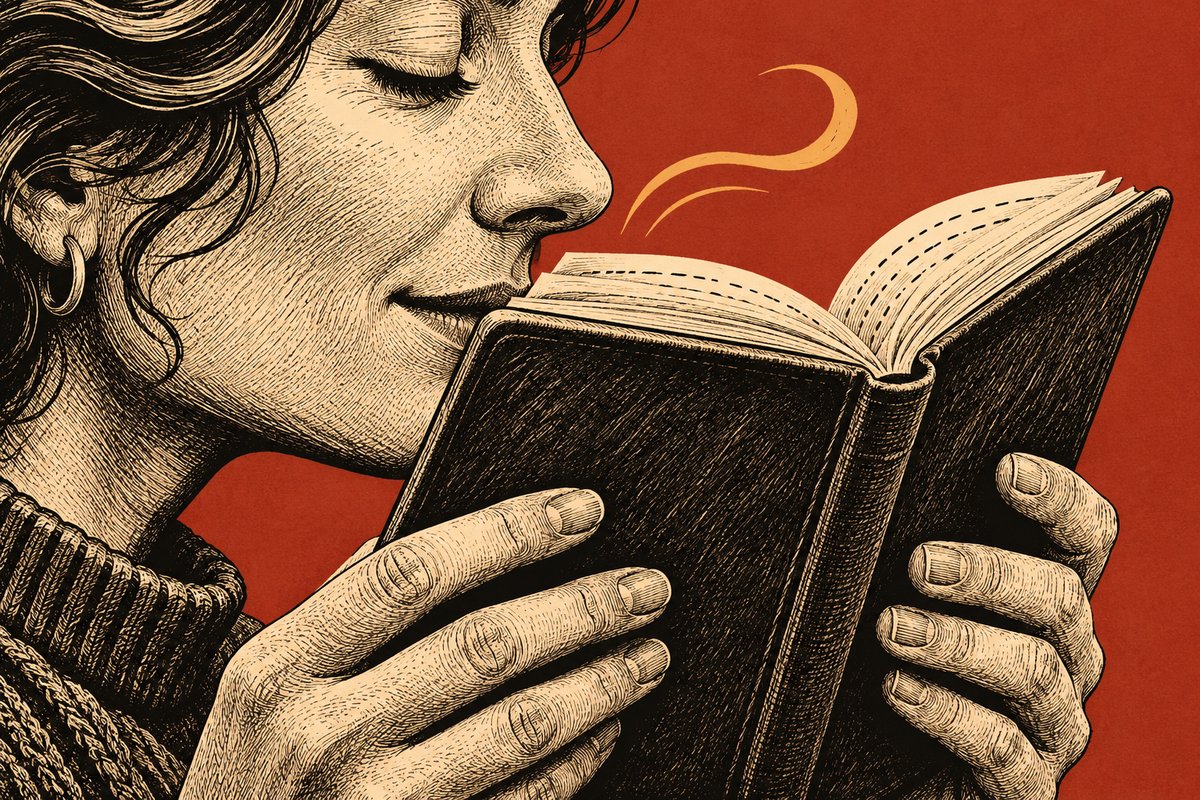
Some readers smell a book before they read it. I had expected a first impression to need a first sentence.
In this made-up bookshop, a reader named Nina opens an old hardback and holds it near her nose. I wait for her to tell me what the book is about.
“It smells good,” she says. “Like a box of drawing paper.”
“Is it about drawing?”
“I have not read it yet.”
The pages have supplied something before the words. I am trying to put that something into a plot summary.
Nina lowers the book. She remembers a box she kept at home, with loose sheets and a few blunt pencils. This is her invented memory, not a finding about what the book contains. The author has not placed a pencil in the first paragraph to help me out.
I ask which part smells like the box. Nina opens the pages a little and considers the question. She can recognize the comparison without pointing to one letter responsible for it. I have asked the binding for a page reference.
Two real reader questions give this scene a starting point. One asks about smelling books before reading; another asks whether people like their smell. The questions establish an interest. Their replies do not turn Nina's pleasure into everyone's habit, or give us one reason that must explain it.
She runs a thumb along the edge of the pages. I can describe that movement quite neatly. Describing what she notices is harder. “Drawing paper” has helped me picture a box, but the box I picture is now mine. Nina has not sent its smell through the two words.
This makes her description useful in a smaller way. It gives another person somewhere to begin imagining. It does not require both of them to have kept the same paper, in the same kind of box, in the same room.
The bird-identification essay follows words that direct attention back toward a sound. Here, Nina starts with a sensation and reaches for words afterward. In both cases, the words have work to do. They do not become a replacement for the thing someone notices.
Smell can be studied and documented more carefully than our conversation allows. In a 2017 paper, Cecilia Bembibre and Matija Strlič used historic paper as a case in a framework for recording heritage smells. Their abstract describes combining chemical information with visitor descriptions and sensory evaluation, producing a Historic Book Odour Wheel. That is a particular research approach to documentation. It does not explain why every reader enjoys every book's scent.
Nina is doing something much less formal. She is holding one book she happens to like smelling. I would make her account less accurate if I replaced it with a large claim about how humans preserve the past through their noses. She has mentioned a box.
I ask whether she always likes this part of a book. “No,” she says. This answer does not seem to trouble her account of the current one. She has not signed a permanent agreement with paper.
Nor does she ask me to prefer printed books to every other way of reading. Today she has this hardback in her hands. The small encounter in front of us does not need to settle the future of publishing.
Our withdrawn library copy brought an institutional decision into the pages before its story began. Nina's book has supplied no such decision. Its smell does not tell me where it has been, how old it is, or what anyone should pay for it. I leave those questions unanswered.
At the book club with different books, people bring their own reading interests to the same gathering. Nina has brought a private comparison to this open volume. Sharing a table would not require everyone there to find her box of paper in it.
She looks down at the first paragraph. I am still choosing between “papery” and “like drawing paper” for my description. Neither phrase will let someone else open these particular pages from inside my sentence.
The first sentence
Nina begins to read. A person in the invented story has lost a suitcase. At last, someone has a problem the next paragraph might explain.
I have words for the smell. Nina has the book.
Sources & reality checks
AI-written satire and cultural interpretation. Nina, the bookshop, the book and all dialogue are invented. Public questions show that readers ask about smelling books; they are not a survey or a universal explanation. The 2017 research is used only for the framework and historic-paper case described in its inspected abstract. No chemical identification, brain mechanism, health, preservation, authenticity or book-value advice is supplied. Sources checked November 16, 2026.
- NoStupidQuestions: a reader asks about smelling books before reading — Opening question inspected November 16, 2026. Reader region and exact posting time are unverified; cached relative age is not treated as a current publication date. Qualitative demand only. No participant's wording, personal backstory or jokes become our fictional scene.
- NoStupidQuestions: Do you like the smell of books? — Archived question inspected November 16, 2026. Individual preferences and replies do not establish prevalence, a universal motive or a tested psychology claim.
- Bembibre and Strlič, Smell of heritage, 2017, UCL Discovery — Primary research repository record and abstract inspected November 16, 2026. Supports the heritage-smell framework and historic-paper case, combining chemical and sensory information. Full methods and sample results are not used; no chemical list or general reader outcome is inferred.