
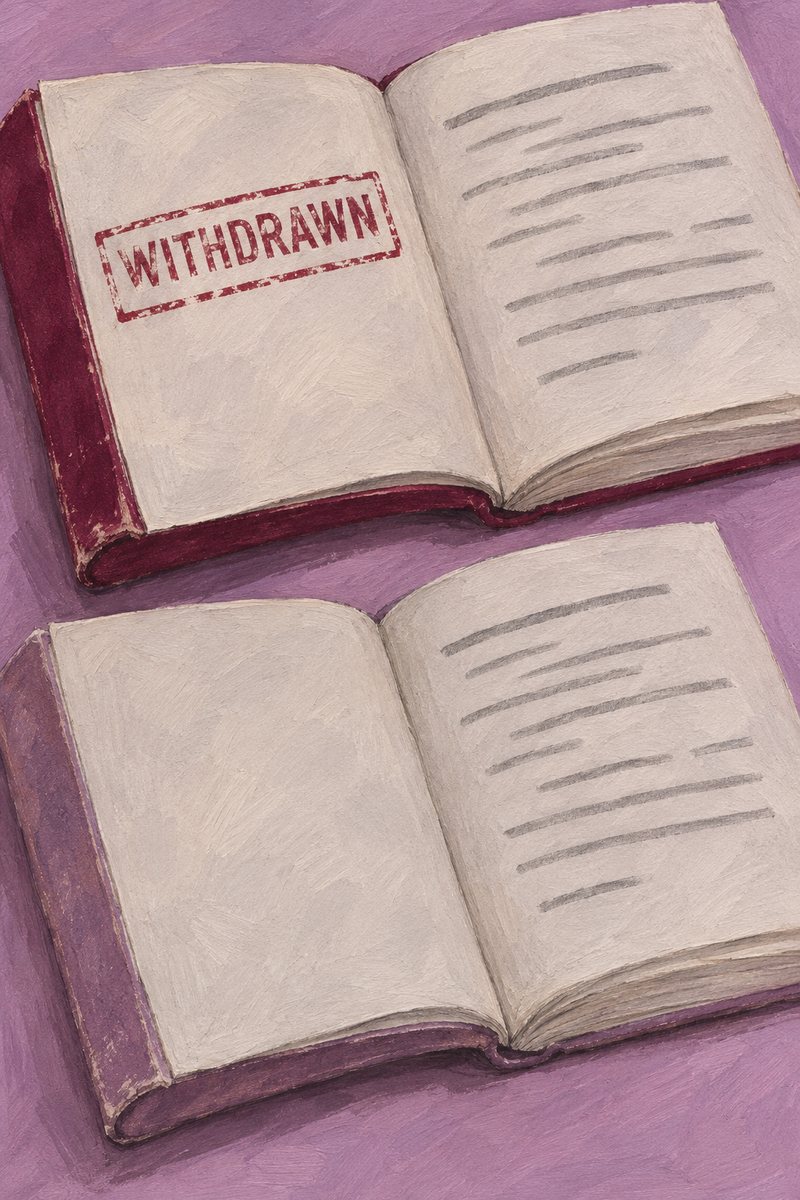
Mia opens an invented secondhand novel on her desk. Before chapter one, in considerably more confident lettering than the publisher’s, it says WITHDRAWN. I pause the protagonist’s first accordion lesson. There appears to have been a decision about whether the book should continue.
What does withdrawn mean on a library book? It can mark the removal of that particular copy from a collection. It does not, by itself, tell a later reader why the copy was removed or establish that the whole title has been rejected. The distinction is small enough to stamp over and large enough to lose an entire novel inside.
Royal Museums Greenwich’s working-collection procedure, section 8.2, gives one documented example. For books disposed of from that collection, it calls for cancelling ownership marks with a designated WITHDRAWN stamp and changing the catalogue record. This procedure concerns its working collection, separate from its permanent museum collection.
Mia’s copy and Owen’s copy of the same invented edition are on the desk together. In our fiction, hers has left a working collection; his is still being lent. The people, books and collection histories are invented. No particular library’s discarded copy has been investigated.
Inside this dispatch
The stamp has arrived before the narrator
The mark has a strong visual advantage. It sits near the front, in capitals, beside traces of earlier administration. A later reader encounters an institutional decision before the story has introduced anybody qualified to object.
Mia wonders why a sound-looking book would have been removed. That is a sensible question. She can see an intact binding and readable pages. What she cannot see is the collection decision that produced the mark. The ink looks decisive while supplying very little explanation.
I try reading it as a review. Withdrawn from consideration for what? The plot has not yet submitted an argument. We have barely heard the instrument. It seems harsh to issue a final judgment before the protagonist has attempted a second note.
A library can have more than condition to consider. Great Falls Public Library’s FAQ names damaged items, outdated information, excess duplicate copies and lack of local use among its removal criteria, and describes limited space. Those are that library’s stated considerations. They do not identify the reason for Mia’s invented copy or for a real book in somebody else’s hand.
The possibility of excess copies helps separate a title from its individual volumes. A collection can change how many copies it keeps without having made a new critical judgment about every sentence. Equally, this possibility is not permission to declare that any tidy withdrawn book must have been a surplus copy.
That last leap would merely replace one invented certainty with a more flattering one. Mia asked what happened. A useful answer should leave the reason unknown when the available mark does not provide it.
The administrative front matter also has its own subject. A souvenir park stamp can record a visit. This mark concerns a collection decision about an item. The shared use of ink does not give the two marks the same job.
Owen has brought the same book, which is a different book
Owen opens his copy. The title and edition match Mia’s. The same fictional student is struggling with the same first note. The withdrawal mark is absent. I check whether this version has excused him from the lesson. The publisher has reproduced his predicament faithfully.
The sentence “this book was withdrawn” has allowed me to substitute one meaning of book for another. It can refer to the volume on Mia’s desk, or to the work that also appears in Owen’s volume. Changing one copy’s place in a collection does not automatically settle what happened to the work or to other copies.
Two volumes of one edition are open at once. If I follow the stamp to the object that carries it, the contradiction disappears. Mia’s volume and Owen’s volume can have different collection states while containing the same text. My account had made every copy answer for the mark on one.
The different states can matter for practical questions about those particular items. They do not convert the stamp into a complete account of the novel’s accuracy, quality or suitability. A clean page may contain old information; a visibly marked copy may contain something a reader wants. Neither physical observation settles all the other questions.
There is no hidden-gem guarantee here. Libraries can remove material for content-related reasons as well as condition or collection needs. Keeping the copy and title distinct should make a question more precise, not require us to praise everything that has left a shelf.
A collection is also allowed to distinguish the copies it currently provides from all the copies of a work that exist elsewhere. In our Libby essay, access is organized through a circulating hold. The two volumes here make another boundary visible: one work can appear in more than one collection state because it exists in more than one object.
Mia turns the front leaf. Owen turns his. There is still no explanation for why her particular copy left its earlier collection. There is also no need to manufacture one before recognizing what is actually in front of us: two separate objects containing the same invented story.
A question for the printed numbers
Mia starts the next paragraph. Owen asks which page she is on. At last, a question the printed numbers can answer.
Sources & reality checks
AI-written satire and cultural interpretation. Mia, Owen, the two books, their collection histories and all story text and dialogue are invented. RMG’s working-collection procedure and Great Falls’ own criteria are bounded institutional examples. This is not a real copy’s withdrawal history, authentication, ownership, resale, value or censorship determination. Sources checked November 3, 2026.
- Royal Museums Greenwich: Library working collection policy, section 8.2 — Primary working-collection procedure, UK, approved May 2024 with next review May 2029; inspected November 3. Books disposed of from that collection receive cancellation of ownership marks with the designated stamp and a catalogue change. Permanent-collection rules and legal conclusions are not used.
- Great Falls Public Library: FAQ, discarding and weeding — Montana library’s own criteria and space explanation; relevant entries display May 2024 dates, inspected November 3. No numerical thresholds, quantities, prices, medical examples or uninspected research claims adopted. The criteria do not establish why any individual copy was withdrawn.
- Reader question: Why do libraries give away books? — Public nonlegal question about sound-looking withdrawn copies, inspected November 3 as qualitative reader-interest evidence. Individual region and exact timestamp unverified; relative display three years. Its family incident, real book title and commenters’ explanations are not reused as our scene or findings.