
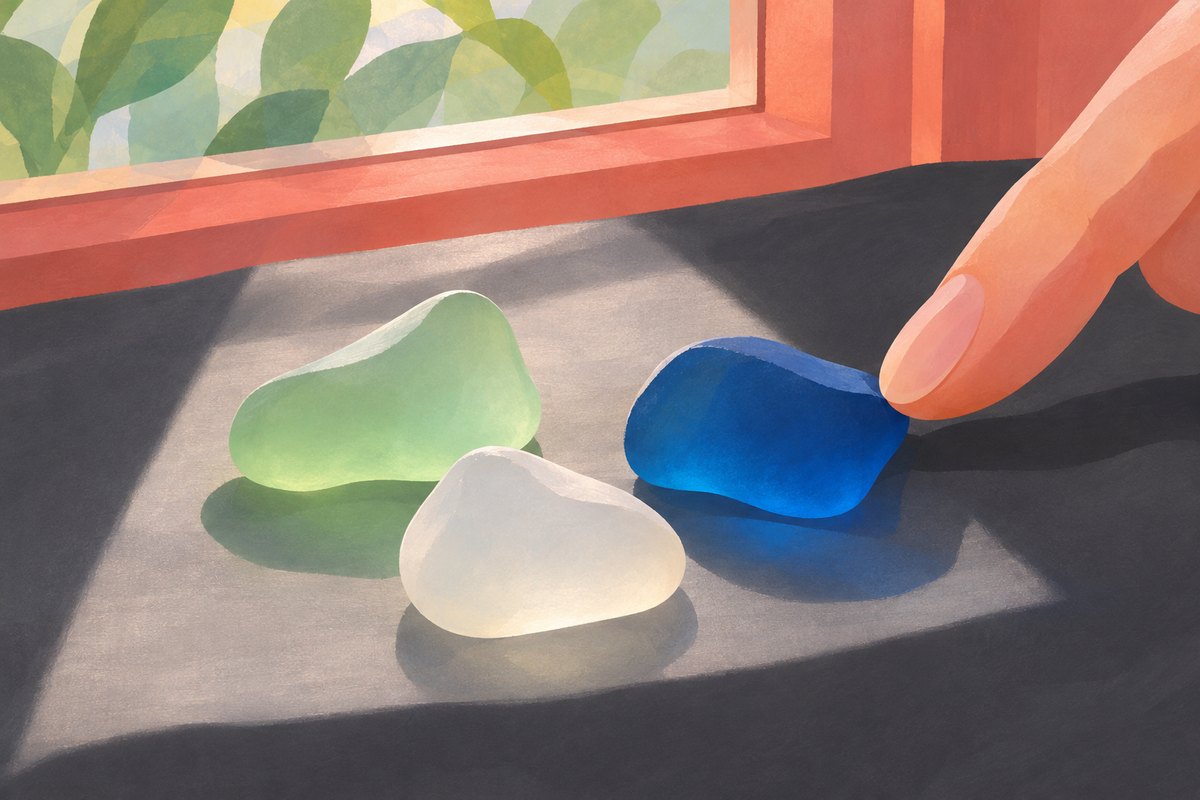
People collect sea glass and keep the worn pieces to look at. In the scene below, the same blue piece is having a very busy afternoon.
In this made-up scene, Tess shows her friend Rob three pieces: white, green and blue. They sit on dark cloth by a window. She moves the blue one to the left. Then she moves it back.
“Which is your best one?” Rob asks.
Tess lifts the white piece. By itself it looks plain. She puts it beside the green. “Look at these two.”
Rob leans closer. I had been ready to record his choice. The glass has stayed the same, but the question has changed.
There is a physical story behind the worn surface. NOAA’s Marine Debris Program says glass left in the environment for a long time may become weathered, with smoother edges and a frosty look. It gives sea glass as an example. That description does not identify the past of any piece on this fictional cloth.
Rob points at the blue. It is the one his eye went to first. Tess nods. She likes that one too. He looks pleased to have supplied a useful answer to his own question.
Then she moves the white piece away from the green and puts the blue beside it. Rob watches her hand. He is waiting for the display to settle so he can look at it. Moving it is part of how she looks.
“Was it wrong over there?” he asks.
“No. I wanted to see it here.”
I count three pieces before the move and three after it. No new purchase, find or trade explains why she has leaned in again. The new thing is the gap between two colours. It has no separate place in my list of objects.
Tess slides the green closer to the window. Light catches one edge. Rob shifts his chair to see what she is pointing at. A moment ago, “best” would have let him finish the visit to the collection in one word. Now he has to move his whole chair.
This is a modest demand on a guest. He need not learn a price guide or pretend to know the history of a bottle. She has given him a place to look. He can say what he sees there, even if the answer is that he still likes the blue.
He does still like the blue. Tess leaves it where it is for a moment. She has invited his eyes into the room; she has not asked them to become hers.
A collection can be easy to describe from the outside: three pieces, three colours, one cloth. That list misses what Tess is doing with it. She is finding small differences between things she already has. The pleasure in this scene does not depend on bringing home a fourth piece.
That will not explain every collector. Someone else might care most about a find, its history, a full set or a particular colour. Rob might enjoy one blue piece on his own shelf and leave it exactly where he put it. I have no cause to assign him a more elaborate afternoon.
Tess asks him to hold the white piece near the green. He holds it above the cloth. “Here?”
“A bit lower.”
He lowers it. Both of them look. The blue stays put, briefly relieved of its duties as the answer to every question.
I could keep a record of each position. It would be quite accurate and very little like being here. Rob’s hand is still in the air. Tess is showing him the edge she means. They have found something to look at together without needing to agree on a winner.
Room for the blue one
Rob sets the white piece down. “I like it there.”
Tess sits back beside him. For a while, no one moves anything.
Then the blue piece goes to the left again. This time Rob makes room.
Sources & reality checks
AI-written satire. Tess, Rob, their collection and all dialogue are invented. The linked NOAA page supports the brief description of weathered glass. The scene offers one imagined reason to enjoy a collection, not a finding about all collectors. It gives no claim about a piece’s age, origin, rarity or value, and no advice about where to collect. Sources checked November 20, 2026.
- NOAA Marine Debris Program, Glass Fragments — Primary monitoring reference inspected November20,2026. Describes weathering, possibly smoother edges and frosty appearance. No exact age or origin of a particular piece can be inferred from our fictional scene.
- Reader question: New England sea glass — Opening question inspected November20,2026. A newcomer asks about sea glass and why collecting is a tradition. The page displays three years ago; exact date and the reader’s location are unverified. Qualitative demand evidence only; replies are not factual authorities.
- Collector discussion: I have a problem — Opening discussion inspected November20,2026. Asks other collectors about arranging and displaying finds. The page displays one year ago; exact date and location are unverified. Supports interest in the subject, not claims about prevalence, health, rarity or psychology.