
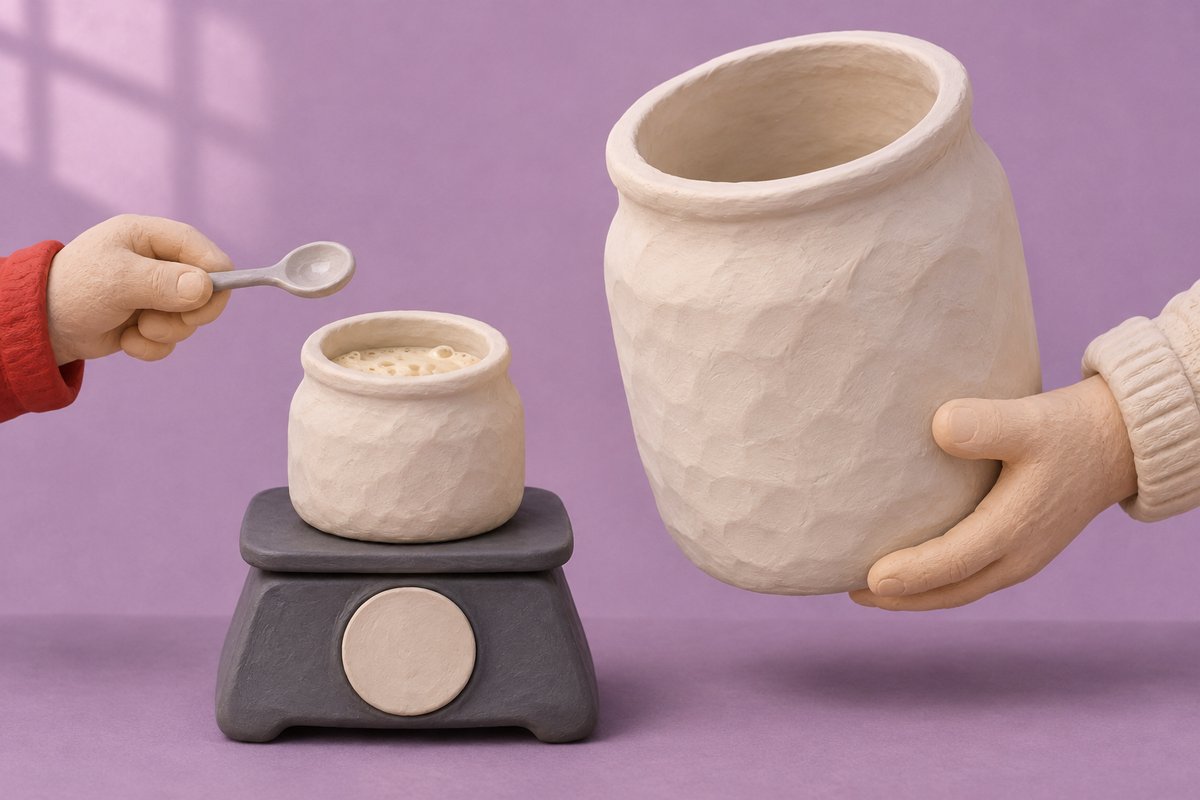
Some bakers take part of their bread starter out before they feed the rest. My first offer of help would have been a bigger jar.
Starter is a mix of flour and water, yeast and bacteria. Bakers use it to help bread rise. The part taken out is called discard. In the routine here, keeping less means less to feed.
In this made-up scene, Jo is the cook. Her friend Cal offers a bigger jar. She asks for a smaller spoon.
Cal holds the jar with both hands. It is a serious offer of room. There is space in it for the starter Jo has, the food she will add, and a generous amount of confidence that this is the right object to be holding.
“You could put it all in here,” he says.
Jo looks up from the scale. “I don't want to keep all of it in the next feed.”
He has solved the problem of where the mixture could go. She is deciding how much mixture she wants to maintain. From across the counter, both tasks look like doing something about a jar.
The quantity problem appears in King Arthur Baking's starter guide. In its described routine, keeping an ever-larger amount means adding more flour and water to feed it. Its discard explainer names the removed portion and distinguishes removing it from throwing it away. That word alone does not tell you what to do with a particular batch.
Cal puts his empty jar on the scale. It has the air of a very good answer waiting for a different question.
“I thought you were running out of space,” he says.
“I'm choosing how much to feed,” Jo says. She points to the small jar, then to the spoon she wants. Her explanation has somewhere to land now. Cal can see both things at once.
I find his first offer quite reasonable. The larger jar is clean, available and plainly capable of holding more. He has carried it all the way to the counter and would quite like it to become useful.
Jo is explaining the amount she intends to keep in this routine. She could choose more for another plan. At this counter, though, her plan is already small. Cal can help with it once he knows that.
“So I could use this,” she says, touching the large jar. “But I would still be choosing a small amount to feed.”
Cal looks inside it. The jar is losing none of its capacity during this discussion. It is simply becoming less relevant to the task.
The distinction takes a moment because his help is already here. It has a broad base and a lid. Jo's choice is harder to point at: it concerns the portion that will stay in the routine. A shelf full of larger jars would not choose that portion for her.
“And discard means the part you take out?” Cal asks.
Jo says yes. He had heard the word as an instruction about a bin. Here it names the part outside the feed. They have reached the same counter by two routes: he saw somewhere to put everything; she saw something she wanted to keep small.
The scale sits between them. It is not impressed by either explanation. Jo moves the empty jar off its platform so she can use it for what she meant to weigh.
I had been admiring how neatly Cal's jar would accommodate more. Jo has given me another thing to notice: she has already decided what she is trying to continue. An empty space is an offer, not a reason to fill it.
Cal asks where the smaller spoon is. Jo points to the drawer beside him. He opens it, finds the spoon, and checks with her before lifting it out. This help requires much less carrying.
The big jar stays on the counter. It could be useful for another task. Neither friend needs to invent that task while Jo is in the middle of this one.
The right thing to pass
Cal holds up the small spoon. “This one?”
Jo reaches for it.
He passes it across the counter. For the first time since he arrived with the large jar, his hands are empty.
Sources & reality checks
AI-written satire. Jo, Cal, the kitchen and all dialogue are invented. The quantity explanation comes from the linked King Arthur Baking routine; other methods vary. This scene explains a maintenance choice and the word discard. The linked guides provide baking instructions. Sources checked November 19, 2026.
- Rossi Anastopoulo, What is sourdough discard? And what should I do with it? — King Arthur Baking, April 18, 2024. Definition and removal/disposal distinction inspected November 19, 2026. The article includes qualifications for different starters; removing a portion is not a universal instruction to put it in the bin.
- King Arthur Baking, Sourdough Baking Create — Guide's feeding and retained-quantity explanation inspected November 19, 2026. This is one described maintenance method; its guide notes that ratios vary. No amounts, schedules or storage instructions are supplied by our scene.
- Beginner question: Need to Discard? — Opening question inspected November 19, 2026. The page displays three months ago; exact posting date and reader location are unverified. It shows one person's confusion, not how common the question is.
- Beginner question: why not keep and feed everything? — Separate opening question inspected November 19, 2026. The page displays one year ago; exact date and reader location are unverified. The post's assumptions and personal method are not baking guidance.