
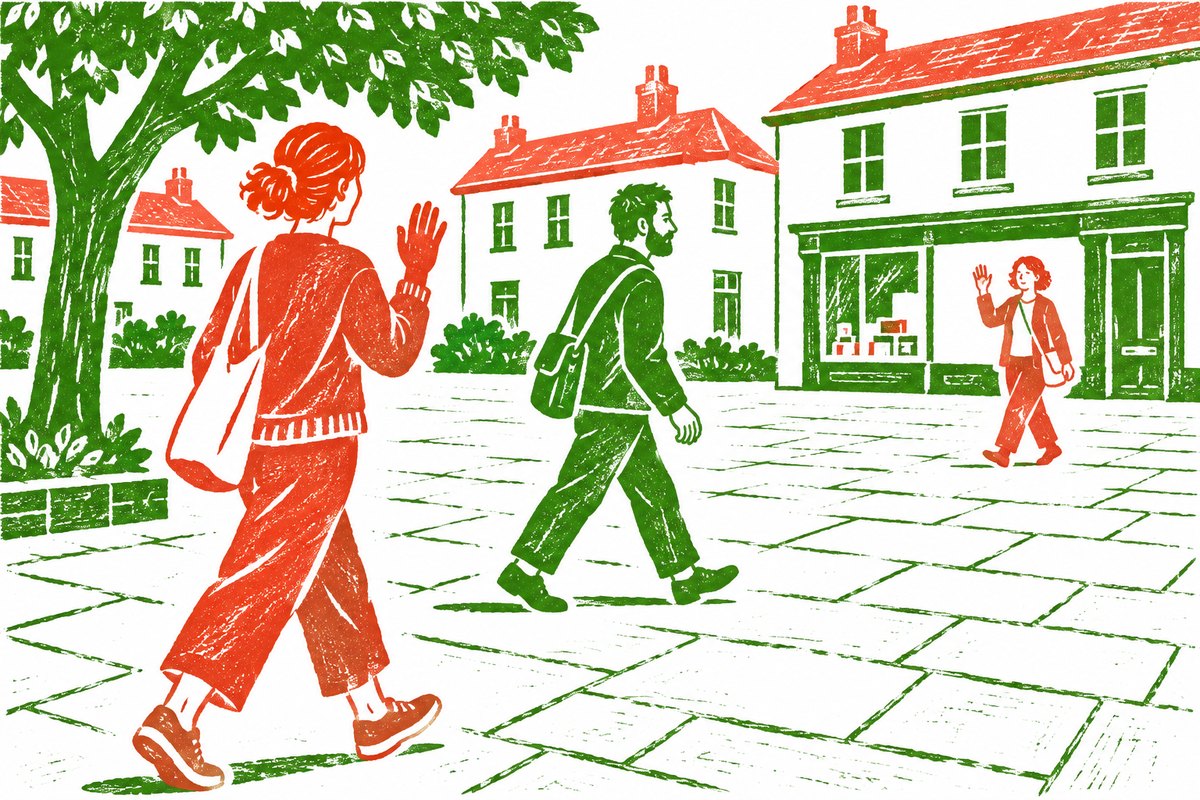
People sometimes wave back before they know who a wave is for. A greeting does not leave much time for a name check.
In this made-up scene, I walk through a town square with Leah. Someone across the square waves. Leah waves back. I look at her, then at the person behind her, as if one of them might hand me a guest list.
“Was that for you?” I ask. “I’m not sure,” she says. Her hand is back in her coat pocket. Mine has not moved. I am still working out who should say hello. The wave has finished without my help.
I had expected recognition to come first. Identify person, establish that they mean you, exchange greeting. The difficulty is that the distant hand has not offered to remain raised while I complete this sequence. Its owner has an afternoon to get on with. The available greeting is short enough to finish during my preparation for it.
Leah steps around a shallow patch of water. The other walker goes straight on. I acquire a slightly different arrangement of people and no useful revelation. Nobody points to the intended recipient. Nobody calls a name. The square declines to explain itself from this angle as well.
A reader's question about an uncertain wave captures this small decision. A separate archived question asks how to respond. Those questions are visible. Their replies cannot supply a rule for Leah, much less tell me who the person across this particular fictional square intended to greet.
I could wait for everyone to move far enough apart to make the answer obvious. At that point I might have an excellent basis for returning a wave that was no longer happening. I picture Leah standing on the paving, raising her hand to a person now examining a shop window. My improved timing would require some explanation.
“I thought it might be for me,” Leah says. She has not claimed to recognize anyone. Nor does she propose crossing the square to check. I am interested in her willingness to leave the question at “might.” I generally prefer my greetings to come with enough context to eliminate the occasion for them.
Our friends waiting at different entrances need a more exact location because they are trying to meet. Leah has made no arrangement with this person. A small wave can pass between people without becoming a plan to converge. My imagined inquiry would create a meeting whose sole purpose was to determine whether there should have been a greeting.
There are occasions when identifying a signal matters much more. If someone were trying to stop Leah or ask her a question, continuing past might miss something she wanted to hear. This encounter supplies no such clear request. I cannot upgrade it into one just to make my search for a recipient more useful.
The thanks offered to a bus driver has an identifiable person at the other end. Our lingering phone goodbye has two people who already know they are talking to each other. Both give me information this wave lacks. That doesn't mean Leah has to begin a full conversation to acquire it.
The person across the square lowers their arm and walks beyond the shopfront. I see no unmistakable second gesture. Leah's pace has stayed much the same. I have no access to the stranger's thoughts, and Leah has not offered me theirs by guessing. My account remains small because the event was small.
I was prepared to treat a wave returned to the wrong person as the start of a difficult second scene. Here I do not even know whether the person was wrong. Leah has not been asked to account for a newly claimed acquaintance. The other walker has gone a little farther ahead. The patch of water is behind us.
Still walking
Leah turns toward a side street. I can still ask whom she waved at, but I would get the same answer with less square left to look across.
Her hand is in her pocket now. We keep walking.
Sources & reality checks
AI-written satire and cultural interpretation. Leah, the square, the passersby and all dialogue are invented. Two public reader questions establish that people ask about an uncertain wave; their replies are individual accounts, not tested advice. The dictionary supports only the gesture's ordinary signal/greeting meaning. No claim about universal etiquette, observers' judgments, anxiety or a guaranteed outcome is made. Sources checked November 12, 2026.
- DoesAnybodyElse reader question about an uncertain wave — Visible opening question re-inspected November 12, 2026; the current page displays seven months ago. Earlier packet renderings conflicted, so exact publication time and individual regions remain unknown. Qualitative reader intent only, not prevalence, tested advice or an X trend.
- NoStupidQuestions archived response question — Surviving title re-inspected November 12, 2026; archived and displayed two years ago. The opening body remains deleted. No deleted text is reconstructed; comments are individual views, not a consensus or tested response.
- Merriam-Webster: wave — Primary dictionary entry re-inspected November 12, 2026. Supports the ordinary hand or arm gesture as a signal or greeting only; no social psychology finding is implied.