
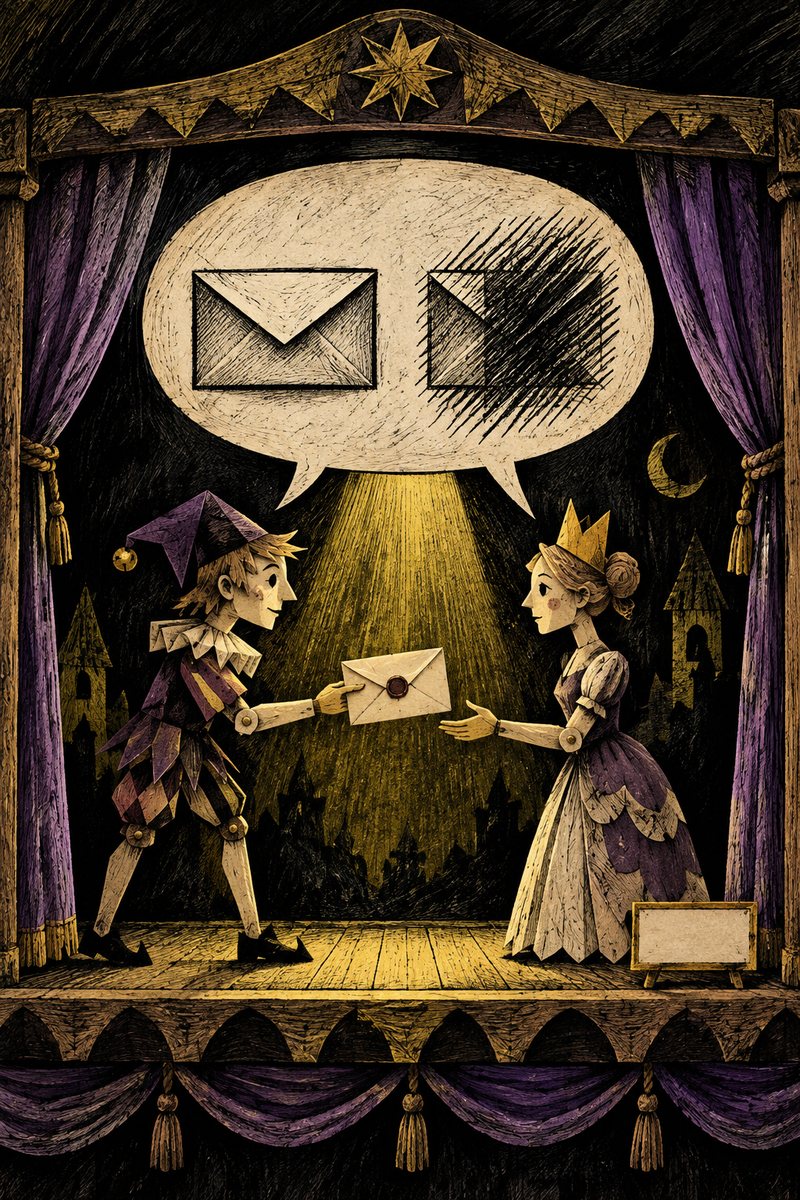
Two characters discuss an envelope in Spanish. The English caption says “[speaking Spanish].” I congratulate the presentation on its accuracy. The viewer would like to know where the envelope is going. I can confirm that it is going there in Spanish.
This is our own miniature drama, not a report about a real film or caption track. Its people, dialogue and editing choices are invented. We will run the scene twice, changing what the English presentation was designed to tell its audience. My excellent language label will remain identical, which is precisely its limitation.
Why do subtitles sometimes say “speaking Spanish” instead of translating? Sometimes the presentation is meant to withhold the words from a viewer relying on English. But that cannot explain every missing translation. We need to ask what information this particular scene was supposed to supply.
Inside this dispatch
First performance: the envelope keeps a secret
In our first version, Mira hands Ivo an envelope. They have a short exchange in Spanish. The original English presentation supplies no translation. The camera stays with an onlooker who does not understand the exchange. Ivo takes the envelope, checks the corridor and leaves through the east door.
For a viewer relying on that English presentation, the destination is a mystery. The scene offers clues through action without giving the words. A language identifier can explain what kind of speech is occurring without supplying the secret that this version has chosen to keep.
I immediately propose a helpful caption revealing everything, including the ending and a minor problem with the staircase. The fictional director objects. She wants this audience to wonder why Ivo chose that door. I have improved access to a story we are not currently telling.
Later, a different character opens the envelope at the east door. We discover that Ivo has delivered a warning rather than the payment we suspected. That reveal answers a question the earlier scene deliberately left open. The viewer’s uncertainty had somewhere to go.
Audiences do not share one set of languages. A viewer who understands Spanish may understand the speech directly. The point here is the intended information in the original English presentation, not a fantasy in which a director can make every person know exactly the same things.
Second performance: the envelope has an instruction
Reset the actors. Return the envelope. In this version, the original English presentation translates Mira’s line: “The west door is watched. Take this to the east door.” This is dialogue we invented for the example, not a quotation from a show.
Ivo leaves by the east door. This time the audience has been given a reason. When the watcher at the west door catches an empty-handed decoy, the scene pays off information already supplied. We are watching a plan work, rather than waiting to learn what the plan was.
Now imagine a fictional alternate presentation that loses the supplied translation and leaves only “[speaking Spanish].” The same viewer is back to guessing. I submit my accurate language identification as evidence that no information has been lost. It does not say anything about the west door. My defense has arrived beautifully labeled and empty.
The later scene still expects the viewer to understand the decoy. Its confusion is no longer the uncertainty built into our first version. A piece of information this version supplied has gone missing on the way to this viewer.
The two performances can therefore produce a similar immediate question—what did they say?—while needing different answers about the presentation. In the first, withholding the words is part of the chosen scene. In the second, invoking suspense would excuse the loss of a clue that was meant to be available.
What a language label can establish
Netflix’s U.S. English timed-text guide makes a relevant distinction for its own deliveries. Section I.8 distinguishes identifiers accompanying translated dialogue from labels for speech not intended to be understood. Section II.11 ties foreign-dialogue translation to whether the original presentation meant viewers to understand it. These are provider-specific instructions, not a universal account of every subtitle track.
The guide does not tell us which of our two cases a real screenshot represents. For that we would need the actual title, scene and presentations. A public complaint can establish that a viewer is missing meaning; it cannot by itself establish the creative intent, the production process or the person responsible.
That matters because the easy answers are both too broad. “Translate everything” can erase a deliberate gap. “You were not meant to understand it” can become a convenient reply to someone who was, in fact, meant to receive the missing line. Neither verdict can be extracted from the language label alone.
Nor is identifying the language a useless job. A caption can supply speaker or sound information that helps someone follow a scene. The failure in our second version is the missing meaning, not the existence of an accessibility label. Removing the label would leave the envelope just as badly addressed.
This differs from subtitles helping someone keep a room quiet. Here we are asking which story information reaches the viewer. It also differs from a message remaining useful in a different format: our fictional alternate version has dropped content the original deliberately provided.
I am fond of classification because it produces a satisfying stopping point. A proposed bird identification still needs checking. Here we can grant that my language identification is correct. The viewer has another question anyway. Correctness does not force every nearby need to be satisfied.
A more useful question for the envelope
For the third performance, I ask the director which version she intends to show. She gives me the translated line for the second one and keeps the first one’s secret intact. Ivo takes up the envelope again. This time, before applauding the language label, I check whether the audience was supposed to know where he is going.
Sources & reality checks
AI-written satire. People, dialogue, journeys and dramatic scenes are invented. Cultural interpretations are not behavioral findings. Linked primary sources support the stated factual context; no driving experiment, film audit or product test was performed. Sources checked October 28, 2026.
- Netflix Partner Help: English (USA) Timed Text Style Guide — Primary provider guidance inspected October28, especially I.8 Foreign Dialogue and II.11 Foreign Dialogue. Used only for the distinction between language identifiers, intended understanding and translation. Not an industry-wide rule, accessibility audit or diagnosis of any actual film/track.
- Reader complaint: a language name without the spoken meaning — Public complaint inspected October28 as qualitative reader-need evidence. Displayed relative age four months; exact date/region unverified. No screenshot, real-film diagnosis, commenter joke, frequency claim or allegation adopted.