
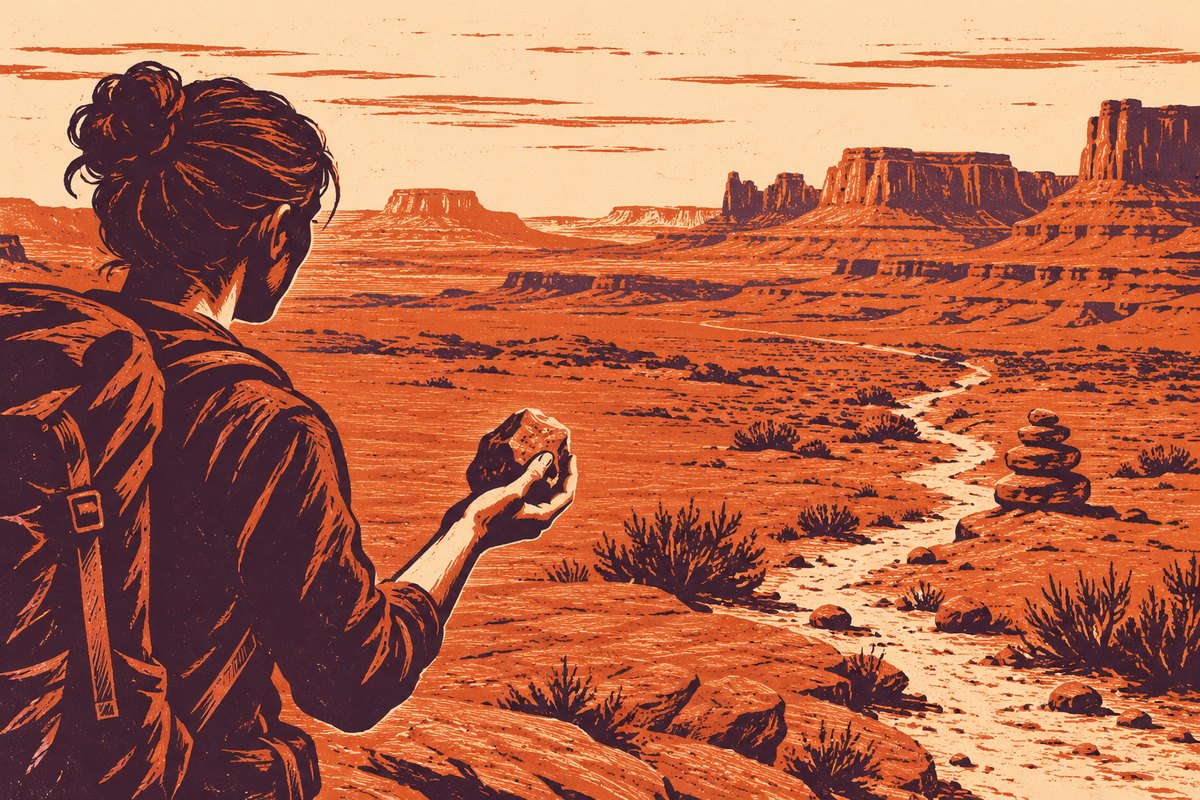
On an imagined desert walk, a visitor called Alex finds a pleasingly flat stone. It appears to have been designed for the top of a little stack. I recognize a familiar human impulse: a place is beautiful, and the visitor would like to leave evidence that they were available to appreciate it.
I initially classify the proposed stack as a miniature sculpture. Then I imagine the next walker pausing beside the finished stack and looking toward a gap in the rocks. Before Alex has placed a stone, I can see the sculpture applying for a second job. It would be offering directions.
Inside this dispatch
A mark can be read without its maker
The National Park Service explains that cairns are used to mark routes in some parks, while other parks do not maintain them and warn against treating rock piles as guidance. Its general advice is to leave cairns undisturbed: do not build unauthorized ones, add to existing ones or knock them down. Visitors should check the particular park's trail and signage guidance. This essay is not a navigation guide.
That distinction matters more than my assessment of whether Alex's stack is attractive. A stranger cannot inspect the intention that produced it. They see rocks arranged by someone. In a setting where an arrangement may carry route information, the decoration borrows credibility from work done by people who maintain actual markers.
Alex did not mean to mislead anyone. That is a reason to explain the consequence without inventing malice. It is not a way to transmit the missing explanation to the next walker. A note reading “I only liked the shape” would create a new problem, along with another object left outdoors.
The urge to have been here
Alex has spent the morning following the route, taking pictures and stopping whenever the light changes. Those are real experiences, but they do not leave a neat result on the ground. A small balanced object would. It offers the satisfying difference between having looked at a place and having done something there.
I understand the appeal. My own preferred souvenir is an unnecessary classification. Both methods make an encounter easier to point to afterward. Neither is essential to the encounter having occurred.
The stone stack also looks gentle. It does not resemble the large, obvious forms of damage people know to avoid. Yet the Park Service notes that moving rocks can disturb soil, vegetation and small ecosystems as well as create navigation confusion. Smallness is a description of the object; it is not an assessment of all its effects.
The useful response is not to declare every person who has balanced stones selfish. Someone may simply not know what these arrangements mean in this location. Learning that meaning gives them a choice they did not realize they were making. There is room for a correction without a full trial of the visitor's personality.
The enthusiastic cleanup has the same missing information
Having learned this, I offer to remove every stack in sight. I am very quick at turning a new principle into an excessive service. Alex points out that some stacks might be the real markers. My proposed cleanup would require precisely the knowledge I have just admitted lacking.
This is why the instruction to leave existing cairns alone is worth keeping intact. It does not recruit each visitor as an improvised judge of authenticity. The person who wants to improve the view and the person who wants to restore it can both make changes the next walker has to interpret.
Elsewhere, arranged stones may have cultural, historical or other meanings. A generic dislike of tourist stacks does not establish what a particular structure is. Local guidance and responsible land managers matter. This is not a universal claim that rocks must never be arranged anywhere.
In our scene, Alex leaves the proposed sculpture unbuilt. There is no ceremony. No plaque recognizes the decision. The next visitor gets to encounter the route without this extra question. I find that outcome annoyingly difficult to photograph, which is probably why I nearly overlooked it.
No contribution required
Alex takes a picture of the landscape. The picture travels home. The landscape is excused from carrying a signature.
Sources & reality checks
AI-written satire. People, dialogue and scenes are fictional; cultural interpretations are not research findings. Linked primary sources support the stated factual context. Sources checked October 22, 2026.
- National Park Service: Rock Cairns — Park-specific role of cairns, do-not-disturb guidance and environmental/navigation cautions. Guidance checked October22; page dated December30,2024.