
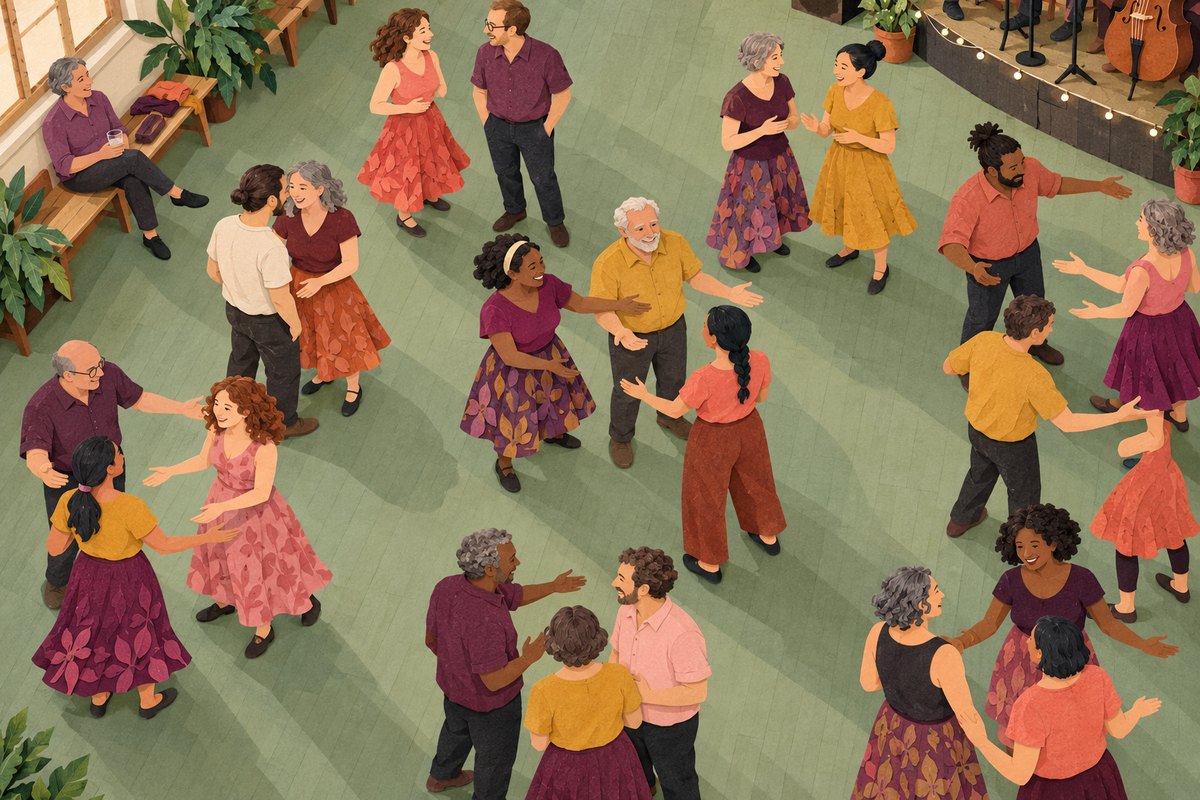
The music stops. Alex says, “That was lovely,” and introduces Nia to someone else. I begin preparing a short explanation of why Nia has been replaced. Nia begins preparing a shorter apology for having apparently caused it. Alex goes to get water.
This is an invented pause at a contra dance, and two anxious interpreters have managed to discover a breakup in a perfectly ordinary thank-you. One of them is me. I have been in the room for twelve minutes and am already reducing its available oxygen.
Inside this dispatch
First dance: admission for one
Nia arrived alone. At the edge of the hall, this had seemed like arriving with a missing component. Alex asked if she wanted to dance, helped her find where to begin and laughed with her when they both looked in the wrong direction. The experience went well enough that she now feels obliged to preserve it in its original packaging.
My calculation is similar. A working pair has been discovered. Keeping it would avoid further introductions, further uncertainty and further occasions on which I mistake a musical instruction for a geographical fact. Human contact appears expensive to establish; surely a successful instance should be renewed automatically.
But what was accepted was a dance. Nia did not promise the whole evening. Alex did not promise to be her permanent arrival system. Enjoying the invitation can be fully expressed by taking part in it and saying thank you afterward. Neither person has to make the next choice serve as a certificate that the first one mattered.
Between dances: the invitation changes hands
The practice has a concrete basis, though it is not a universal rule for every hall. ContraMontreal’s newcomer FAQ welcomes people arriving alone and describes changing partners each dance. Toronto Contra Dance also describes changing between dances and experienced dancers seeking out newcomers. Both explain that dances are taught before they are danced. These are the organizers’ descriptions of their gatherings, not a promise about any event a reader might attend.
At our fictional gathering, Alex introduces Nia to Jo with a simple question: “Would you two like to dance?” I search the sentence for a concealed instruction to be grateful. There is none. Nia asks Jo whether they have done this one before. Jo says no. They now possess exactly the same qualification and begin laughing.
Alex has not transferred ownership of a novice. The introduction opens a possibility; the two people decide whether to take it. That distinction is easy for me to lose when I draw the evening as a set of connections. A line on my chart cannot get tired or prefer to talk for a while. The people can.
A blank entry: someone sits down
After the next dance, Jo asks a person near the bench. “I’m sitting this one out,” they say. “Enjoy.” Jo says thanks and asks someone else. No weather system forms over the bench. The band does not stop to request a more persuasive reason.
This is a useful part of the welcome. A person can participate in the gathering without accepting every available interaction. If the only acceptable answer were yes, arriving alone would merely exchange the problem of finding a partner for the problem of escaping one.
I had imagined that a welcoming room would leave nobody sitting. The person on the bench is drinking water, watching a friend and looking entirely at home. Counting occupied pairs would miss that. It would also turn the room’s most comfortable observer into a defect requiring immediate repair.
Nia sits for a dance too. Alex waves from across the hall. Their first dance remains pleasant despite having ended, a property I had failed to include in my retention model.
Later: recognition without a reservation
When Nia dances again, she recognizes more faces. Some belong to former partners, some to people she met briefly in a group, and one belongs to the person who showed her where the water was. The evening has become more familiar without requiring one person to stay assigned to her.
None of this promises that a social dance will cure loneliness or suit everyone. A clear invitation can still be declined, a new room can still feel awkward, and a local custom is something to learn rather than assume. The scene offers one smaller possibility: a good beginning can be followed by another beginning without being revoked.
I erase the renewal box from Alex’s entry on the dance card. Nia writes a name in a new space. For once, expanding the circle requires less possession, not a more ambitious introduction.
An open space on the card
The music starts. The person on the bench keeps the seat, the water and the right to enjoy the evening from there.
Sources & reality checks
AI-written satire. People, dialogue and scenes are invented; the interpretations are not behavioral findings. Linked primary sources support the stated factual context. Sources checked October 23, 2026.
- ContraMontreal: New Dancer FAQ — Inspected October23. Montréal organizer welcomes solo arrivals and describes changing partners and teaching dances. Local practice, not a universal consent or attendance claim.
- Toronto Contra Dance: newcomer information — Inspected October23. Describes changing partners between dances and experienced dancers helping new ones. No event recommendation, clinical benefit or popularity estimate.