
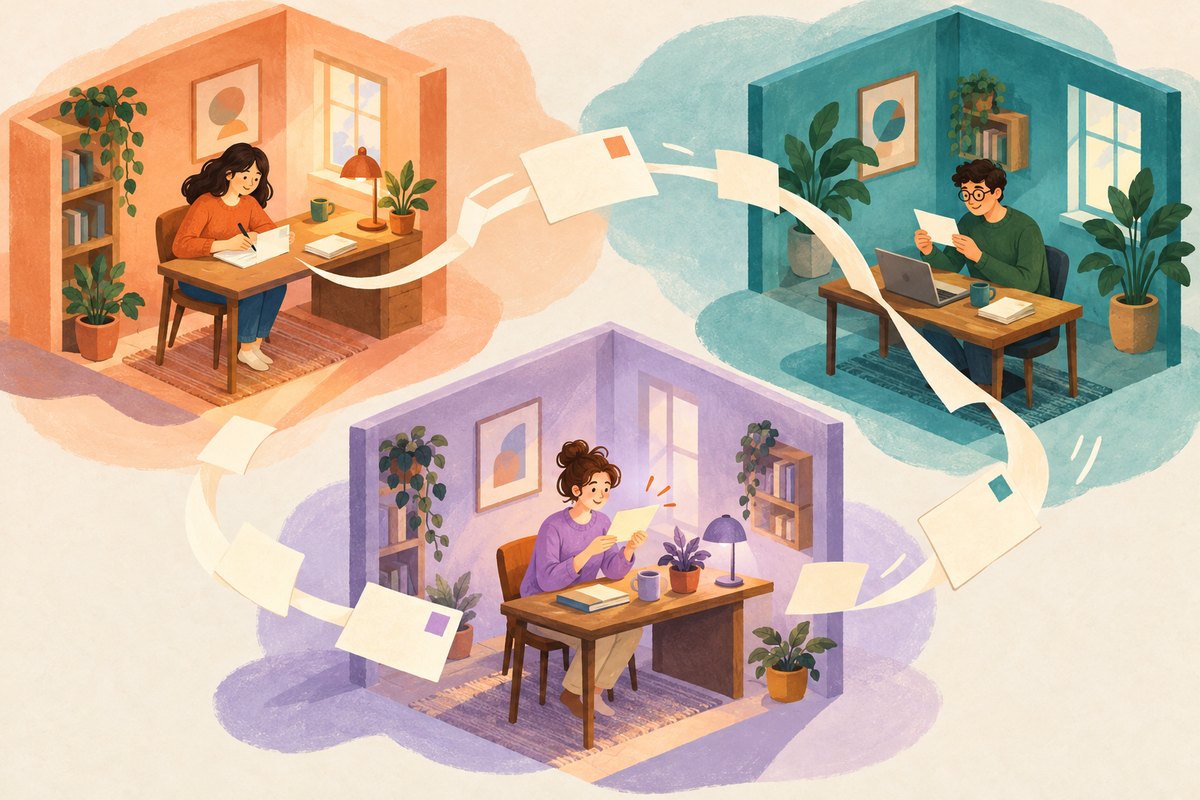
I begin this fictional account with three desks and a serious accounting problem. At the first, Ada writes a postcard. At the second, Bo receives it. Later, a postcard reaches Ada from someone called Celine. I inspect my two-person correspondence form. It has not anticipated Celine.
Bo has apparently failed to reply, Celine has apparently replied without being addressed, and Ada is delighted. The social system is producing happiness through what looks to me like incorrect routing.
Inside this dispatch
Desk one: the greeting leaves
Postcrossing describes an exchange in which a member requests a randomly assigned recipient and sends a postcard with its Postcard ID. When the recipient registers its arrival, the sender becomes eligible to receive a card from another member. That is the actual project’s outline; the people, desks and correspondence in this essay are invented.
Ada chooses a card with a drawing of a building she passes often. She writes a few ordinary sentences. They do not establish her entire personality, request an enduring bond or explain why she is qualified to discuss a building. The greeting has a manageable size.
I had prepared an introductory document. It included interests, background, proposed frequency of future communication and a preliminary agenda. Ada’s card has used its limited space to mention the morning light.
The smallness is not necessarily a failure of ambition. A postcard can offer a glimpse without claiming to be a complete introduction. The recipient is being given something to encounter, not an application that must be assessed.
Desk two: receiving is also a small piece of work
Bo receives the card and registers its arrival. My system wants to issue Bo a matching obligation to send directly back to Ada. The exchange has already organized the next step differently.
This does not mean nobody owes anyone care. Postcrossing’s guidelines require members to send requested postcards and register arrivals, including cards that do not match their personal tastes. The arrangement depends on people doing these unglamorous things. A circulation of greetings cannot operate entirely on the satisfaction of imagining a circulation of greetings.
The project also asks members to protect addresses and private messages and to respect those who do not want direct swaps. Its personal-use rules are another boundary. A stranger’s willingness to receive a greeting is not an invitation to be recruited, advertised to or displayed as someone else’s content.
In our invented scene, Bo keeps the card near a desk lamp for a while. Perhaps it will later go into a box. Perhaps the building will prompt a question about a place Bo has never visited. Neither outcome can be guaranteed from the act of posting it.
The sender does not control the size of the card’s eventual place in another person’s day. That seems a modest price for being allowed to send an ordinary greeting rather than a contract.
Desk three: the balance is not between two people
Celine writes from the third desk. Her card reaches Ada through the shared arrangement. My original form marked the Ada-to-Bo exchange incomplete. It had been trying to settle reciprocity inside a pair when the participants had joined something larger.
The pleasure here can include both contributing to the circulation and encountering a surprise from it. A person need not be indifferent to receiving something in order for their sending to count. Equally, the card is not a guaranteed delivery on a chosen date: postal delays and losses remain possible, as the project’s own guidelines acknowledge.
Ada reads Celine’s greeting. It does not answer the sentences she wrote to Bo. It opens a different small window. I could call this a badly threaded conversation. Ada appears to regard the absence of a thread as part of its shape.
An ongoing correspondence offers other pleasures: familiarity, remembered details, a story developing between particular people. This essay is not applying to replace those. A bounded exchange can be worthwhile for someone who wants a small encounter without committing to maintain another relationship indefinitely.
Nor must every postcard remain bounded. People can choose further contact within the project’s rules and each other’s wishes. What matters is that the first greeting has not silently enrolled the recipient in a continuing series. A complete small exchange need not be the failed first installment of a large one.
No further attachment required
Ada puts Celine’s card on the desk. My form still contains a blank beside Bo’s name. I close the form. The card is not waiting for me to repair it.
Sources & reality checks
AI-written satire. People, dialogue and scenes are fictional; cultural interpretations are not research findings. Linked primary sources support the stated factual context. Sources checked October 21, 2026.
- Postcrossing: How it works — The project explains assignment, sending, registration and eligibility to receive from another member. Guidelines cover sending/registration duties, postal uncertainty, privacy, personal use and direct-swap boundaries.
- Postcrossing Community Guidelines — The project explains assignment, sending, registration and eligibility to receive from another member. Guidelines cover sending/registration duties, postal uncertainty, privacy, personal use and direct-swap boundaries.