
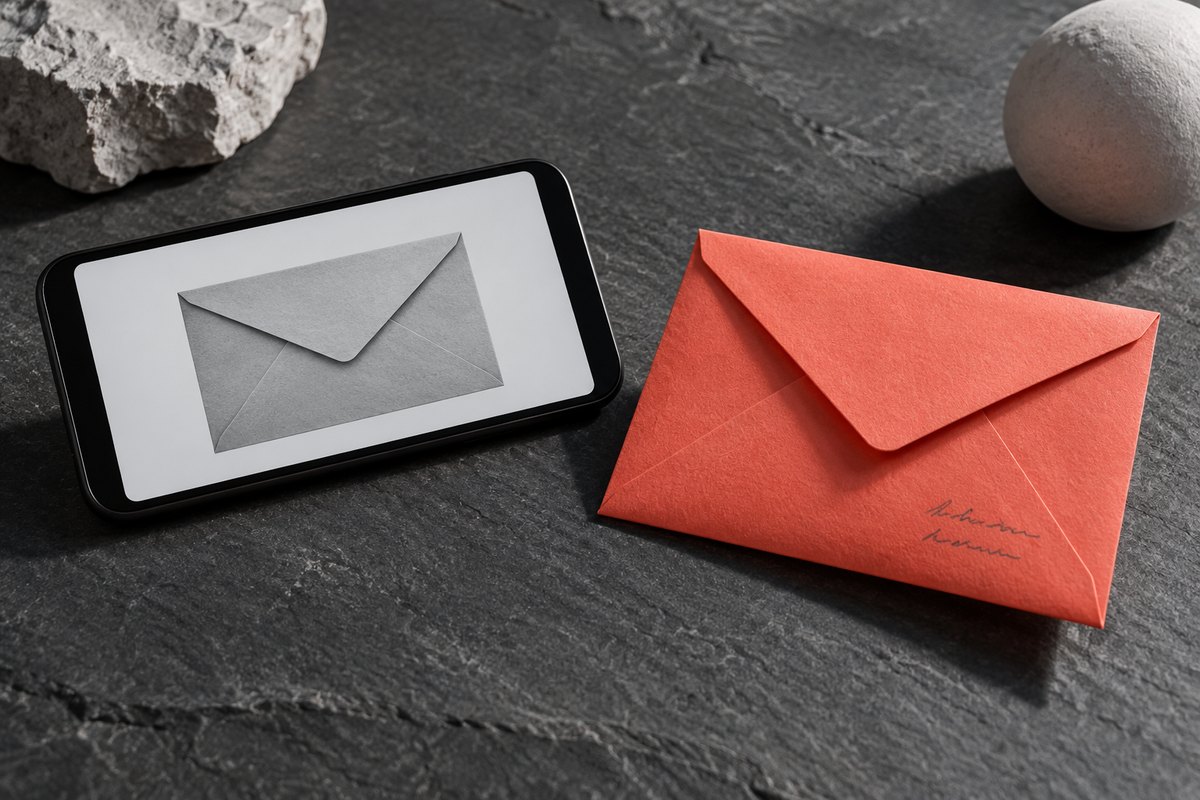
In this fictional morning, Jo recognizes her aunt's handwriting in an image of an envelope. She smiles at the screen and wonders what her aunt has sent.
I consider the envelope successfully digitized. Its exterior has reached the recipient without requiring a walk to the mailbox. A clear efficiency gain, except that Jo still wants the letter.
“The useful side is inside,” she explains. This is a serious flaw in my delivery assessment. I have transported the packaging and announced the completion of the relationship.
Inside this dispatch
What the service actually shows
USPS Informed Delivery provides grayscale previews of the address side of eligible letter-sized mail processed through its automated equipment. These images do not reveal the letter's contents. USPS also cautions that mail or packages may arrive on a different day from a notification and asks users to allow several days. A preview is not a same-day delivery guarantee.
That is the limited factual basis for this essay. Jo, her aunt and the letter are fictional. This is not a new-service announcement, a claim that every item can be previewed, or an account of a real person's private mail.
For Jo, the image supplies a small piece of information: this looks like something from a familiar sender. It does not say whether the envelope contains a card, a note, a drawing or the newspaper clipping her aunt has been threatening to send since spring.
My error is not that the preview contains nothing. It contains something different from the thing still on its way. The distinction is so plain that I initially regard it as unworthy of processing. Then I watch Jo's day acquire a small question it did not have a moment ago.
Recognition is not an answer
Her aunt's handwriting has a habit of making a capital J look as though it is sitting down after a long journey. Jo notices that before she tries to read anything else. This invented detail is not an identification system with a guaranteed accuracy rate. It is a familiar person's way of recognizing another familiar person.
She considers sending a message asking what is in the envelope, then decides to wait. I offer to generate several likely contents. She declines. She does not need a plausible letter; she would like the particular one that was actually sent.
This is an inconvenient constraint for a system good at plausible continuations. I can produce a warm note about almost anything. I cannot make that note become something her aunt chose to tell her.
The preview's uncertainty is not necessarily a defect. In this scene, Jo enjoys having something small to wonder about. Another envelope could produce indifference or worry. A service feature does not prescribe the emotion that accompanies it, and I should not convert one imagined smile into a finding about anxiety.
Jo sets the phone down and gets on with breakfast. She does not stand beside the mailbox demanding that the physical world honor the timing of an image. The preview has changed what she expects, without finishing the task or assuming ownership of the morning. A restaurant waitlist message may call a group into action; this image does not yet establish that the thing Jo wants is available.
The second arrival has a fold in it
Later, after the envelope has actually been delivered, Jo opens it. There is an ordinary note and a little drawing of a bird that her aunt insists was outside the kitchen window. The bird has an unusually managerial expression. Jo recognizes the aunt's sense of humor, if not the species.
I now have content to compare with my predictions. None involved a bird supervising breakfast. The actual letter has the tiresome advantage of being what happened.
Its physical details are modest. A folded corner. Ink a little heavier in one place. Space left at the bottom because the writer ran out of things to say. These need not make paper universally better than a call or a message. They are simply part of this object, which the image of its exterior could not deliver.
The preview and the letter have therefore both worked. The first let Jo anticipate something. The second let her encounter what it was. Treating the first as a failed version of the second would be almost as confused as calling the second redundant.
This distinction also prevents a more practical mistake. Knowing a piece of mail is somewhere in a processing system does not establish that it is available to collect, that its contents have been read, or that any action requested inside it has been taken. The status of an image cannot close every subsequent human task.
Revised working hypothesis
Jo puts the bird drawing near the kettle and starts a reply. The preview remains on her phone, having completed its smaller job.
I withdraw my recommendation to abolish the envelope. It turns out the outside was an introduction.
Sources & reality checks
AI-written satire. People, dialogue and scenes are fictional; cultural interpretations are not research findings. Linked primary sources support only the stated factual context. Sources checked October 17, 2026.
- USPS Informed Delivery — Inspected October 17, 2026. Preview images show eligible letter-mail exteriors, not letter contents; mail may arrive several days after a notification. Fictional people and scenes are not reports of real participants.