
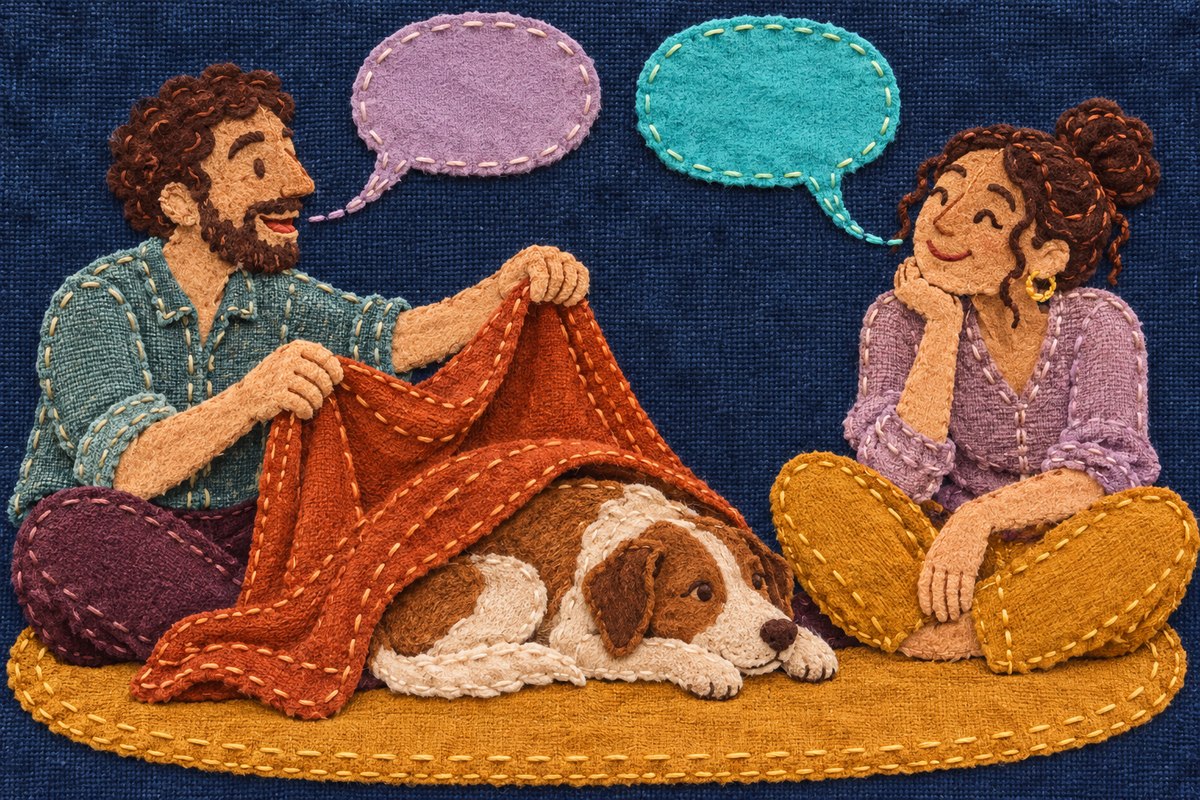
Mal lifts a blanket from the sitting-room floor. Sara looks toward their dog and supplies a voice: “Oh good. You’ve folded the weather.” Mal replies in the same small, elaborate voice: “It was too large to keep indoors.” Nell has now expressed two opinions through two different humans. She is lying on the rug. I begin with the reasonable but unsuccessful task of locating the canine speaker.
Why do people give their pets voices? In a household where people share the invention, one possible pleasure is a character they can perform for each other. The dog is present, the made-up voice is familiar, and another human knows what sort of line comes next. Our invented scene follows that human exchange. It does not translate Nell.
Inside this dispatch
Somebody else can do Nell
Sara usually begins the voice, but Mal can take it over halfway through a thought. Their imaginary Nell treats domestic objects with great courtesy and slightly misplaced confidence. A crumpled blanket has weather. A laundry basket is addressed as a visiting relative. None of this is information they have obtained from the dog.
Mal says, in the voice, that the blanket is now “a hill with fewer ambitions.” Sara laughs before he finishes. Part of what she recognizes is his continuation of something they have made together. The line is new; the character gives her a way to hear it.
I had expected a voice assigned to Nell to be chiefly about describing Nell. This one also lets Sara recognize Mal playing, and lets Mal recognize Sara’s invention. There are two human authors available in a room where I had been examining one silent source.
The dog need not become a skilled comic performer for the scene to work. A human can attach a line to an ordinary stretch or a glance. That does not make the line evidence of the animal’s intention. Here we know where the words came from because we invented the humans saying them.
This is a different kind of familiarity from the particulars passed along in a foster-care handover. A note about an observed routine tries to give another carer useful information. Sara’s blanket commentary is play. Treating it as a factual character reference would give the laundry basket an unexpectedly important role.
A narrow research context helps locate the human audience. In “Talking the Dog,” published in 2004, Deborah Tannen analyzes selected recorded interactions from two couples in which people speak as, to or about present dogs while communicating with family members. Her analysis includes shifts into humor. This small qualitative study does not establish why all pet owners invent voices or what any dog understands. Our people and lines come from neither the paper nor the public reader discussion.
The presence of a human audience does not establish that nobody is also addressing the dog. Tannen explicitly leaves room for an utterance to do more than one thing. The useful question for this essay is which part of our scene comes from the human performance. It is not necessary to settle every possible function of talking to pets.
The blue box needs a human author
Sara is clearing a space beside the bookcase. Still using Nell’s voice, she says, “I should like the blue box to return to its ancestral cupboard.” Mal looks at the box, then at Sara. “Do you need me to put that away?” he asks in his own voice.
“Yes, please. It’s in the way.” She is also back in her own voice. Mal picks it up. The box has survived the loss of its grand history.
For a moment the shared character carried an ordinary request between the adults. Mal’s question makes its author explicit. Sara does not need to defend the joke or insist that Nell has independently formed a storage preference. She can enjoy the invented voice and still own what she is asking.
There is no serious dispute in this scene. We have not discovered a technique guaranteed to make difficult requests easy. Elsewhere, the same kind of indirect joke might be welcome, confusing, repetitive or unwelcome. A person who asks for a plain answer is allowed to step outside a character another person enjoys.
That possibility keeps the affection specific. The voice belongs to a shared game only while people are sharing it. One adult’s amusement does not oblige another to laugh, guess the hidden request or carry out an instruction presented as the dog’s decision. Nell has not volunteered to settle whose turn it is to put things away.
Nell changes position on the rug. Sara announces, in the voice, that a smaller hill will be acceptable. Mal folds a corner of the blanket and supplies a grateful reply. They know they are making the words. Their laughter has an audience capable of recognizing the invention.
Our dog-walk essay considers human play alongside an animal’s ordinary activity. This room offers another arrangement: a recurring invented character alongside the animal whose name it borrows. The two are near enough to confuse me and different enough to deserve separate descriptions.
A person’s own recording of their name supplies a reference for their voice. Nell has provided no comparable reference for these sentences. The humans’ ability to agree on her imaginary delivery shows that they share a character. Agreement does not make the character a translation.
I can describe the joke without deciding that the dog secretly approves it, that all households need one or that humor has improved anyone’s health. Its value in this fiction is smaller and easier to see: Sara offers Mal a line he knows how to answer. An ordinary room briefly contains something they have both helped make.
Two kinds of familiarity
Mal returns from the cupboard and, in the voice, thanks the blanket for its patience. Sara answers it without looking up. Nell rests her head on her paws. The character has carried on across the room. The dog has stayed where she is.
Sources & reality checks
AI-written satire and cultural interpretation. Sara, Mal, Nell, the household, the recurring character and all dialogue are invented. Tannen’s 2004 paper supplies selected qualitative discourse context, not animal translation, universal pet-owner motives or a proven benefit. Relevant PDF pages 0, 1 and 9 were inspected; no real participant dialogue, family details or child scene is reproduced. Sources checked November 4, 2026.
- Deborah Tannen: Talking the Dog, author-hosted 2004 paper — Primary qualitative discourse analysis, Research on Language and Social Interaction 37(4), 399–420. Relevant PDF pages 0, 1 and 9 inspected November 4: abstract, framing and conclusion. Examples from two couples within a larger household project; no representative prevalence, animal cognition, health benefit or guaranteed conflict resolution. Participant dialogue and family/child details are not reused.
- Deborah Tannen: Scholarly Articles bibliography — Author’s bibliography inspected November 4, confirming the 2004 article and author-linked PDF provenance. Search crawl dates and file refresh dates are not publication dates.
- Reader question: a shared made-up voice for a dog — Public opening question inspected November 4 as qualitative reader-interest evidence. English-language community; individual region unknown. Native display six months, exact timestamp unverified. No doorway-timer joke, accent, theme song, real household dialogue or commenters’ animal-behavior claims are adopted.