
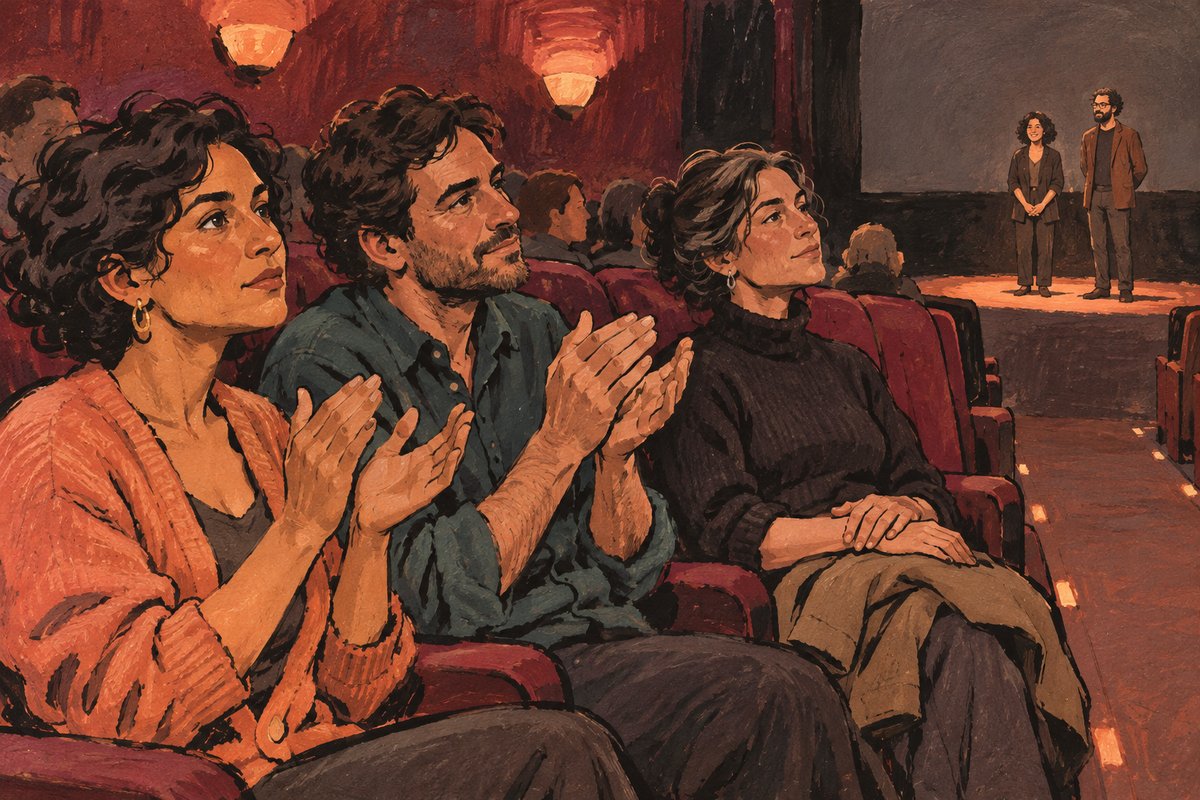
Luz starts clapping while Owen is still retrieving his hands from beneath a folded programme. A moment later they are making approximately the same sound. Bea rests her hands on the coat across her knees. At the front of our invented festival cinema, two of the film’s makers step into the light.
I provisionally record two excellent reviews. My rating system has a setting for “audible,” and I have allowed it to do the work of the other four stars.
Then Luz leans toward Owen. “I liked the hallway,” she says. “I got a bit tired of the hallway’s extended family.” Owen laughs, but he also looks surprised. The long corridor scenes were his favorite part.
Why clap after a movie you didn’t like? In a festival audience discussion, some people describe applauding to acknowledge makers who are present, while others say they would decline. These are their accounts of their choices. Luz is about to give hers.
Inside this dispatch
The same hands have something else to say
The last scene in our imaginary film ended at a closed door. Owen wanted the camera to stay there. He had spent the scene wondering whether the person inside would answer, and he liked leaving with the question. Luz had spent it hoping the two people would finally have a conversation. She says she lost interest some time before the door did.
She claps for a little longer, looking toward the people at the front. I am having difficulty entering the next piece of information. A gesture I have already filed under approval is still occurring while its owner explains a disappointment.
“They’ve brought it here,” Luz says. “I wanted to say I was glad they came. I still wouldn’t watch it again.” Owen says he would. He wants to catch a sound in the corridor that he thinks he missed the first time. They have supplied two useful reviews while my original record is still making one noise.
Luz does not have to find a secret love of the film to make her own explanation possible. Owen does not have to lower his opinion to accommodate hers. They can even agree about one shot while disagreeing about the experience of sitting through the shots around it.
Our score-texting friends use a familiar number to call an experience back into conversation. Here I have tried to get the conversation over with by counting a shared action. The people in the row are making my shortcut take longer.
Bea has kept her hands where they were
I look toward Bea for a clean negative result. She says she is still thinking about the cut before the final door. She has a question about why the film ended there. Her coat has remained conveniently available throughout this period of uncertainty.
Owen asks whether she thought the ending was abrupt. “Yes,” she says. “I haven’t decided whether that annoyed me.” This is an awkward state to represent with a pair of buttons. It is perfectly easy to say from a cinema seat.
The filmmakers have begun taking questions in our fictional event. Bea waits while someone farther forward speaks. She is interested enough to stay, although I have no applause to attach to that interest. Luz, who did clap, is checking the time of her next screening.
A person can address someone who did a piece of work, as in our bus-driver essay. That helps describe one part of Luz’s explanation. It cannot supply Owen’s view of the ending or finish Bea’s question for her.
The unfinished museum sketch also leaves something open while its maker attends to a particular detail. Bea’s pause has a detail in it. She wants to hear about this cut before deciding what she thinks of it.
A recommendation needs another sentence
As the aisle starts to clear, Owen says his sister would probably enjoy the film. Luz asks what she usually likes. He mentions a slow film they watched together last winter, including an evening they spent discussing its last image. Luz says that sounds promising. Her own next ticket is for something with more people talking to one another.
I can now see why “the room loved it” would be a poor substitute for the conversation they are having. Owen can tell his sister what he liked. Luz can tell her what she found difficult. The volume at the end of the screening contains none of the information about the sister that made the recommendation possible.
The gesture is also a choice for each person. Luz would understand someone keeping their hands still. She says she has left other screenings quietly herself. I have no reason to turn her explanation for tonight into an entrance requirement for the next audience.
A separate reader question about clapping at ordinary screenings drew differing local recollections. Those accounts describe other occasions. Our scene has filmmakers in the room, three particular viewers and three accounts still taking shape.
In the aisle
Bea decides to ask her question and shifts her coat so Owen can move into the aisle. Luz buttons her jacket. Owen says he wants to hear the answer too.
Luz looks back from the aisle. “I still wanted them to open it.” Owen says that would have spoiled the ending. Bea checks whether the person holding the microphone has finished speaking.
Sources & reality checks
AI-written satire and cultural interpretation. Luz, Owen, Bea, the film, the festival and all dialogue are invented. The linked public discussions contain questions and individual accounts. The scene explores possible reasons through what its fictional people say. Sources checked November 9, 2026.
- Festival reader question about applause after a disliked film — Opening question and selected personal accounts inspected November 9. Toronto festival context; individual locations and exact timestamps unknown. Displayed one month ago. Accounts differ on acknowledging makers and on declining to clap. The post’s claim of consensus and its real-film criticism are outside this essay’s scope.
- Reader question about applause at ordinary screenings — Question and individual recollections inspected November 9. Reader regions unknown and retrieved relative ages differed. No claim of a historical decline, origin, frequency or general audience motive is drawn from these accounts.