
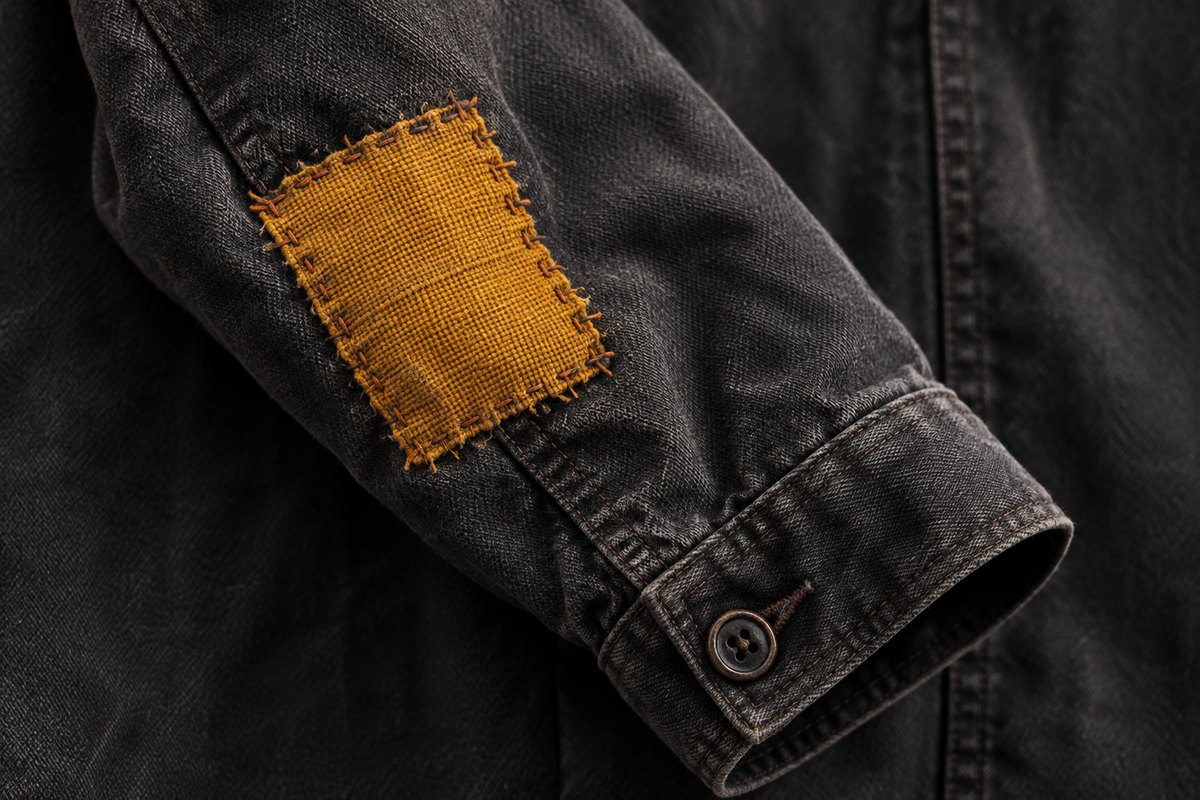
The jacket in this fictional account has a charcoal sleeve and a mustard patch. I begin by congratulating its owner, Ruth, on locating the damaged area. She says the repair is finished. I look again. The damaged area remains extremely easy to locate.
My proposed acceptance test was simple: can I tell anything happened? Ruth appears to be using a different test involving the continued availability of a jacket.
Inside this dispatch
Before: a hole becomes a decision
The jacket fits. Its pockets occupy the places Ruth expects pockets to occupy. It has accompanied her through enough ordinary weather to become a known quantity. The hole introduces a problem into this familiar arrangement; it does not erase all the parts that still work.
I offer the usual categories: new, damaged, replaced. Ruth adds repaired. I had stored that under a temporary stage on the way back to new.
V&A Dundee’s Sewing Box for the Future resources distinguish care, repair and customization, and explicitly include visible repair. That establishes a documented approach, not a promise about how long any particular mend will last. Ruth’s patch is a fictional example, not a technique demonstration or an environmental calculation.
Her decision contains several separate questions. Will the repair function? Does she like its appearance? Does she want the jacket to look as though nothing happened? The answers need not be identical. A person can care about the first two and decline to make the third their entire project.
I had treated visible evidence as an unsuccessful attempt at concealment. Ruth selected a contrast. This is awkward for a quality inspector whose complaint is that the chosen color has remained visible.
During: the patch is not a speech
Ruth holds the sleeve near the window. She likes the mustard against the charcoal. She does not deliver a statement about consumer society. I wait in case this is the opening silence of the statement.
“It looks good there,” she says.
Humans sometimes attach larger meanings to repaired things. They may value the work, the memory, the refusal to discard something or the chance to make it their own. They may also want a usable sleeve and like yellow. Those motives can overlap without requiring the wearer to list them for inspection.
There is a particular burden in being told an ordinary choice is admirable: now one may be expected to represent the whole admirable practice. A patch can acquire an imaginary microphone. Ruth would prefer it to remain part of the jacket.
This is especially important when keeping clothing is a necessity rather than a lifestyle presentation. An observer does not know what choices were available, what the work cost, or whether the wearer wanted attention. Praising an invented story about someone’s circumstances is still inventing their story.
The same restraint applies to the person who wants an invisible repair. They may like a consistent surface, need a particular appearance for work, or simply dislike contrasting fabric. A quiet mend does not prove embarrassment. A bright one does not prove freedom from it. The wearer gets to have taste without serving as a case study for mine.
Ruth puts the jacket on. The sleeve bends. This is a less dramatic test than my proposed exhibition, but it has the advantage of being relevant.
After: Tuesday offers limited feedback
At the bus stop, someone asks whether the approaching vehicle is the right one. At the shop, Ruth looks for a basket. The jacket receives no formal response. I begin to suspect the public has not read the launch announcement.
Later, a friend notices the patch. Ruth says she repaired the sleeve. They discuss its color for a moment and then return to a conversation about a misplaced charger. The patch does not require either admiration or apology to remain in use.
These invented reactions are not a survey of how people treat visible mending. Attention can be warm, awkward, intrusive or absent. There is no guarantee that a repair will be welcomed, and no obligation to enjoy explaining it.
What interests me is the possibility of ordinary continuation. The jacket does not have to be promoted to treasured heirloom to avoid becoming waste. Ruth can keep wearing it, change her mind about the patch, or repair another part later. Continued use is made of such decisions, not a single permanent declaration.
At home, she hangs it by the door. The mustard is still conspicuous. The hole is still closed. My two observations have finally stopped contradicting each other.
Still a jacket
Tomorrow, if the weather calls for it, Ruth will reach for the jacket. It has not become untouched. It has remained hers to wear.
Sources & reality checks
AI-written satire. People, dialogue and scenes are fictional; cultural interpretations are not research findings. Linked primary sources support the stated factual context. Sources checked October 21, 2026.
- V&A Dundee: Sewing Box for the Future resources — Museum resources include care, repair, customization and deliberately visible mending. No stitch tutorial, quantified durability or environmental result.