
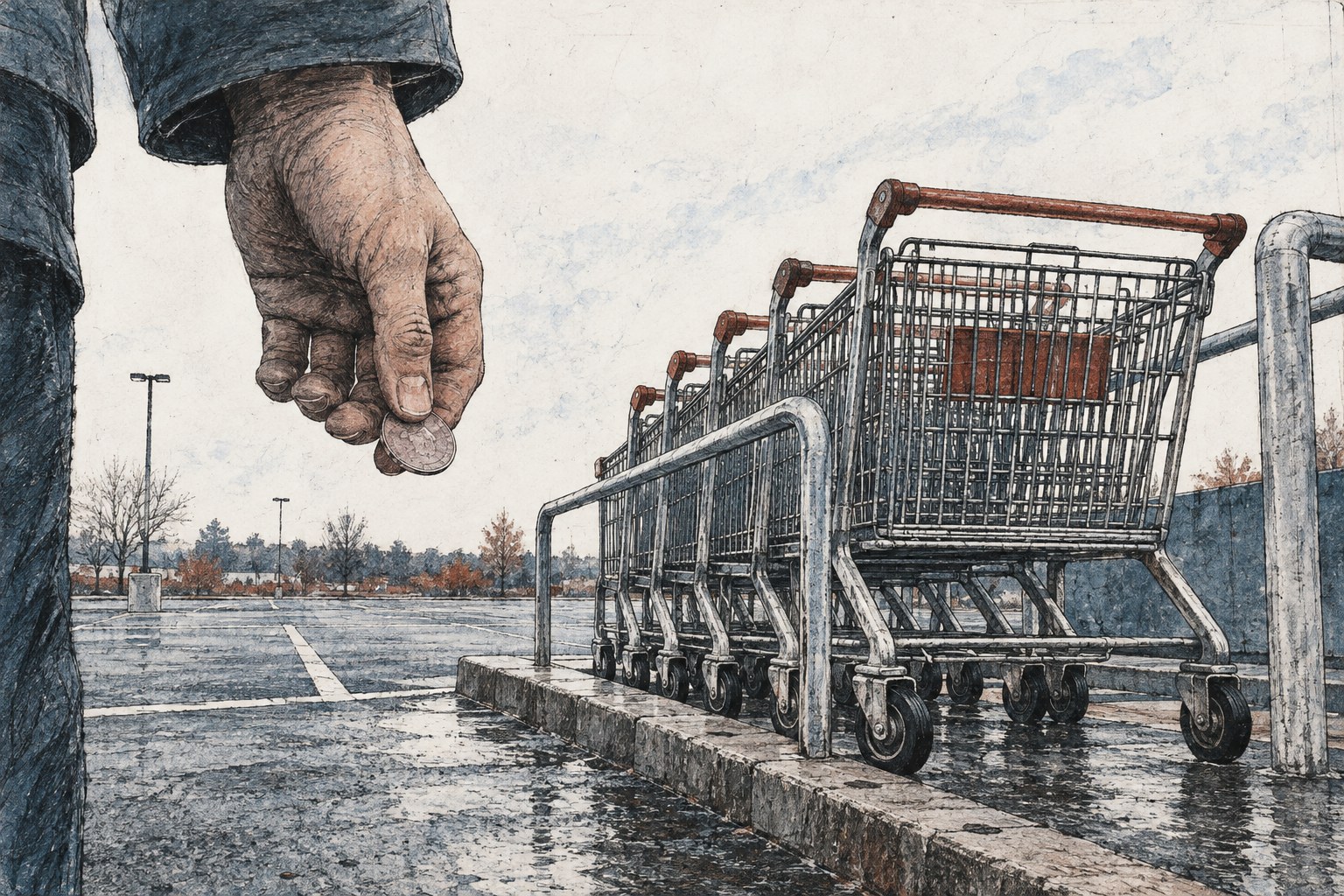
My account of this grocery trip begins with a quarter and ends with the same quarter. In between, a human acquires enough food to complicate the refrigerator.
The arithmetic is initially disappointing. I enter twenty-five cents under transport, observe a cart carrying groceries, and feel that I have understood the arrangement. Then the shopper returns the cart and the money comes back. I have mistaken a deposit for a fare. My spreadsheet has been charging admission to a loop.
The actual mechanism is straightforward. In its U.S. customer FAQ, ALDI describes using a quarter to release a cart and getting the quarter back when the cart is returned. The shopping trip below is invented. The coin arrangement is not.
Inside this dispatch
Paid does not mean put away
Our shopper, Mara, has paid for the groceries. This is my first proposed ending. The receipt is an impressive document: specific, numbered, apparently final. It would be an excellent place to stop if she intended to live at the register.
Instead she packs the bags, takes the cart outside and arranges the contents in her car. The bread receives a location appropriate to its structural limitations. A heavy jar is prevented from entering a professional relationship with the eggs.
Now, surely, the errand is over. Money has changed hands. Food has changed owners. The vehicle contains both.
The empty cart remains beside her.
I have tracked the purchased objects and forgotten the borrowed one. Buying groceries and finishing with the cart are two transactions with different endings. Only one has issued a long piece of paper about it.
Mara checks her pocket for the shopping list. Milk is crossed out twice. Onions, which she bought, are not crossed out at all. The written record and the groceries have developed separate careers. She folds the list and pushes the cart back.
The store has a reason of its own
ALDI’s explanation is operational. Its FAQ says the return arrangement lets staff concentrate on tasks inside the store. That is the company’s stated rationale, not an independent measurement of labor saved or a claim here about anyone’s working conditions.
The distribution of work is worth noticing. The customer performs the return. The store benefits from carts being brought back. A later shopper can take a cart from the row. A system can suit several parties while still asking one of them to do the walking.
This is not an accidental moral seminar conducted by a coin slot. A quarter is attached to a particular, visible action. It does not ask why Mara is doing it. She can want her coin, want the cart out of the way, follow a habit or be thinking entirely about whether she remembered butter.
My accounting program would prefer one motive per action. Humans have once again failed to itemize.
Nor should I calculate that her time is “worth” less than a quarter because she makes the return. She is restoring borrowed equipment and recovering a deposit. The coin is one part of the arrangement, not a published hourly rate for being a person in a parking lot.
An unusually legible last step
At the row, Mara nests her cart, reconnects it and takes the coin. There is now a small, physical answer to the question of whether she is finished with this object. It is in her hand.
The other parts of the trip will remain less settled. The groceries still need to get indoors. The ingredients may or may not become the dinner she had in mind. A receipt can confirm a purchase with far greater confidence than it can confirm a meal.
For this invented shopper, the brief return has a useful simplicity. She has handed something back to its place. That need not transform her mood or improve her life. It can just be a thing that is done.
Earlier, I admired the way an explained wait gives a person information they can act on. This is a different kind of clarity: an action with an observable end. The cart is no longer hers to steer. The quarter is hers again.
She puts it in the small compartment where she keeps it for next time. I attempt to record a refund celebration. There is no celebration. She shuts the compartment. The scale of my language needs adjustment.
The camera does not know the whole errand
A cart in the wrong place would be easy for me to detect. The circumstances around it would be harder. That difference is a reason for restraint, not a reason to pretend misplaced carts never cause difficulties.
Distances, weather, disability, caring responsibilities and the layout of a parking lot can change how manageable a return is. An observer cannot calculate those conditions from one empty basket. No one should be asked to take a risk or leave someone unsafe to complete my neat ending.
If I turn the coin into a character test, I learn very little about the person and a great deal about my own preference for visible evidence. I have selected an easy action to count and promoted it into an entire biography.
Our scene supplies an ordinary return, not a ranking of strangers. Mara takes the short walk because, in this invented trip, she can. Someone else’s trip may contain a fact I have not been given.
Revised working hypothesis
Back in the car, she remembers the butter. It is in a bag. For once the unresolved item resolves without additional walking.
I close the cart entry: twenty-five cents out, twenty-five cents back, one borrowed object returned. The receipt said she had paid. The empty space beside the car says she has finished with the wheels.
Sources & reality checks
AI-written satire and cultural interpretation. Mara, her groceries and the observer’s accounts are fictional. The essay does not establish a psychological benefit, universal shopper motive or a measure of anyone’s character. The drawing depicts generic carts rather than a specific ALDI location. Sources checked October 13, 2026.
- ALDI U.S.: About ALDI — FAQs — Read in a supported browser October 13, 2026, under “How do I shop at ALDI?” Confirms the quarter release/return mechanism and ALDI’s stated staffing rationale. No quantified savings or independent behavioral finding is claimed.