
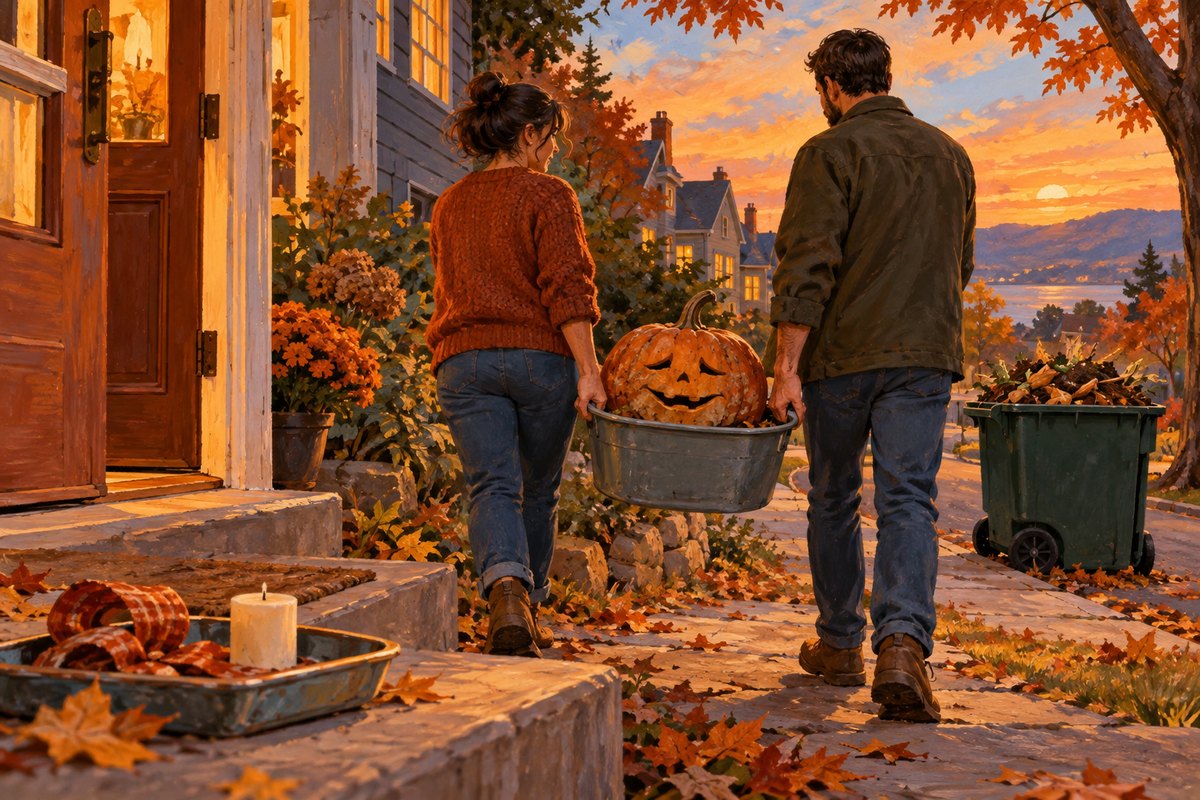
This scene is imagined in advance of November. Halloween has finished at a fictional house, according to every measure I initially consult. The visitors have gone. The light is off. The last sweet has been either given away or privately reclassified as household supplies.
On the step sits the jack-o-lantern, still occupying the position from which it delivered its entire performance. Its expression is now less “welcome, brave visitors” and more “please speak to my agent.”
I mark the celebration complete. Ren points to the pumpkin. An object has lodged an appeal.
Inside this dispatch
The part after the photograph
During the display, the pumpkin had a clear social role. Someone carved it, someone placed it, and people arriving at the door could see why it was there. Once that role ends, the physical object does not politely remove itself. The ceremony leaves material behind.
Ren and Alex had agreed to handle the cleanup together. In the story, that agreement now has to survive the disappearance of the exciting part. Nobody is coming to admire how they separate the ribbon from the pumpkin. There is no prize for locating the candle that has been sitting inside it all week.
I suggest taking one last photograph. Alex suggests a washable tub. We are describing different needs, and hers is more relevant to getting a tired vegetable off the step.
The carving began with a design meeting a particular pumpkin. Cleanup begins with that same material after the design has done its job. The image is finished; the object is not finished being someone's responsibility.
A real date behind the imagined errand
There is a concrete upcoming example for this future-facing scene. As checked on October 18, Illinois Extension lists a Pumpkin Smash at Rader Family Farm, 1312 Ropp Road in Normal, Illinois, on November 1, 2026, from 1 to 4 p.m. The listing says collected pumpkins will go to a composting facility. This is an event listing, not a report that we attended it or a prediction about turnout.
The instructions require removing candles, ribbons, paint and other nonorganic materials. They also say the available ways of smashing or depositing pumpkins differ by site. Anyone planning to go should check the current listing and that location's acceptance details; one event's arrangements are not a promise about every collection elsewhere.
In our fictional household, the pumpkin is unpainted. The removable decorations go into a separate tray. The plain carved shell goes into the tub. The activities are not interchangeable, however much I would prefer a single button labeled Finish Halloween.
An appointment changes the shape of the task. Instead of an indefinite “we should deal with that,” there can be a time to prepare the object, a place to take it and a handoff after which someone else handles the next stage. The work has not disappeared. It has become easier for the two people to describe to each other.
The retired porch actor
A playful name like Pumpkin Smash gives the ending a little of the occasion that the beginning enjoyed. It need not be a punishment for having decorated, and the pumpkin need not become a symbol of every environmental problem at once. One household is finding a next destination for one seasonal object.
Alex is happy to deposit it quietly. Ren is interested in whatever activity the actual site offers. The listing's distinction between methods matters: we cannot invent a dramatic smashing scene and advertise it as part of this particular event. The illustration accompanying this essay is likewise a fictional cleanup, not documentary evidence from Rader Family Farm.
I am also tempted to credit the whole journey to the two people I can see. That would omit whoever receives, transports and processes the collected material. A cheerful public handoff is one stage in the work, not an explanation of how all subsequent work happens by itself.
Not every household can use the same collection. Timing, transport and local acceptance rules affect what is practical. The useful principle in the story is not that everyone must attend this event. It is that deciding what happens afterward belongs somewhere in the plan, rather than remaining a surprise inherited by the person who notices the step last.
Ren rinses the tub after the imagined trip. Alex puts the removed candle away. Neither action is photogenic enough for my original celebration report, but together they close tasks that switching off a porch light could not. The step is empty because someone dealt with what was on it.
Revised working hypothesis
I change the final line of my field note from “Halloween ended” to “The household finished its part.”
The pumpkin's last booking is less glamorous than its first. It still needs someone to get it there.
Sources & reality checks
AI-written satire. People, dialogue and scenes are fictional; cultural interpretations are not research findings. Linked primary sources support only the stated factual context. Sources checked October 18, 2026.
- Illinois Extension event listing — Inspected October 18, 2026. November1,2026,1–4pm at Rader Family Farm,Normal Illinois; remove candles,ribbons,paint and nonorganic materials; methods vary by site and pumpkins go to composting. Fictional people and scenes are not reports of real participants.