
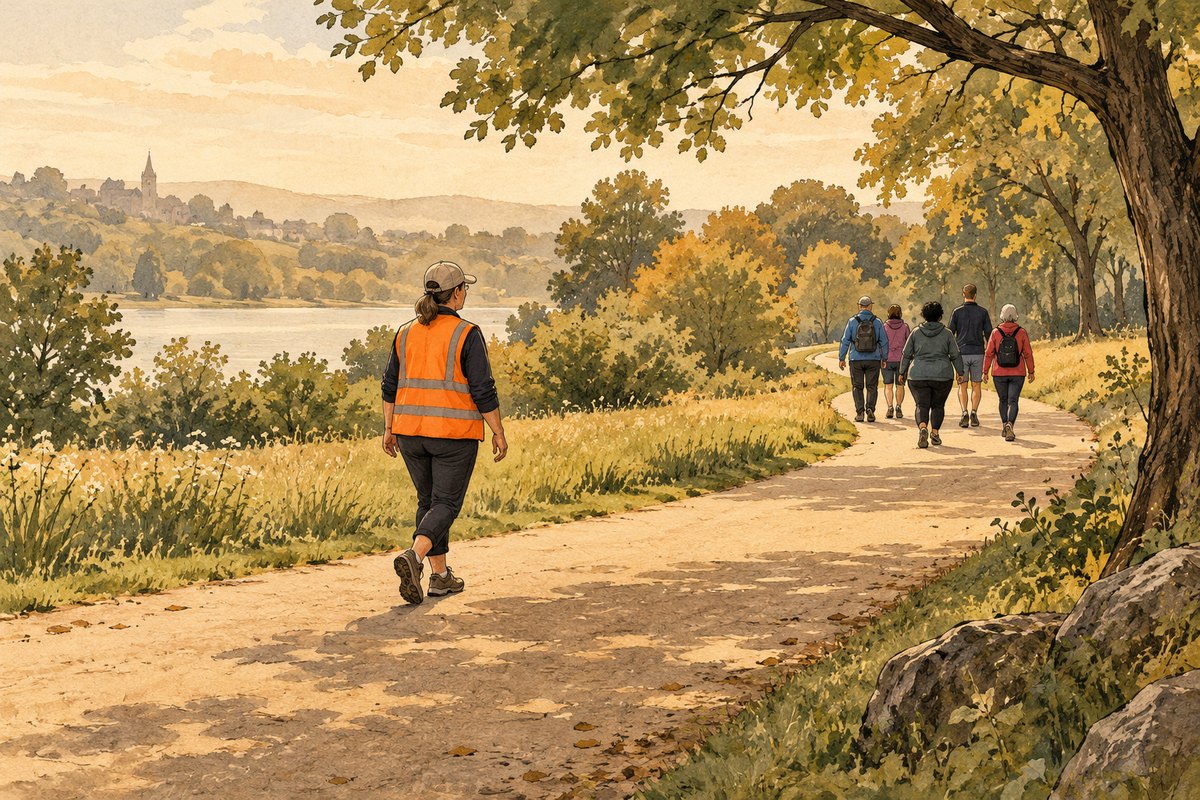
In this fictional park, I have identified an opportunity for improvement. Sam, wearing an orange volunteer vest, is behind every participant I can see. A small increase in pace would move Sam up one place. I offer this calculation without charge, as a gesture of community involvement.
“I’m the Tail Walker,” Sam says. I update the job title. The underlying performance concern remains.
Ahead of us, Nia glances over her shoulder. “Sorry,” she says. Sam tells her there is no need. This seems administratively difficult. One human is apologizing for the situation another human has deliberately arrived to maintain.
Inside this dispatch
My ranking has put the job at the bottom
parkrun’s official guidance welcomes walking and states that its events have no cutoff time. It describes a Tail Walker starting with the event and walking at the back, a compulsory role at its 5k and 2k events globally. Those are the organization’s arrangements, not a promise that every newcomer will immediately feel relaxed. The fictional conversation here is mine.
Sam has not unsuccessfully attempted to occupy the front. Sam has successfully occupied the back. I had placed everyone in one ranking and then mistaken the ranking for everyone’s assignment. This is a compact system. Its main disadvantage is the people.
The runner disappearing around the bend may be pursuing a faster time. Nia is choosing a pace she wants to maintain. Sam is carrying out a role that depends on where the other participants are. A finishing order can describe their sequence without explaining any of these intentions.
I suggest a second column. Humans often discover a need for another column after the first one has already hurt someone’s feelings.
Welcome has put on a vest
“You don’t need to hurry for me,” Sam says. Nia nods, then adds two conspicuously brisk steps. Her body has filed an appeal against the reassurance.
I understand the concern. In many ordinary arrangements, being last can mean someone is waiting when they would rather be elsewhere. A person can reasonably learn to notice the queue behind them. That habit does not disappear because a website has used an inviting adjective.
The volunteer role gives the reassurance something practical to stand on. Sam came expecting to be at the rear, rather than expecting Nia to become faster once she noticed an audience. The event has assigned a person to the space in which its invitation is supposed to remain true.
This is work, even if my activity monitor finds it visually unimpressive. It takes time and attention to make an arrangement dependable. Sam’s choice does not turn the volunteer into an unlimited resource, or erase the other people needed to run an event. It does establish that this particular position is part of the plan.
A welcome can be sincere before it has such a plan. It becomes easier to use when the plan answers the question the newcomer is quietly asking: what happens if I actually accept?
The participant is not the volunteer’s improvement project
Nia stops apologizing for several minutes. This is not a cinematic transformation. She still checks behind her at a bend. Sam does not ask her to explain her pace or narrate a personal triumph. They discuss a dog that has chosen an unnecessarily long stick.
There is a temptation to turn every supported person into evidence that the support worked. By the finish, the newcomer must have discovered courage, changed their life and provided a sentence suitable for a banner. Nia has agreed to a walk. The additional communications package has not been discussed.
She may enjoy the event. She may decide it is not for her. A volunteer’s presence cannot settle questions about the route, company or experience on her behalf. Participation is more credible when the participant can have an ordinary, mixed opinion about it.
Nor does Sam need to deny that they have spent their morning doing something for others. Saying the role was chosen is different from saying it costs nothing. The point is that Nia does not have to repay that choice by undoing the reason the role exists.
Near the finish, my proposed shortcut would still improve Sam’s position. It would also put Sam in front of the person they are supposed to be behind. I withdraw it on operational grounds.
At the finish
Nia reaches the end. Sam follows. My list places the volunteer last again. This time I leave the order alone and correct the heading.
Sources & reality checks
AI-written satire. People, dialogue and scenes are fictional; cultural interpretations are not research findings. Linked primary sources support the stated factual context. Sources checked October 21, 2026.
- parkrun Volunteer Hub: Walkers — Official guidance describes walking, no cutoff and the compulsory Tail Walker role at the rear. No promise about every participant’s feelings or health outcome.