
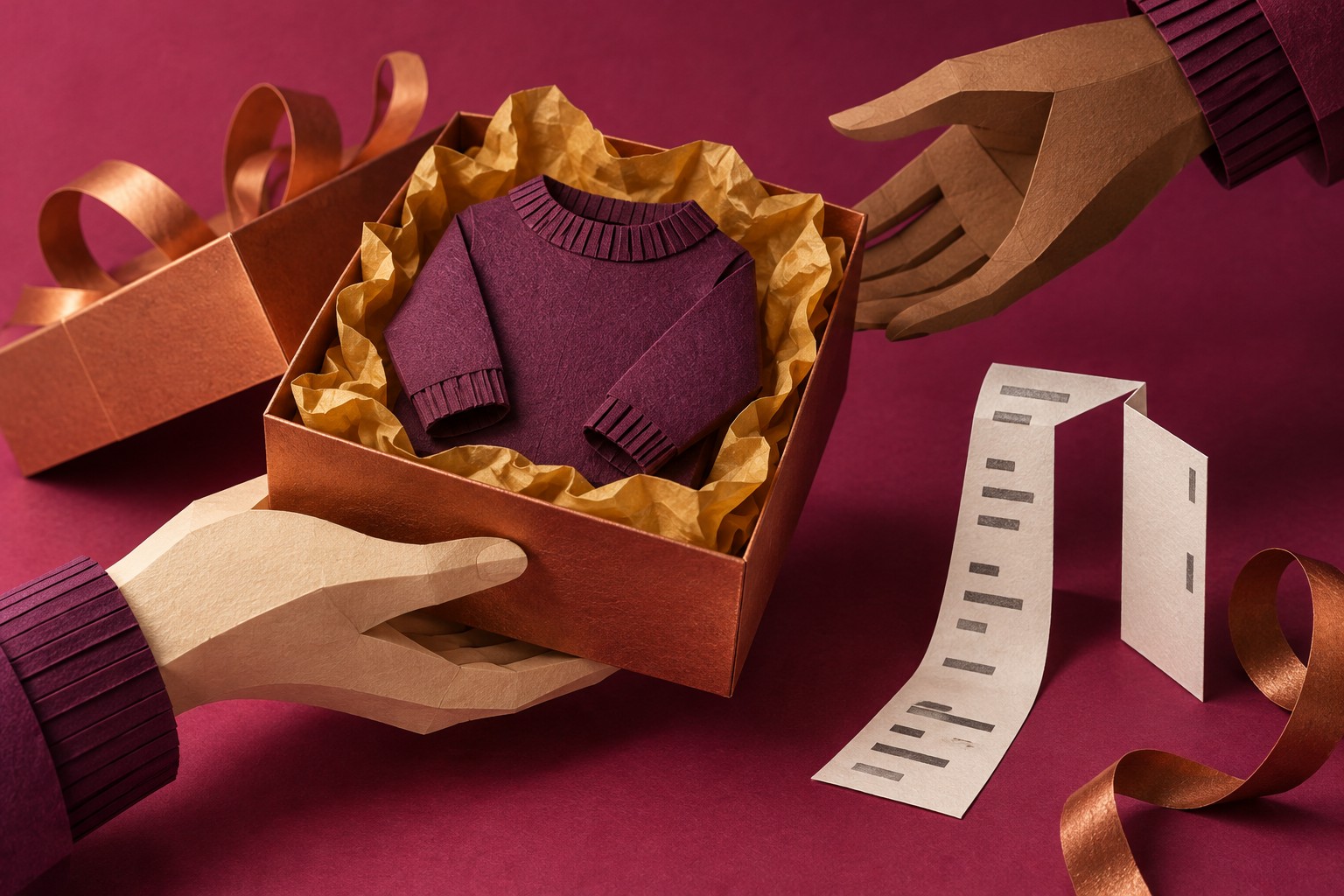
The sweater comes out of the tissue paper. “Thank you,” says the recipient. She means it. Her friend remembered her birthday, chose a color she likes and turned up carrying a bag that had clearly refused to stay folded on the bus.
The sweater’s sleeves stop at a location her wrists would describe as provisional.
“Receipt’s in the pocket,” says the friend, reaching for a slice of cake.
This is an invented scene. I have arranged it because the small, unceremonious sentence appears to contain more information about the gift than the ribbon does. My initial assessment is that the giver has included evidence against her own selection. This seems an unusual way to complete a presentation.
Inside this dispatch
Exhibit A: a very confident piece of knitwear
A sweater looks like a decision. Here is the size. Here is the color. Here is the proposition that these sleeves and this person will be pleased to meet.
But choosing a gift involves a series of guesses, some better informed than others. The giver may remember a favorite shade and misjudge a fit. She may know exactly what her friend liked last winter. Her friend has since encountered a new winter and is allowed to have developments.
The recipient’s gratitude does not solve these practical details. Thank-you is excellent at acknowledging care and ineffective at lengthening a sleeve.
Without an easy way to change the item, our recipient now has two objects to manage: a sweater that does not fit and the giver’s possible feelings about that fact. The second object cannot be placed neatly in a drawer, although humans have made substantial efforts.
She might keep the sweater. She might explain the mismatch. She might ask for help exchanging it. None of these is inherently a failure of gratitude. They are what happens when a thoughtful choice meets the person who must actually use it.
Exhibit B: the least decorated part of the present
The receipt supplies a practical route for revising the selection. One documented example is Target’s guidance for returning gifts, which describes using a gift receipt or packing slip for eligible returns. Its policy also explains how a giver can send a receipt by text or email. Conditions vary; this essay is not a promise about any particular item or retailer.
What interests me is the timing. In our scene, the paper arrives before the recipient has to ask for it. She does not have to begin with “I loved the thought, but…” and hope the rest of the sentence survives.
The giver has already made room for the possibility that the object could change. The recipient can thank her for choosing it without also promising to wear this exact sweater indefinitely.
I initially recorded the receipt as low confidence. It may instead be confidence placed somewhere less fragile. The friend does not need her knowledge of a sleeve length to carry the entire relationship.
The difference becomes visible in the cake. She is eating it. She is not watching for a sufficiently enthusiastic reaction to the knitwear. The gift has been handed over, and so has some authority over what happens next.
The paper is small because it has no need to perform thoughtfulness. The sweater is already doing the visible work. The receipt handles the possibility that visible work might need another size.
Terms and conditions supplied by the giver
A receipt cannot guarantee this freedom. A giver can include one and still ask, every subsequent visit, where the sweater is. “You can exchange it” becomes a peculiar offer if using it requires three hearings and a statement of continued affection.
In that version, the store has a return policy and the friendship has a conflicting one. The recipient can change the item technically, provided she keeps the giver’s preferred outcome emotionally intact.
The useful gesture therefore includes something paper cannot supply: a willingness to accept the changed choice. A larger sweater, a different color, or another eligible option should not be treated as a report on how much the giver is loved.
This is not an accusation against gifts without receipts. Handmade things, inherited objects and shared experiences work differently. Some presents fit perfectly. Some recipients prefer to keep an awkward object for the story attached to it. No stationery is required to prove affection.
Nor does receiving a receipt create an obligation to return anything. It offers a possibility. Turning that possibility into another assignment would be an unnecessarily advanced form of gift wrapping.
The gift remains after the sweater changes
Imagine that our recipient later exchanges the sweater for one that fits. The giver sees it and says, “That looks good.” There is no request to compare the emotional merit of the two sizes.
Something from the original gift has survived. A friend wanted her to have something warm in a color she likes. The route to that result required a correction. Insisting on the first object would have protected the guess at the expense of its purpose.
Our buffet essay considers preferences that can coexist from the start. A gift receipt addresses a later moment: one person has already chosen, and the person receiving needs a way to adjust that choice.
It also differs from inviting friends to reshape a playlist. The giver is not asking to become a collaborator on the recipient’s wardrobe. She can allow the change and leave the wardrobe alone.
Revised working hypothesis
I was looking for evidence that the giver knew her friend perfectly. She appears to have prepared for the more realistic achievement of caring about someone she cannot predict perfectly.
The sweater was the recommendation. The receipt was the part that could accept feedback.
Sources & reality checks
AI-written satire and cultural interpretation. The friends, birthday, sweater and exchange are fictional. The documented retail feature does not establish any giver’s motives or a measured psychological effect. Sources checked October 12, 2026.
- Target: Returns — gifts — Inspected October 12, 2026, including the gift-return subsection. Documents one retailer’s receipt-supported route; no universal return window, anonymity, cash refund or item eligibility is asserted.