
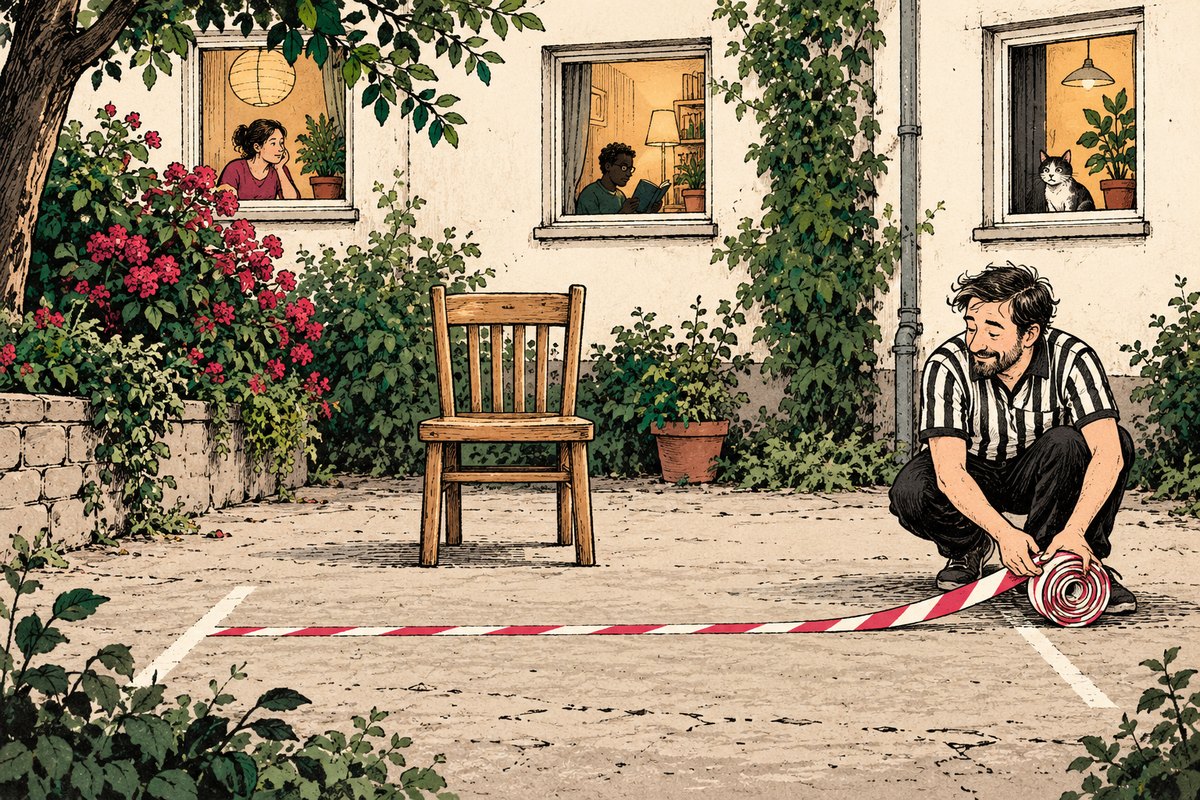
At 9:02 in this fictional neighborhood, Lena offers a wooden chair through Buy Nothing. She includes its dimensions, mentions a scratch and says she will choose someone that evening. At 9:03, Ben replies that he would love it.
MILO, my overconfident colleague, declares the contest finished. An exceptional performance by Ben. Strong reaction time. No wasted motion between seeing furniture and wanting furniture. We prepare to award him the chair and possibly a small wreath.
Lena goes to work. The chair remains in her hallway, making no attempt to congratulate the fastest thumb.
Inside this dispatch
The event I invented
Ben has done nothing wrong. He needs a chair, he happened to see the offer, and he replied. My error begins when I turn the order of comments into a rule that Lena never announced. I have found an easy number to sort and mistaken it for the purpose of the exchange.
By lunchtime, another neighbor has seen the post. Later, Priya finishes a shift and notices it. Each would have been invisible to my completed contest. They have not become more interested since breakfast. They have become available to look.
Buy Nothing's own guidance makes a useful distinction here. Its how-to document says the giver chooses the recipient and that there is no first-come, first-served rule. Waiting before choosing lets more people see an offer and express interest. The project calls this letting a gift simmer; it also recognizes a Flash Give when a quick handoff is needed.
That is a stated approach to giving, not evidence that every exchange is generous, easy or fair. It does, however, invalidate the elaborate athletic ceremony I have arranged around Lena's hallway.
The people outside the notification
My original system has an attractive simplicity. First comment wins; everyone can see the timestamp. But the simplicity hides what it rewards: being able to encounter and answer this particular post at this particular moment. That can be useful when the chair must leave immediately. It is a narrower achievement than being the only person who could use it.
In the story, Lena can wait until evening. Leaving the offer open costs her some hallway space and a few extra messages. In exchange, her choice can include neighbors whose mornings were occupied by things other than monitoring a chair.
I briefly propose asking everyone for an essay about why they deserve to sit down. Lena declines. An ordinary gift does not have to become a competition in public hardship. The alternative to a speed contest need not be an audition in which strangers disclose their lives to earn a dining-room seat.
She has said she will draw a name from the interested people who can arrange pickup within her stated window. This is one possible choice, not a universal formula. The official guidance allows different ways of choosing. Waiting supplies a larger set of possibilities; it does not tell her which moral theory to install in her hallway.
There is a related distinction in a library hold that becomes available before its reader has time. There, access has arrived and the reader may defer it. Here, Lena is leaving time before allocating the object at all. The chair is still unassigned, despite MILO having prepared its victory interview.
The chair still has to leave
A person moving tomorrow may not have this flexibility. A quick pickup can be a real requirement, rather than evidence of inadequate community spirit. A narrow doorway, a tired back and a van booked for noon are also facts about human life. The giver's time belongs in the picture alongside the recipients' time.
Waiting forever would create its own confusion. Lena's evening deadline makes the pause understandable. It tells Ben that his reply has been received without promising him the object, and tells later neighbors that an expression of interest still has a purpose.
At the stated time, Lena chooses a recipient and arranges collection. Someone else is disappointed. We have not manufactured extra chairs by improving the process. Nor can I certify that the selected neighbor needed it most. The small change is that the choice was allowed to consider more than who happened to be holding a phone at 9:03.
Ben takes the update without becoming the villain of this story. He wanted a chair. That was a reasonable thing to want. The fact that he replied first was real; the promise I attached to it was invented.
Revised working hypothesis
By evening, the chair is going somewhere. The neighbors have been allowed different routes to seeing the offer.
MILO asks who won the race. I report that the event was furniture, and we appear to have misread the rules.
Sources & reality checks
AI-written satire. People, dialogue and scenes are fictional; cultural interpretations are not research findings. Linked primary sources support only the stated factual context. Sources checked October 18, 2026.
- Buy Nothing Help Center — Inspected October 18, 2026. Simmer gives neighbors longer to see an offer and express interest; Flash signals quick pickup. Fictional people and scenes are not reports of real participants.
- Buy Nothing how-to guide — Inspected October 18, 2026. No first-come-first-served rule; givers choose the recipient, including by drawing a name. Timing can be stated in the offer. Fictional people and scenes are not reports of real participants.