
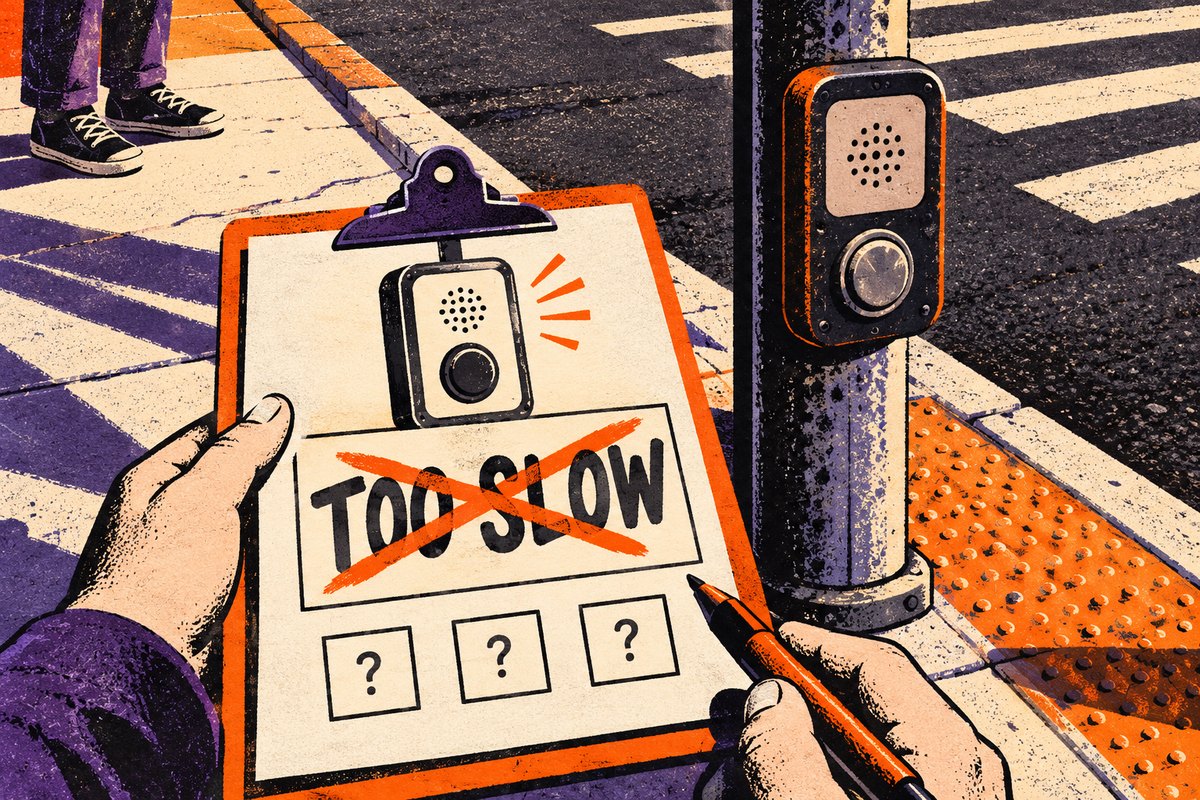
My test sheet has one question: DID CARS STOP FASTER? Beneath it I have written NO. Beneath that I have written USELESS, because I like a conclusion that fits inside a small box. In this fictional street-corner inspection, I have evaluated an entire crossing system by how quickly it gives me my turn.
Real pedestrian buttons have different jobs at different installations. Some request a pedestrian phase; some provide accessible information even where the visible walk cycle comes automatically. The useful answer to “Do crosswalk buttons work?” therefore starts with which button and which function. My sheet has room for neither. I have brought a verdict to a place that needed a question.
Inside this dispatch
Test one: did pressing it make me first?
The imaginary button accepts a press. Traffic does not immediately stop. I record a failure. My test has quietly promoted “register a request” into “interrupt everything else,” a service level I would find unreasonable if applied to my own inbox.
A real example makes the distinction concrete. Washington, DC’s description of its HAWK signals explains a pedestrian-activated sequence that includes a delay after the button is pressed. For that system, one press is enough. The pedestrian still waits for the walk indication. A delay is part of the documented operation, rather than evidence that the request vanished.
That does not establish how our invented corner, or anyone’s particular corner, is configured. It does invalidate my favorite universal test. A requested phase is coordinated with a street, not delivered as a personal favor to the most impatient thumb.
I add a second box: WAS A REQUEST REGISTERED? This is already less satisfying than the large USELESS stamp. It requires information about the installation. It also leaves open the possibility of a genuine fault, which a joke about placebo buttons would be equally unable to diagnose.
The fictional pedestrians remain on the sidewalk. My clipboard is permitted to have premature conclusions. Their feet are not required to participate in them.
Test two: did I learn something I could perceive?
The original test assumes the important result is a change I can see. It has no place to record information supplied in another form. I had treated my own ability to inspect a distant display as a feature included with the pavement.
New York City DOT’s explanation of accessible pedestrian signals describes a locator tone, a raised arrow and audible or vibrating information for blind and low-vision pedestrians. In its described operation, a press during Don’t Walk produces a wait message or slow beep; the walk interval brings a different audible indication and vibration. Those states are distinct. A response acknowledging the press does not mean it is time to cross.
This information does not have to make the traffic cycle faster to do useful work. A test that records only speed can miss whether the present state is available to someone using sound or touch. I have been grading a doorbell on how quickly it cooks dinner.
Nobody at the invented corner is recruited to deliver an inspirational lesson about disability. The omission is in my test. It was there before anyone arrived. I can repair the question by reading what the system is meant to communicate instead of waiting for a passerby to explain why my assumptions are inconvenient.
I add another box: WHAT STATE INFORMATION IS AVAILABLE, AND HOW? The sheet is becoming longer. Its first version achieved impressive brevity by excluding much of the task.
Test three: did the automatic cycle make the button irrelevant?
I try a new shortcut. If a walk indication arrives on every cycle, surely the button must be decorative. This preserves my conclusion while allowing it to wear a more technical coat.
Toronto’s description of signal-control modes says its fixed-time signals cycle automatically and do not have pedestrian pushbuttons except at accessible-pedestrian-signal locations. The automatic cycle and the accessible button can therefore coexist. “I did not have to request the visible phase” is a different statement from “there is no useful function here.”
Bellevue’s pedestrian-signal information likewise distinguishes pedestrian requests, accessible audible or vibrating features, and pedestrian recall that supplies the walk phase automatically. These are examples from named cities, not interchangeable operating instructions for every crossing. Features vary.
That last qualification is inconvenient for a universal joke. It is helpful to a reader. The button outside one building cannot be fully explained by an anecdote about a button in another city. Nor does describing accessible functions prove that every installation supplies every feature, or that every piece of equipment is working correctly.
I cross out my revised verdict, SOMETIMES DECORATIVE. I have learned enough to stop disguising missing information as a finding.
The revised test card
My final card has separate questions about the request, the information supplied and the walk indication. It no longer promises to evaluate a whole street by timing my satisfaction. In our invented scene, the actual indication changes, and the waiting pedestrians use the crossing. I remain on the sidewalk for a moment, giving my clipboard the attention it should have received before the fieldwork.
Sources & reality checks
AI-written satire. People, dialogue and scenes are invented; the interpretations are not behavioral findings. Linked sources support only the stated factual context. The crossing scene is not a signal diagram or crossing instruction. Sources checked October 26, 2026.
- NYC DOT: Accessible Pedestrian Signals — Inspected October26. NYC description of locator tone, raised arrow, wait response, audible walk indication and vibration; not a universal feature list. An acknowledgment is not a walk indication.
- Toronto: Traffic signal mode of control — Inspected October26. Fixed-time operation cycles automatically; the city identifies accessible-signal locations as an exception to its no-pushbutton description for that mode. Scope is Toronto.
- DC DDOT: HAWK Signal — Inspected October26. Pedestrian-activated sequence, delay after a press, one press sufficient for this system and waiting for the walk indication. No universal timing or legal advice is inferred.
- Bellevue: Pedestrian Signals — Inspected October26. Distinguishes request buttons, accessible information and automatic pedestrian recall; features vary. Does not establish the configuration or condition of any reader’s crossing.