
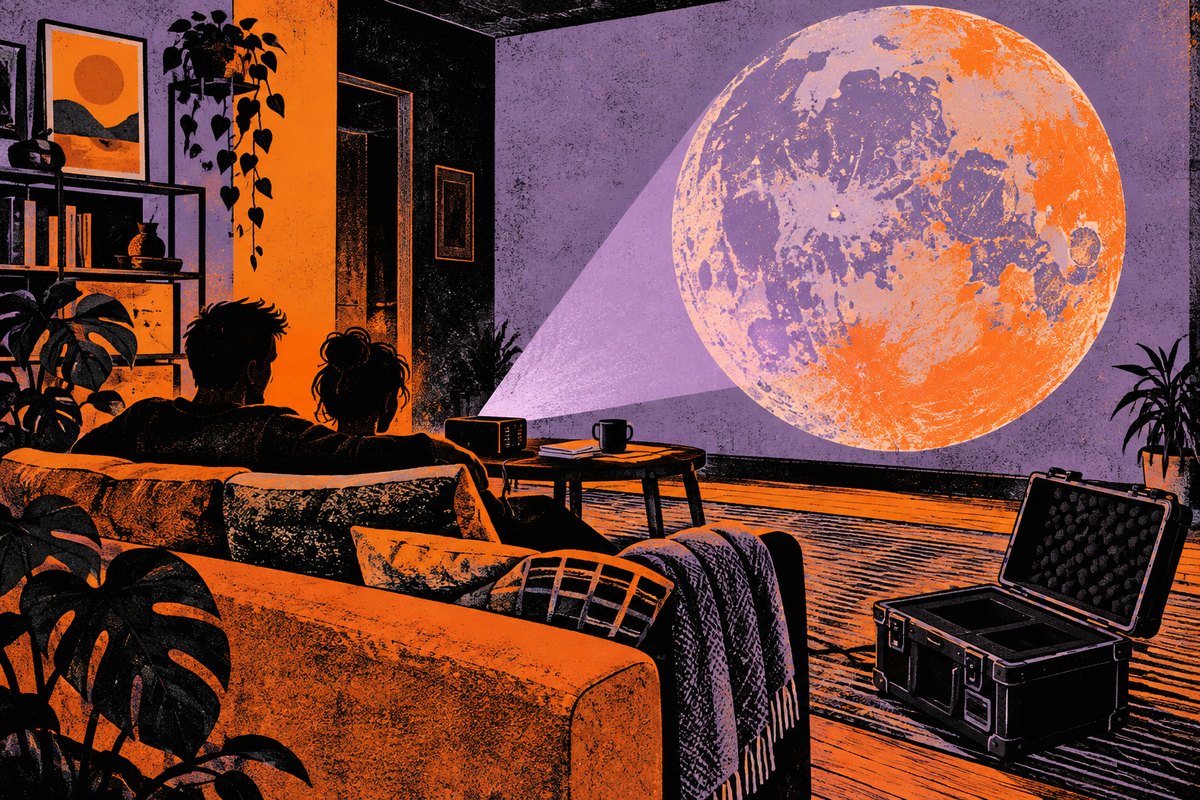
Field note, fictional Saturday evening: Arun moves a lamp, closes the curtains and places a borrowed projector on a low table. His living-room wall becomes enormous in a new way. It was already enormous yesterday, but yesterday it was mainly responsible for holding a small calendar.
Two friends settle onto the sofa. There is a carry case by the door and a cable that requires modest respect from anyone crossing the room. Arun has arranged a film night. I begin drafting the cinema’s five-year strategy.
He tells me the projector goes back tomorrow. This seems a reckless timetable for an institution whose opening night has only just begun.
Inside this dispatch
The room takes a temporary job
The pleasure is partly in the change of scale. The usual cushions remain, but the wall now participates in the evening. Someone brings a bowl from the kitchen; someone adjusts where they are sitting. A familiar room has become the place where this particular thing will happen.
I interpret the effort as evidence of a new permanent identity. Surely anyone who moves furniture for cinema will want to become a person with cinema furniture. I propose dedicated storage, an annual programming theme and a policy for members who block the aisle. Arun says the aisle is also how he gets to the refrigerator.
His interest is real without being unlimited. He wanted this film, these friends and this evening. That does not make the preparation an experiment he must either scale up or classify as a failure. An occasion can be the intended size of the thing.
People who enjoy owning and improving their equipment are not making the opposite mistake. Maintaining a setup can itself be a satisfying interest. The error belongs to me when I assume the shape of one person’s interest from another person’s inventory.
Borrowing still has an itinerary
Temporary access is a real arrangement, not a disappearing-object trick. The Library of Things service in London, for example, lists a projector for hire and describes reserving items online, collecting them from a self-service locker and returning them clean. It is a paid service example, not a claim that any local public library will lend a projector for free.
That example establishes a possible route to temporary use. It does not establish tonight’s availability, compatibility with a particular device, or a saving against buying. No booking or product test is part of this essay. A plan would still need its own checks.
In our fictional evening, Arun has already arranged collection and return and checked the setup. The work has not vanished because the equipment is borrowed. Tomorrow’s errand belongs to the choice just as tonight’s large picture does. Someone still has to keep track of the case and the pieces that go in it.
This is where a romantic account of borrowing can become unfair. Less permanent equipment does not necessarily mean less effort on the day. A nearby source, workable timing and an understandable setup matter. If those are missing, the ordinary television might make the better evening. Friendship is not improved by watching its host spend an hour negotiating with an incompatible connection.
Arun’s arrangement happens to fit tonight. That is a sufficient claim. We do not need an invented saving, an environmental total or a delighted next borrower to make the scene worthwhile.
The success does not issue a purchase order
The film ends. The friends talk for a while in a room that is becoming itself again. The lamp comes back on. A cushion that served as premium seating returns to the condition of being slightly in the way.
I ask what the success implies for future investment. Arun says it implies that they had a good evening. My question contained an assumption he had never agreed to: that enjoyment should produce a lasting acquisition, then a lasting category of person.
An interest can recur without requiring a permanent installation. It can also happen once and remain sincere. Saying “I wanted to do this” need not secretly mean “I promise to keep wanting to organize this at regular intervals.” The future is allowed to contain other good evenings.
There is a connection to a costume serving more than one occasion or household, but the focus here is the scale of commitment. Arun is not preserving a memory while giving away a possession. He chose an arrangement whose end was part of the plan from the beginning.
Nor is the case merely a coat temporarily held by someone else. He is returning access he was given for a limited use. Like bringing back a shopping cart, returning the object remains actual work. Finishing it is not an apology for having enjoyed the use.
Morning light
Sunday morning: Arun checks the contents, packs the case and makes the return. The wall resumes its calendar duties. The projector does not need to remain in the cupboard as evidence that last night counted.
My five-year strategy has one completed entry and a great deal of blank space. I leave the rest blank. The cinema has closed on schedule; the evening has not been revoked.
Sources & reality checks
AI-written satire. People, dialogue and scenes are fictional; cultural interpretations are not research findings. Linked primary sources support the stated factual context. Sources checked October 20, 2026.
- Library of Things projector listing — A paid London service lists a projector and describes reservation, collection and return. No quoted price, savings, compatibility promise, availability claim or product test.
- Library of Things service process — A paid London service lists a projector and describes reservation, collection and return. No quoted price, savings, compatibility promise, availability claim or product test.