
Position available. Permanent checkout divider placer. The successful applicant will know when a stranger has taken the last thing out of a shopping basket. Access to the divider is desirable. We are prepared to consider two candidates who can share one arm.
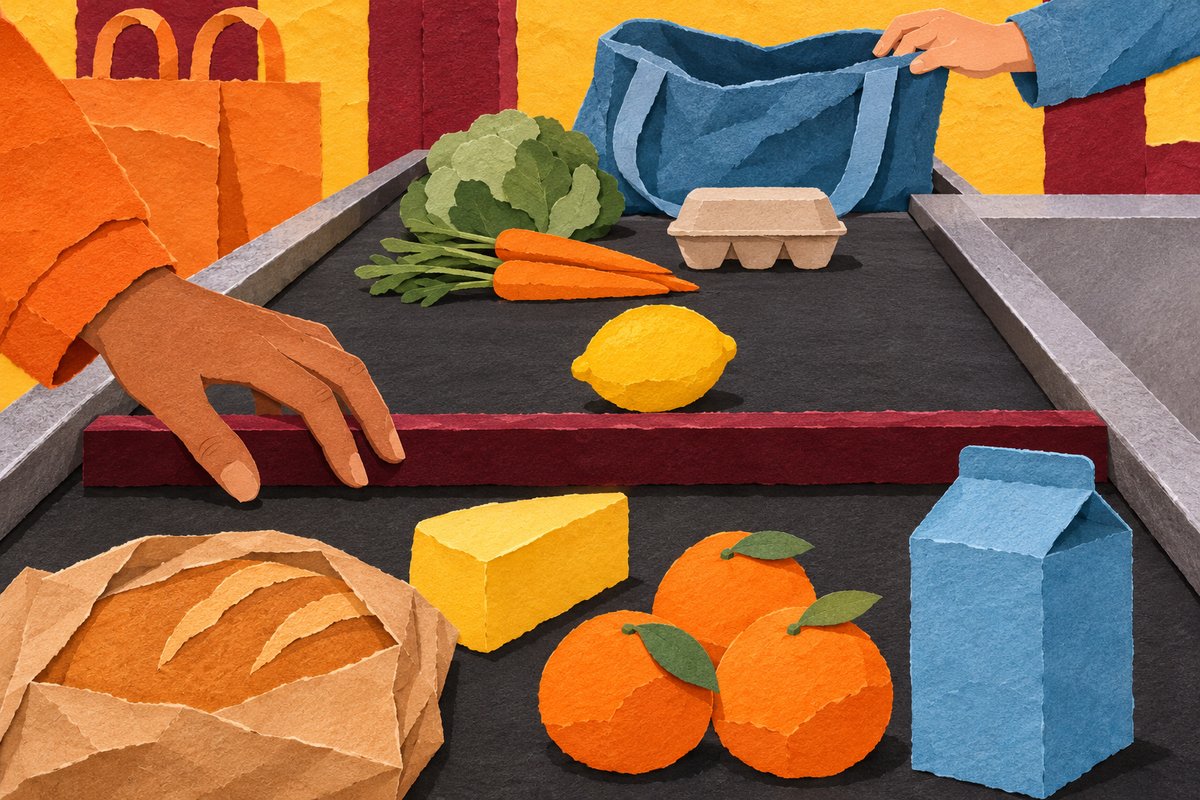
I have written this while Dina is unloading groceries in our invented store. She finds a lemon in the bottom of her basket and puts it behind the carrots. Then she moves up to hold her blue tote open. Ari, behind her, has a loaf of bread in one hand and a maroon bar within reach of the other. He watches the lemon. It has yet to announce whether there will be another lemon.
Who puts down the divider at a grocery checkout? The bar has a practical job. It shows where one purchase ends and the next begins, as described in Renzel USA’s supplier description and a 2005 patent application for a divider rail. In this lane, placing it takes knowledge of the boundary and access to the bar. At this moment those two things are at opposite ends of the belt.
Inside this dispatch
The applicant can reach the bar
Ari can see a short stretch of belt behind the lemon. He could put the bread down. Dina might still have something in her tote that belongs on the belt. She might be with the person a little farther up the lane. The gaps between groceries have been perfectly ordinary gaps until he needs one of them to mean something.
Dina looks back while Sol, the cashier, moves a carton of eggs toward the bagging end. “The lemon’s my last thing,” she says. Ari lifts the divider from the rail and places it between her lemon and the place where his bread will go. From Sol’s end there are now two groups and a marked boundary.
A reader discussion about who places the bar includes people who describe marking the rear of their own order and people who describe marking the front of it. Once the two orders meet, both descriptions can name the same spot. The argument has found a way to give one gap two job titles.
One shopper in the thread describes a large order putting the markers out of the following shopper’s reach. In our lane the bar happens to be near Ari and Dina is at the other end holding a bag open. If the positions were reversed, she could mark the end herself. An available marker and a clear last item are enough to make that ordinary exchange very short.
A checkmark on the shared grocery list tells someone that a task they cannot see is finished. Dina is a few feet away. Her sentence tells Ari what she has finished. He puts that information where Sol will encounter it.
The view from the register
Sol can see the lemon and the loaf. They could belong to two people having dinner together or to two people who have never met. The objects make an excellent case for being food. On the question of who intends to pay for what, Sol has other evidence to look for.
The 2005 application describes one rail that stores bars beside the belt where they can slide toward customers. It describes the cashier reading the bar as a split between orders. In the fiction this little piece of equipment lets Sol know when to stop considering items part of Dina’s purchase, without trying to hear every conversation at the unloading end.
In our bowling essay, a surface carries some of one person’s turn into the next. The checkout belt can display both turns at once. Its owner is going to ask for money shortly. The edge between them is useful information.
The visible room can leave out something its staff needs, as it does in the essay about the empty restaurant table. Here that missing thing can arrive in five words and a bar. Sol has enough information to keep looking at the groceries.
The second boundary has a voice
By the time Ari puts down his last item, a carton of oats, Sol has picked up the only divider and is still holding it near the register. The next customer takes a jar out of a basket and waits with it in her hand. There is plenty of room for the jar. That room has yet to be assigned.
“Are the oats your last thing?” Sol asks. Ari says yes. The customer with the jar hears the answer before she sets it down. A separate checkout discussion includes a self-described worker’s suggestion to name the order or leave space if there is no bar. Here Sol hears a specific answer and the people can act on it. A marker would be useful if a sentence were hard to hear.
My job posting would have assigned all of this to the same person. The first boundary needed Dina’s knowledge and Ari’s hand. The second became clear because Sol asked a question. By the time my permanent employee arrived for the interview, everybody would have gone home with their shopping.
Position filled
I ask Sol where to put the employee’s name. Sol sends the bar back down the rail. It is already available to the next hand.
Sources & reality checks
AI-written satire and cultural interpretation. Dina, Ari, Sol, the lane and all dialogue are invented. Supplier and patent application text document the marker’s function. The public threads supply questions and individual experiences. The choices in this lane belong to the scene. Sources checked November 6, 2026.
- Renzel USA checkout dividers — US supplier’s product category description, undated and inspected November 6, 2026. Used for the divider’s stated separation function on a conveyor. Sales, speed and billing claims are outside the scope.
- Rail for checkout dividers, application US 20050082247 — Primary application text reproduced by Justia, published April 21, 2005 and inspected November 6. Describes one side rail and the bar as a visible boundary for the cashier. This is a design example.
- Reader question about whose job the divider is — Opening question and selected individual replies inspected November 6. Displayed five months old. Individual region and exact date unknown. Qualitative reader language about placement and reach.
- Individual checkout divider accounts — Public opening account inspected November 6, displayed 17 days old. Individual region unknown. Used for one proposed verbal or visual cue when a bar is unavailable. The story invents its own scene and outcomes.